For three years, the biggest complaint from serious plot buyers in the twin cities was not the sticker price — it was the wall of transfer taxes stacked on top of it. Finance Act 2024 had piled a fresh Federal Excise Duty (FED) of up to 7% onto property allotments and transfers, sitting on top of an already heavy 236K advance tax, stamp duty, registration and CVT. On paper, moving a plot into your own name could cost close to a tenth of its value before you even took possession.
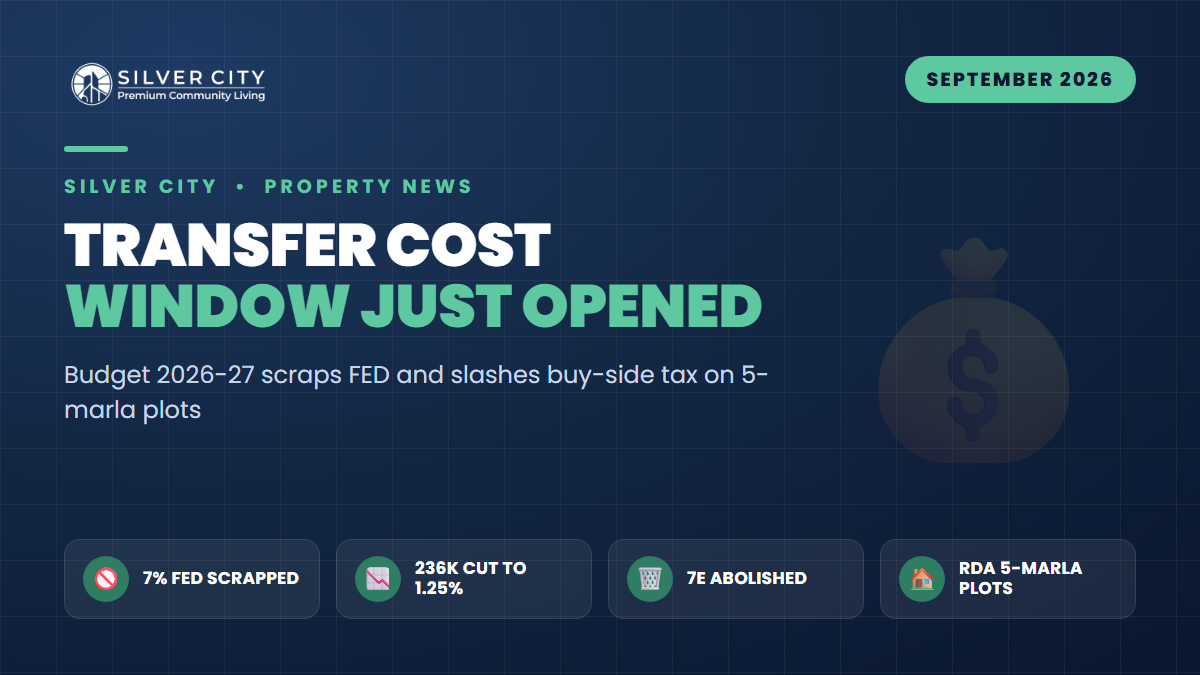
Budget 2026-27 quietly dismantled that stack. The 7% FED is gone, the 236K and 236C advance taxes have been cut and simplified, and Section 7E — the deemed-income tax that haunted every holding — has been abolished from 1 July 2026. For anyone eyeing an RDA-approved 5-marla plot, the buy-side maths has genuinely changed. Here is the recomputed cost, line by line.
What Budget 2026-27 Actually Changed
Four moves matter for a plot buyer in Rawalpindi:
- Federal Excise Duty (FED) abolished. The 3–7% FED on transfer of plots, commercial property and first allotments — introduced by Finance Act 2024 — has been repealed. Immovable property is a provincial subject, most land authorities never collected it cleanly, and it was challenged in court. It is now zero.
- Section 236K (buyer’s advance tax) slashed. The old three-tier filer slab (roughly 3% and up by value) is replaced by a single flat 1.25% for anyone on the Active Taxpayer List (ATL), regardless of property value. Non-filers still pay steeply — 10.5% up to Rs 50m, and more above.
- Section 236C (seller’s advance tax) reduced. Now a flat 2.75% for filers (11.5% for non-filers). This is a sell-side cost, but it directly shapes resale liquidity.
- Section 7E abolished. The 1% deemed-income tax on the notional “rent” of held property is deleted, removing a recurring drag and the 7E certificate hurdle at transfer time.
The Old Buy-Side Stack (With FED)
Take a Silver City 5-marla plot at an illustrative value of Rs 2,750,000. Taxes are calculated on the FBR-notified value or DC rate — whichever is higher — not always the price you negotiate, but this gives a clean like-for-like picture. Under the pre–Finance Act 2026 regime, a filer buyer faced roughly this:
| Buy-side charge (filer) | Rate | On Rs 2,750,000 |
|---|---|---|
| 236K advance tax (buyer) | ~3% | Rs 82,500 |
| Federal Excise Duty (FED) | 3% (filer); up to 7% non-ATL | Rs 82,500 |
| Stamp duty (Punjab) | 1% | Rs 27,500 |
| Registration fee | 1% | Rs 27,500 |
| Total buy-side | ~8% | Rs 220,000 |
That was the best case. A buyer not on the ATL was hit with 7% FED and a 236K rate several times higher, easily pushing the buy-side burden past 15% of value — often more than a full year of expected appreciation swallowed on day one.
The New Collapsed Stack
Now run the same Rs 2,750,000 plot through the Budget 2026-27 rules, as a filer:
| Buy-side charge (filer) | Rate | On Rs 2,750,000 |
|---|---|---|
| 236K advance tax (buyer) | 1.25% | Rs 34,375 |
| Federal Excise Duty (FED) | 0% (abolished) | Rs 0 |
| Stamp duty (Punjab) | 1% | Rs 27,500 |
| Registration fee | 1% | Rs 27,500 |
| Total buy-side | ~3.25% | Rs 89,375 |
The headline: a filer’s buy-side cost on this plot falls from roughly Rs 220,000 to about Rs 89,375 — a saving of around Rs 130,000, or from ~8% down to ~3.25% of value. Zeroing the FED alone strips out Rs 82,500; halving 236K removes another Rs 48,000-odd. Both were federal, both were the largest movable numbers in the stack, and both are now gone or gutted.
Why the Buy-Side Window Just Opened
Three things make this a genuine window rather than a footnote:
- The saving compounds with entry price. On an installment plot, transfer taxes hit at booking/transfer on notified value. Cutting that fixed friction by ~Rs 130,000 on a sub–Rs 3m plot is a meaningful chunk of a down payment — capital that stays in your pocket rather than the challan.
- Filer status is now the whole game. The gap between filer (3.25% buy-side) and non-filer (double digits) is now enormous. Getting onto the ATL before you transfer is the single highest-return hour of paperwork in the process.
- 7E removal clears resale friction. With Section 7E deleted, the deemed-income certificate that used to stall transfers is gone, and holding costs drop. Combined with a lower 236C for sellers, resale liquidity improves — which matters when you eventually exit.
Practical Notes Before You Transfer
- One-counter registry is live. Since 21 August 2026, Punjab’s integrated PLRA–FBR system auto-generates a single combined challan covering stamp duty, CVT and withholding tax — Rawalpindi included. One counter, one payment, fewer touchpoints.
- Taxes follow notified value. 236K, stamp duty and registration are computed on the FBR/DC value or consideration, whichever is higher — confirm the notified value for the sector before you budget.
- Female-name registry saves more. Registering in a female family member’s name can lower stamp duty further under Punjab concessions — worth checking against your plan.
- Verify ATL before transfer day. Your filer status is checked at the moment of the transaction. File your return and confirm you appear on the current ATL first.
Frequently Asked Questions
Has the 7% FED on property really been removed completely?
Yes. The Federal Excise Duty of 3–7% on transfers and first allotments of plots and commercial property, introduced by Finance Act 2024, has been abolished. It contributes zero to the buy-side stack now. This was reinforced by the fact that immovable property is constitutionally a provincial subject and the duty was widely challenged.
What is the 236K rate for a filer buying a 5-marla plot now?
A flat 1.25% for anyone on the Active Taxpayer List, regardless of the plot’s value. On a Rs 2,750,000 plot that is Rs 34,375. Non-filers pay far more — 10.5% and up — so being on the ATL before transfer is critical.
Does abolishing Section 7E benefit a buyer or only a seller?
Both. 7E was a deemed-income tax on held property and its certificate was a routine bottleneck at transfer. Removing it lowers ongoing holding cost for owners and clears a paperwork hurdle that slowed resales, improving liquidity for whoever buys and later sells.
Are these figures exact for my plot?
They are illustrative, based on a Rs 2,750,000 value and current filer rates. Your actual liability depends on the FBR-notified value for the specific sector, your ATL status on transfer day, and any female-name or category concessions. Always confirm the notified value and generate the combined PLRA–FBR challan before committing.
The Bottom Line
Budget 2026-27 didn’t tweak property costs — it collapsed the buy-side stack. For a filer, transfer friction on a sub–Rs 3m plot has dropped from roughly 8% to around 3.25%, freeing up in the region of Rs 130,000 that used to vanish into FED and inflated 236K. That’s exactly the moment disciplined investors like to enter. An RDA-approved, NOC-cleared scheme such as Silver City on Girja Road near the Thalian interchange — with 5-marla plots in the roughly Rs 2.55–2.75m band on four-year installment plans and Ring Road–adjacent positioning — is one worth shortlisting while the cost window is genuinely open. Do your own valuation and filer checks, but the arithmetic has clearly moved in the buyer’s favour.