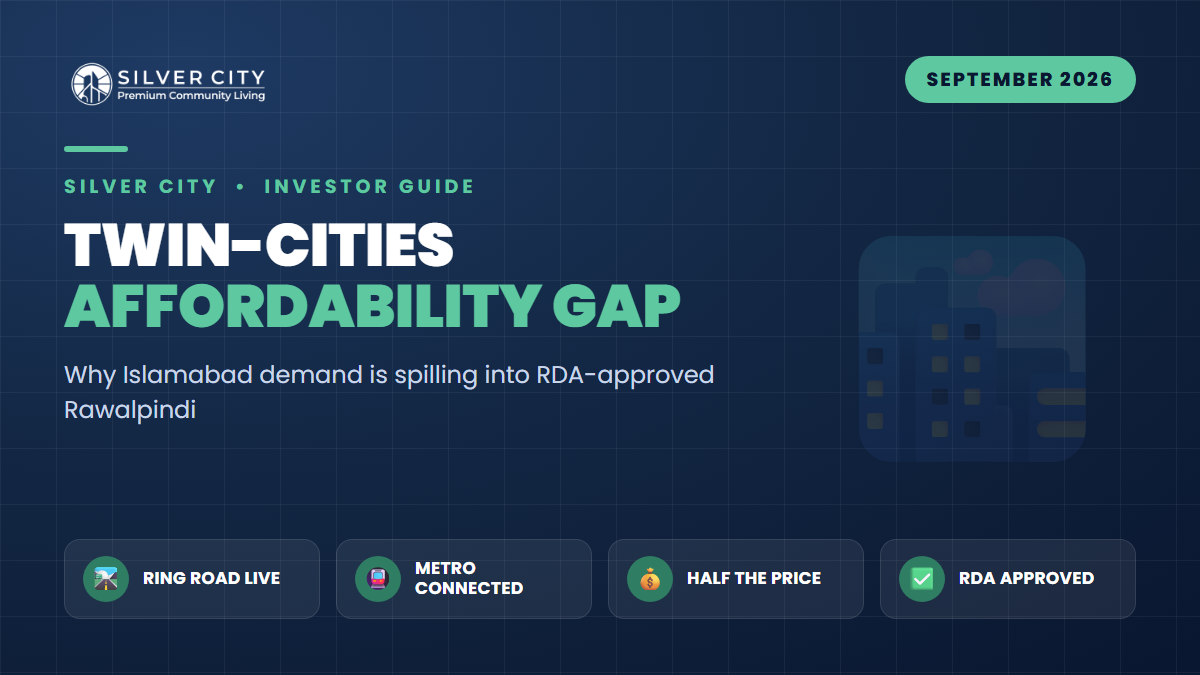
For two decades, an Islamabad address carried a premium that most salaried professionals simply accepted as the cost of living in the capital. In 2026, that logic is quietly breaking down. With the Rawalpindi Ring Road (RRR) carpeted end-to-end and open to traffic, and the Islamabad–Rawalpindi metro network now reaching the airport corridor, the practical distance between the two cities has collapsed. What remains is a price gap — and that gap is exactly the opportunity smart Pakistani investors are moving on today.
The Infrastructure That Changed the Math
The 38.6-kilometre Rawalpindi Ring Road is the single biggest catalyst. As of mid-2026, the main carriageway has been fully carpeted and opened to traffic, with the Baanth, Chak Beli Khan, Adiala and Chakri interchanges completed. The Thalian interchange — the connection point closest to the New Islamabad International Airport and the Girja Road corridor — is in final finishing stages after being pushed to a later phase. The RRR links the airport, the M-1/M-2 motorways and Grand Trunk Road, turning previously “far” pockets of Rawalpindi into 15–25 minute drives from employment hubs.
On the transit side, the Rawalpindi–Islamabad Metrobus (Red Line) already stitches Saddar to the Islamabad Secretariat, and the Orange Line now runs 25.6 km with 14 stations from Faiz Ahmed Faiz station directly to the New Islamabad International Airport at a flat Rs 100 fare. New Green Line electric feeder buses launched in 2026 to handle last-mile connectivity. For a professional commuting to Blue Area, G-sectors or the airport, living in an approved Rawalpindi society is no longer a compromise — it is a rational trade.
The Affordability-Gap Thesis, in Plain Numbers
The thesis is straightforward: when two locations offer comparable commute times and comparable lifestyle access, but one costs half as much per marla, capital flows toward the cheaper one until the gap narrows. Islamabad’s CDA sectors command a legal-security and prestige premium; Rawalpindi’s RDA-approved societies offer far lower entry points with longer, easier instalment plans. The table below shows why the spillover is happening.
| Location / Authority | Typical 5 Marla (approx.) | Notable feature |
|---|---|---|
| CDA I-16, Islamabad (cheapest sector) | Rs 5.8 million | Federal jurisdiction, developed |
| CDA I-15, Islamabad | Rs 7.3–7.7 million | Established, higher security premium |
| Premium CDA sectors (D/E-series) | Rs 1.5 crore+ | Prestige, central location |
| RDA-approved Rawalpindi (Girja Road corridor) | From ~Rs 2.75 million | 4-year instalments, RRR-adjacent |
An approved Rawalpindi plot on the Girja Road / Thalian corridor can start near Rs 2.75 million for 5 Marla, with 1 Kanal around Rs 10.35 million — often on 48-month payment plans. Against a CDA 5 Marla that rarely dips below Rs 5.8 million (and usually far higher), the entry cost is roughly halved for a location that the Ring Road has placed minutes from the airport and motorway network.
Why “RDA-Approved” Is the Non-Negotiable Filter
Rawalpindi’s periphery is dotted with schemes at every stage of legality. The spillover thesis only works if you buy inside an RDA-approved (NOC-cleared) society. Approval means the layout, land use and development plan have been sanctioned by the Rawalpindi Development Authority — the difference between a title you can transfer, mortgage and build on, and a file that a bulldozer can invalidate. Unapproved plots look cheaper on paper precisely because they carry demolition and non-transfer risk. In a spillover market, approved inventory is what institutional and end-user demand actually chases.
What to verify before you sign
- RDA NOC status — confirm the society’s approval directly through RDA’s records, not just the brochure.
- Proximity to a completed interchange — Thalian, Chakri and Adiala access dramatically affects resale.
- Development on the ground — carpeted roads, utilities and possession status, not just marketing renders.
- Clean transfer history — verify the seller’s payment record and dues with the society office.
Why the Timing Window Is Now
Approved Rawalpindi plots have carried an “under-construction discount” — prices held down by the fact that the Ring Road wasn’t finished. That discount is the one that disappears at the ribbon-cutting. Once an interchange is fully operational and commute times are proven rather than promised, the reason the plot was cheap evaporates, and the price re-rates toward its Islamabad-adjacent value. Historically in the twin cities, the sharpest appreciation clusters around the 6–18 months surrounding a major road becoming operational, not years after.
Add two macro tailwinds. First, overseas remittances have stayed strong while foreign direct investment has been soft, and remittance money overwhelmingly favours tangible, approved plots over volatile assets. Second, Islamabad’s own supply is constrained and expensive, pushing genuine end-user demand — not just speculators — across the boundary into approved Rawalpindi corridors.
How to think about your entry
- Buy approved, buy near a live interchange — this is where spillover demand concentrates first.
- Prefer instalment inventory — 4-year plans let you average your cost against a rupee that continues to inflate.
- Hold through the re-rating — the value unlock is the gap closing between your entry price and Islamabad-adjacent pricing, which plays out over quarters, not weeks.
Frequently Asked Questions
Is the Rawalpindi Ring Road actually open in 2026?
Yes. The 38.6 km main carriageway has been fully carpeted and opened to traffic in 2026, with the Baanth, Chak Beli Khan, Adiala and Chakri interchanges complete. The Thalian interchange near the airport and Girja Road corridor is in its final finishing phase. Always confirm the latest status before purchase, as finishing works and formal inauguration schedules can shift.
Why buy in Rawalpindi instead of Islamabad?
Because the price gap is large and the practical gap is now small. Comparable 5 Marla plots start at roughly half the price of Islamabad’s cheapest CDA sectors, while the Ring Road and metro links have cut commute times to the airport, motorways and central Islamabad. That combination is what drives spillover demand and appreciation.
What’s the difference between RDA and CDA approval?
CDA (Capital Development Authority) governs Islamabad under federal jurisdiction and is prized for legal security and higher values. RDA (Rawalpindi Development Authority) governs Rawalpindi under Punjab’s provincial framework and offers lower entry prices with strong growth potential in developing corridors. Both are legitimate authorities — the critical point is buying only inside an RDA-approved society if the plot is in Rawalpindi.
How do I confirm a society is genuinely RDA-approved?
Ask the society for its NOC and layout-plan approval, then cross-check the status through RDA’s own records or a verified property lawyer. Do not rely solely on marketing material or a dealer’s verbal assurance — approval status is public and verifiable, and it is the single biggest protection against demolition and transfer risk.
The Bottom Line
The twin-cities affordability gap is not a permanent feature of the market — it is a temporary mispricing created by infrastructure that was still under construction. With the Ring Road live and metro links connecting the corridor, that gap is now closing. For investors who want to capture the spillover while it is still priced in, an RDA-approved society such as Silver City on the Girja Road / Thalian corridor — sitting directly in the path of this connectivity upgrade, with flexible instalment plans — is one option genuinely worth adding to your shortlist. As always, verify approval and interchange proximity independently before you commit.