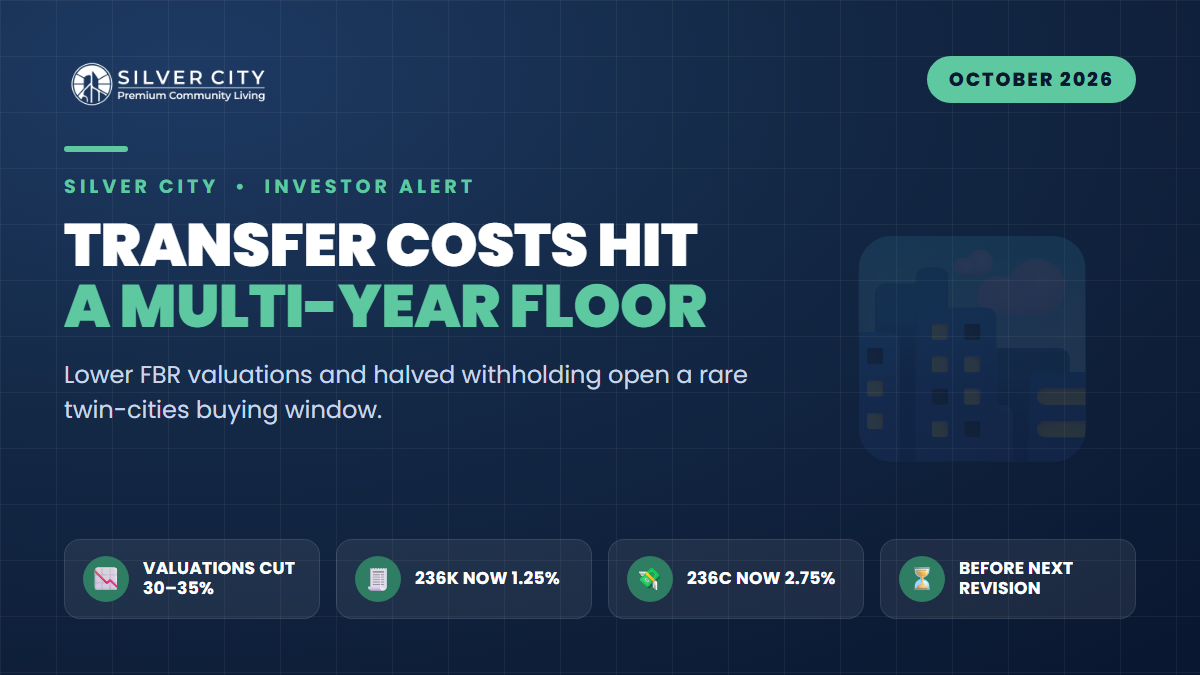
For the first time in years, two separate cost levers in Pakistan’s property market have moved down at the same time — and both landed on the Rawalpindi–Islamabad corridor. The FBR has trimmed its official valuation tables across the twin cities, and the Finance Act 2026 (budget 2026-27) cut advance withholding under sections 236K and 236C to flat filer rates effective 2 July 2026. Stacked together, they put the all-in cost of transferring a plot at a multi-year low. Here is exactly what changed, a worked example, and why the window may not stay open.
Two cuts are stacking at once
Transfer cost in Pakistan is driven by two things: the base value the tax is calculated on (the FBR valuation table for your area), and the percentage rates applied to that base. Both just fell. When the base shrinks and the rate shrinks, the saving multiplies rather than adds.
The valuation tables fell roughly 30–35%
After a chaotic December 2025 notification that had briefly raised values steeply, the FBR reversed course. In Islamabad, downward revisions were issued through SRO 163 of 2026 and amended by SRO 332 of 2026, with an April 2026 round cutting rates by up to 35%. For Rawalpindi, SRO 877(I)/2026 (May 2026) trimmed several high-value residential brackets — including DHA phases — by about 10–35%. A few illustrative Islamabad moves:
| Area / item | Old rate | Revised rate | Cut |
|---|---|---|---|
| B-17 possession plot (per sq yd) | Rs 30,000 | Rs 21,000 | ~30% |
| Margalla Town (per sq yd) | Rs 55,000 | Rs 38,500 | ~30% |
| Chak Shahzad (per sq yd) | Rs 50,000 | Rs 35,000 | ~30% |
| Superstructure ≤5 yrs (per sq ft) | Rs 3,000 | Rs 2,500 | ~17% |
A lower table value means lower 236K, lower 236C, and lower stamp duty and CVT — because all of them are calculated off that number.
Withholding under 236K and 236C roughly halved for filers
The bigger structural change is on the rates. The old system used value-based slabs that climbed as the property got more expensive, and it penalised a confusing “late filer” category. The Finance Act 2026 scrapped the slabs for filers and replaced them with simple flat rates, while also removing the late-filer tier. The non-filer penalty, by contrast, remains punishing.
| Section | Who | Old filer slab (pre-July 2026) | New filer rate |
|---|---|---|---|
| 236K | Buyer (purchase) | 3% / 3.5% / 4% by value band | 1.25% flat |
| 236C | Seller (sale/transfer) | 3% / 4% / 5% by value band | 2.75% flat |
| 236K | Non-filer buyer | — | 10.5% / 14.5% / 18.5% |
| 236C | Non-filer seller | — | 11.5% flat |
For a filer buyer, going from 3% to 1.25% is more than a halving. For a seller on a high-value plot, 5% down to 2.75% is close to half. Overseas Pakistanis are treated at the filer rates. Non-filers, however, now pay up to 18.5% as buyers — the gap between being on the Active Taxpayer List and off it has never been wider.
Worked example: a 5-marla twin-cities transfer
Assume an FBR table value of Rs 2.5 million on a 5-marla residential plot (comfortably under the Rs 50 million first band). Because the plot sits in the lowest band, the old filer slab was already the 3% rung — so the saving here comes almost entirely from the rate cut, before you even factor in the lower table value on pricier assets.
| Charge | Old (filer) | New (filer) | Saving |
|---|---|---|---|
| 236K — buyer | Rs 75,000 (3%) | Rs 31,250 (1.25%) | Rs 43,750 |
| 236C — seller | Rs 75,000 (3%) | Rs 68,750 (2.75%) | Rs 6,250 |
| Combined buyer + seller WHT | Rs 150,000 | Rs 100,000 | Rs 50,000 |
On higher-value plots the effect compounds: the old 4–5% slabs disappear, and the base value itself is 30–35% lower in revised areas. A transaction that would have carried a Rs 5% seller rung on a pre-cut valuation can now sit on 2.75% of a reduced base — a double discount.
Why “act before the next revision” is not just a sales line
FBR valuation tables are revised periodically, and the long-term trend is upward to close the gap with market prices — the December 2025 episode, where values were first hiked by triple-digit percentages before being rolled back, is a reminder of the direction of travel. The current tables are a correction, not a permanent policy. The flat 1.25%/2.75% withholding rates are equally a budget-cycle decision that can be re-slabbed in any future Finance Act. In other words, the floor you see today is the product of two temporary alignments. When either the valuation base is revised up or the rates are re-tiered, the arithmetic reverses.
A filer-first checklist before you transfer
- Get on the ATL first. File your return and confirm Active Taxpayer status before the transfer date — this is the single biggest cost lever, worth up to 17 percentage points on 236K.
- Pull the current table value for the exact area/phase from the latest SRO before negotiating, so you tax on the correct (lower) base.
- Time the registry while the reduced valuation and flat rates are both live.
- Budget the full stack — 236K/236C plus provincial stamp duty, CVT and registration — all computed off the same table value.
- Verify on IRIS. Budget-cycle rates have moved more than once; confirm the figure on FBR’s portal on the day of transfer.
Frequently Asked Questions
Do the lower rates apply to non-filers too?
No. The flat 1.25% (236K) and 2.75% (236C) are filer/overseas-Pakistani rates. Non-filer buyers face 10.5% to 18.5% depending on value, and non-filer sellers pay 11.5%. Becoming a filer before your transfer is the most effective way to capture the floor.
Does a lower FBR valuation reduce my market purchase price?
No — the FBR table value is only the figure used to calculate taxes (236K, 236C, stamp duty, CVT). Your negotiated market price is separate. But a lower table value directly lowers every tax computed on it, which is where your saving sits.
When exactly did the withholding cuts take effect?
The flat filer rates under the Finance Act 2026 (budget 2026-27) took effect from 2 July 2026. The Rawalpindi valuation revision came via SRO 877(I)/2026 in May 2026, following the Islamabad downward revisions earlier in the year.
How long will this floor last?
There is no fixed expiry, which is the risk. Valuation tables and withholding slabs are both revised on policy cycles, and the historical direction is upward. Treat the present alignment as a window, not a permanent setting.
The takeaway
Lower valuation bases plus halved filer withholding mean the cost of moving money into twin-cities property is about as low as it has been in years — but only for filers, and only until the next revision. For investors who want to lock that in on an RDA-approved asset, Silver City on Girja Road, Rawalpindi — near the Thalian Interchange and M-2 — offers 5-marla, 10-marla and 1-kanal plots on multi-year instalment plans, making it a credible, approved option to transact through while the arithmetic is in your favour. As always, confirm live rates on FBR IRIS and verify society approval status directly with the RDA before committing.