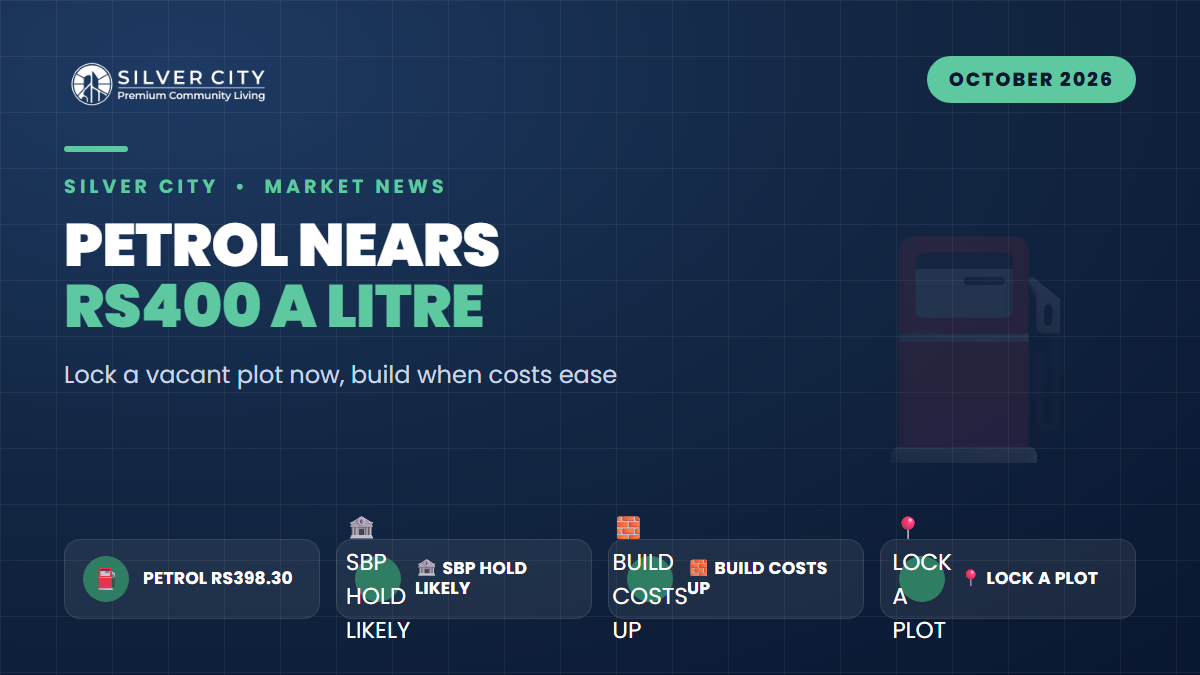
On 10 October 2026, OGRA notified petrol at Rs398.30 per litre and high-speed diesel (HSD) at Rs396.24 for the 10–12 October window. Petrol actually eased by a token Re0.66 from the Rs398.96 seen on 9 October, while diesel climbed Re0.52. But the headline most investors remember is the direction of travel: after a run of fortnightly increases through late summer and autumn, both major fuels are now pressing against the psychological Rs400 mark.
For property investors in Rawalpindi and Islamabad, this is not just a line item at the pump. Diesel is the fuel that moves cement, steel, bricks, sand and crush to your site and runs the machinery that turns them into a structure. When diesel sits near Rs400, every truckload of material and every day of excavation gets dearer. That single fact reshapes the oldest question in plot investing: buy land now, or build now?
The cost-push chain: pump to plot
Pakistan’s fuel prices are largely rupee-driven and import-linked. The rupee has hovered in the 277–278 per dollar range in early October 2026 — relatively stable, but with no meaningful appreciation to pull import costs down. When global oil firms up and the rupee does not strengthen, the pricing mechanism passes the cost straight to consumers. That is textbook cost-push inflation: prices rise because inputs cost more, not because demand is booming.
The chain is direct:
- Freight: Diesel near Rs400 raises per-tonne haulage for cement, steel and aggregates.
- Machinery: Excavators, concrete mixers and generators all burn diesel on site.
- Materials: Cement and steel are energy-intensive to produce; fuel costs feed back into factory prices.
- Labour: Transport inflation nudges up the daily wage a mason or helper will accept.
Build costs are already elevated
Construction was expensive before this fuel run, and it has stayed that way. Industry trackers for 2026 put cement around Rs1,350–1,600 per bag and steel (Grade 60) roughly Rs270–320 per kg. Grey-structure cost per square foot sits near Rs2,650–3,800 depending on city, quality and design. Materials alone are 60–70% of a build budget, so even small percentage moves in cement and steel translate into real money on a 5–10 marla house.
| Input | Indicative 2026 Rate | Fuel-cost sensitivity |
|---|---|---|
| Petrol | Rs398.30 / litre (10 Oct) | Transport of workers, light logistics |
| High-speed diesel | Rs396.24 / litre (10 Oct) | High — freight & site machinery |
| Cement | Rs1,350–1,600 / bag | Medium–high (energy-intensive) |
| Steel (Grade 60) | Rs270–320 / kg | Medium–high |
| Grey structure | Rs2,650–3,800 / sq ft | Compounds all of the above |
Why this clouds the 26 October SBP decision
The State Bank of Pakistan holds its next Monetary Policy Committee meeting on 26 October 2026. The policy rate has sat at 11.5% since the 100bps hike of 27 April, with holds on 27 July and 14 September. Many borrowers have been hoping the easing cycle would resume so that construction finance and mortgages get cheaper.
Fresh fuel-driven inflation makes a rate cut harder to justify. A central bank watching cost-push pressure feed into transport and food tends to stay cautious rather than cut into an inflation upturn. The realistic base case for 26 October is therefore a continued hold, not a cut — meaning financing costs for anyone constructing on credit stay high a while longer. Fuel near Rs400 and a cautious SBP push in the same direction: building right now is costlier on both the materials side and the money side.
The investor move: secure the plot, stage the build
This is where a vacant plot earns its keep. Land is a store of value that does not consume diesel while you hold it. Buying the plot today locks your entry price and your location, while letting you defer the construction decision until input costs and interest rates are friendlier.
Why a vacant plot beats a ready-built unit right now
- No cost-push drag on holding: A plot has no build bill exposed to today’s fuel and material inflation.
- Price entry locked: In an approved society, plot values tend to track development milestones; buying before the next possession or development phase can mean a lower entry.
- Timing flexibility: You choose when to build — ideally when diesel eases and/or the SBP finally resumes cutting.
- Lower capital outlay: A plot ties up far less cash than a finished house, keeping your options open.
A simple staged plan
- Buy the plot now in an RDA-approved, litigation-free society with clear transfer records.
- Hold and verify — complete transfer, confirm dues, and track development progress.
- Design during the hold so drawings and approvals are ready to go.
- Build when the window opens — watch for softer diesel prices and an SBP cut that lowers financing.
Risk checks before you commit
Buying a plot first is a hedge, not a guarantee. Protect yourself:
- Approval status: Confirm the society and your specific block are RDA-approved — not just “NOC applied.”
- Documentation: Verify the file, transfer letter and that no dues or disputes are attached.
- Development reality: Roads, water, electricity and sewerage should be in place or credibly funded, so the plot is buildable when you are ready.
- Holding cost: Factor annual charges and any instalments into your return calculation.
Frequently Asked Questions
Does a small petrol cut mean fuel pressure is over?
No. The 10 October revision trimmed petrol by less than a rupee while raising diesel. Both fuels remain close to Rs400 after a series of increases. For construction, diesel matters most, and it rose — so the cost pressure on building materials and freight is still very much in play.
Will the SBP cut rates on 26 October 2026?
The policy rate has held at 11.5% since April 2026. Fresh cost-push inflation from fuel makes an immediate cut less likely; a continued hold is the more realistic base case. That keeps construction financing expensive for now, which is another reason to secure land and defer the build. Always confirm the actual decision on the day via the SBP’s statement.
Is a plot really a better hedge than a built house?
For investors sensitive to today’s input costs, often yes. A plot does not carry an active build budget exposed to current cement, steel and diesel inflation, needs less upfront capital, and lets you time construction to a cheaper window. A finished unit may suit end-users who need to move in immediately, but it locks in today’s elevated build costs.
What should I check before buying a plot in Rawalpindi?
Verify RDA approval for the exact block, inspect the file and transfer documents, confirm there are no outstanding dues or litigation, and assess on-ground development so the plot is genuinely buildable later. Keep annual holding charges in your return math.
The takeaway
With petrol at Rs398.30 and diesel at Rs396.24 as of 10 October 2026, a stable-but-soft rupee, elevated cement and steel, and an SBP that looks set to stay cautious on 26 October, the arithmetic favours patience on construction and decisiveness on land. Lock your location and entry price with a vacant plot now; build when fuel and financing ease. For investors wanting an approved, documented base to execute this strategy, Silver City — an RDA-approved housing society in Rawalpindi — is worth shortlisting as you compare plots, development status and transfer transparency before committing your capital.