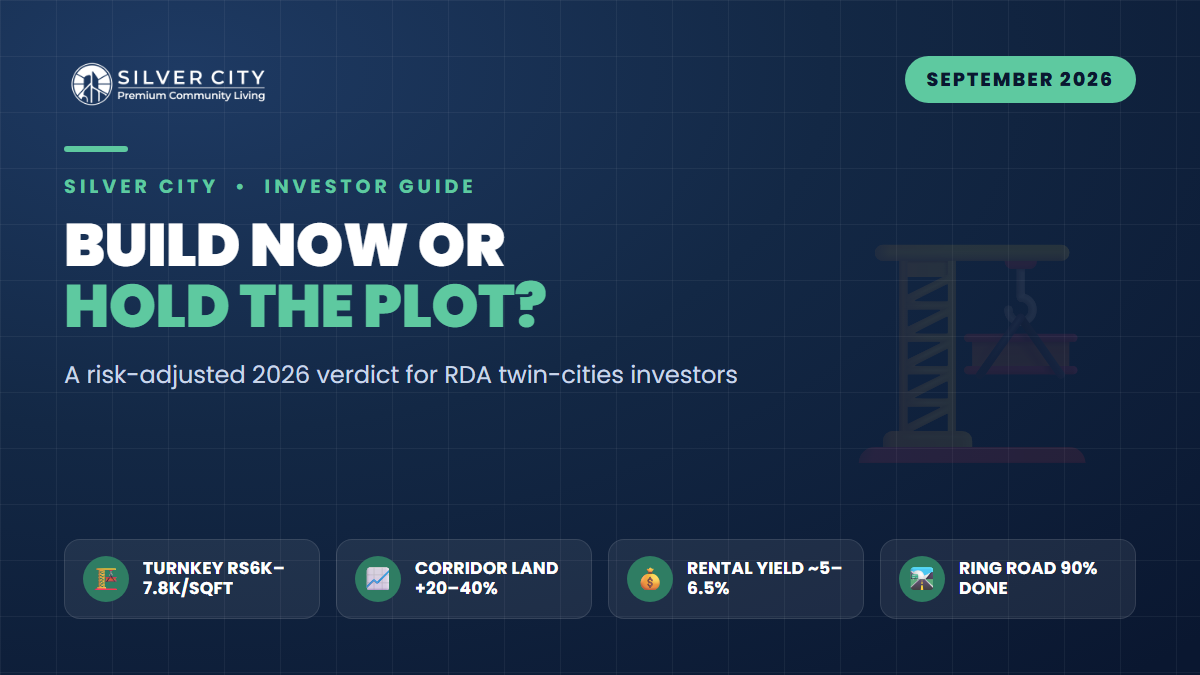
It is the question dominating twin-cities investor chats in 2026: with quality turnkey construction now costing roughly Rs6,000–7,800 per square foot, and land along the Rawalpindi Ring Road (RRR) and Expressway corridor having jumped 20–40% over the past 12 months, should you pour capital into building a house on your 5-marla now — or keep holding the vacant plot and let raw land do the work?
There is no single right answer. But there is a right framework. Below we break down the real numbers, the risks each path carries, and how to think about it on a risk-adjusted basis in RDA-approved societies around Rawalpindi and Islamabad.
The Two Strategies, Side by Side
A vacant plot is a pure capital-gains play. You pay for the land, wait, and hope the corridor premium and society development lift its value. A built house adds a second engine — rental income — but demands a large second cheque and exposes you to construction risk.
Here is an illustrative comparison for a 5-marla (125 sq yd) plot in an RDA-approved society on the Girja Road / Thalian corridor. Figures are indicative for late 2026 and will vary by society, sector, and finish quality — always verify current rates before committing.
| Factor | Hold Vacant Plot | Build & Rent (double-storey) |
|---|---|---|
| Entry cost (5-marla plot) | ~Rs2.55m–2.75m | ~Rs2.55m–2.75m |
| Build cost (~2,200 sq ft covered @ Rs6,000–7,800) | Rs0 | ~Rs13.2m–17.2m |
| Total capital deployed | ~Rs2.6m–2.75m | ~Rs15.8m–19.9m |
| Annual income | None | Rent ~Rs900k–1.3m/yr |
| Gross rental yield | 0% | ~5–6.5% |
| Liquidity | High (plots trade fast) | Lower (fewer buyers, larger ticket) |
| Main risk | Price stagnation, dead capital | Cost overruns, finish depreciation |
What the Verified Numbers Actually Say
Three facts anchor the 2026 decision:
- Construction is expensive but has stabilised. Grey-structure rates sit around Rs2,500–3,500/sq ft, and full turnkey builds run roughly Rs7,000–9,500/sq ft at the top end — the Rs6,000–7,800 band applies to efficient, well-managed 5-marla projects with standard (not luxury) finishes.
- Corridor land has genuinely outperformed. Values around the Chakri and Adiala interchanges have surged as the RRR nears completion — over 90% of civil work is done and 38 km of asphalt is laid, though Phase 1 has repeatedly slipped past its December 2025 target.
- Rental yields are modest. Pakistan’s average gross rental yield was about 6.53% in Q3 2025; Islamabad-Rawalpindi residential typically lands nearer 4.5–6.5% gross, and net yields run 1.5–2 percentage points lower after tax, maintenance, and vacancy.
The Risk-Adjusted Logic
Why holding often wins on a pure return basis
A vacant plot needs almost no additional capital, carries near-zero holding cost, and stays highly liquid — a 5-marla file sells far faster than a Rs18m house. If the corridor keeps appreciating even 15–20% annually, the plot’s return on a small capital base can beat a house whose value is anchored by a large, partly depreciating construction cost. Crucially, buildings age; land does not.
Why building can still be the smarter risk-adjusted move
Building converts a speculative asset into a productive one. Rent gives you cash flow that cushions any flat patch in land prices — a real hedge if the RRR timeline slips again. A completed, rented house in a developed sector is also less volatile than a plot in an under-developed phase, and it lets you capture end-user (owner-occupier) demand, not just investor flipping. The catch: your blended return is diluted because most of your money now sits in bricks earning ~5–6% rather than in land compounding at 20%+.
The decisive variable: development stage
Building only makes sense where a society is possession-ready with live utilities and neighbours. Constructing in an empty phase strands your capital in a house nobody will rent. In early-stage or corridor-play sectors, holding the plot is almost always the superior risk-adjusted choice until the area matures.
A Practical Decision Timeline
- 0–12 months (plot bought in a developing sector): Hold. Let development and corridor news lift the land. Building now traps capital.
- 12–36 months (sector reaching possession, utilities in): Re-evaluate. If rental demand is real and finish costs are controlled, building starts to make sense.
- 36 months+ (mature, populated sector): Build if you want income and long-term stability; keep holding if you are purely chasing capital gains and have other cash-flow sources.
Bottom Line
On a strict risk-adjusted, return-on-capital basis in developing RDA societies, holding a vacant plot usually still edges out building through 2026 — the corridor premium on a small capital base is hard for a rent-yielding house to match, and the plot keeps you liquid. Building wins when the society is mature, you value cash flow and lower volatility over maximum upside, or you are an end-user rather than a pure investor. The worst move is building in an empty sector: you take on full construction risk without the rental demand to justify it.
Frequently Asked Questions
Is Rs6,000–7,800 per sq ft realistic for a 5-marla in 2026?
Yes, for a standard-finish double-storey managed efficiently. Grey structure alone is Rs2,500–3,500/sq ft, and premium turnkey can exceed Rs9,000. Get itemised, written quotes and lock material rates where possible, as cement and steel prices move.
Does building always increase resale value more than the plot alone?
No. In a developed sector a good house can sell at a healthy premium, but in an under-developed one buyers discount construction heavily and may prefer a bare plot. The building can even become a liability if finishes date before the area matures.
How much does the Ring Road delay affect this decision?
It raises the risk of holding pure land, since much of the corridor premium is priced on completion. A rented house partly hedges that timeline risk with steady cash flow — a point in favour of building in already-livable sectors.
What rental yield should I expect in twin-cities societies?
Plan for roughly 4.5–6.5% gross, and 1.5–2 points lower net after tax, maintenance, and vacancy. Treat rent as a stabiliser, not the main return — capital appreciation still drives most twin-cities property gains.
Wrap-up: Whichever path you choose, it only works on a clean, verifiable title. For investors weighing this build-or-hold question on the Girja Road / Thalian corridor, Silver City — an RDA-approved (NOC-cleared) society positioned near the Ring Road / Thalian interchange with structured installment plans — is a legitimate option worth shortlisting. Confirm current plot prices, payment terms, and possession status directly with the developer before you commit either way.