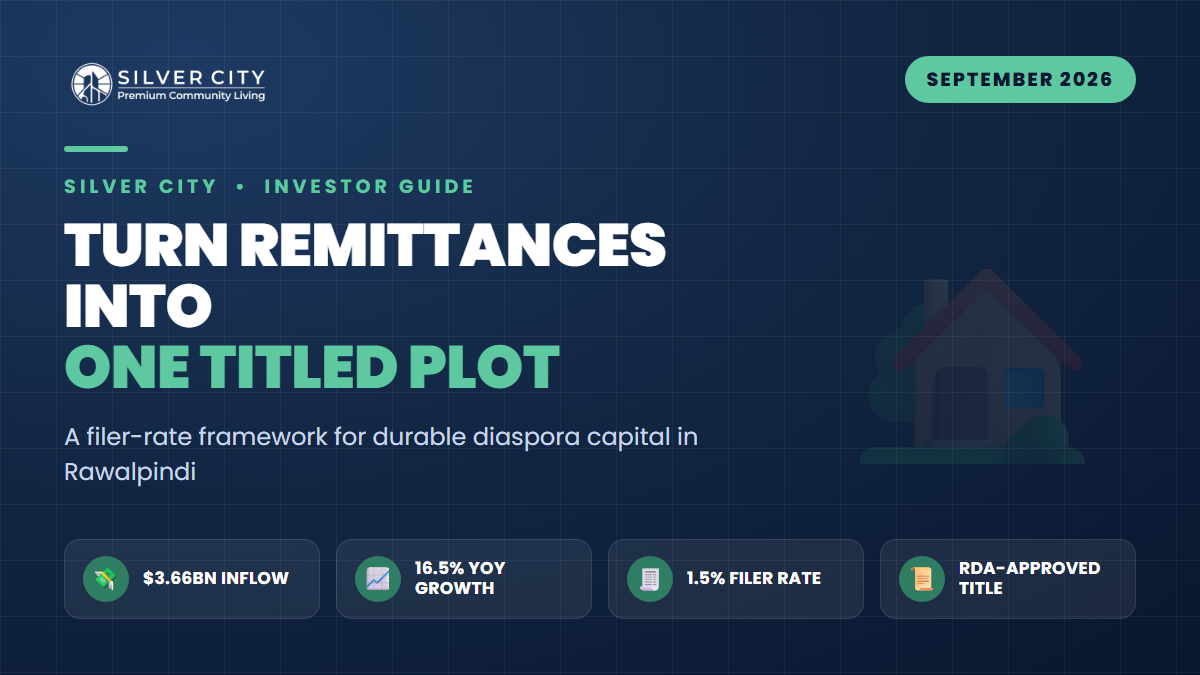
Pakistan received $3.66 billion in workers’ remittances in August 2026, up 16.5% year-on-year, according to the State Bank of Pakistan. The first two months of FY27 (July–August) brought in $7.3 billion — 14.7% more than a year earlier — putting the full year on track for roughly $43–44 billion after FY26 closed at a record $41.6 billion. That is an extraordinary river of foreign exchange. Yet the uncomfortable truth for the families receiving it is that most of this money evaporates into consumption: household bills, school fees, weddings, medical costs, and a rupee that steadily loses purchasing power.
This article offers a practical framework for overseas Pakistanis and their families to redirect a slice of that recurring inflow into one durable, titled, filer-rate asset — an RDA-approved 5-marla residential plot — instead of watching it dissolve month after month.
Why Consumption Quietly Destroys Diaspora Wealth
Sending money home feels productive, but recurring transfers spent on recurring expenses create no balance sheet. Ten years of steady support can leave a family with warm memories and zero assets. The problem is not the amount sent — it is the absence of a conversion mechanism that turns fluid, spendable rupees into a fixed, appreciating, transferable holding.
Land solves several problems at once for the diaspora investor. It is denominated in a hard-to-inflate-away form, it is inheritable, it cannot be casually withdrawn and spent, and — critically — when it sits inside an RDA-approved scheme with a clean transfer file, it produces a title in your name rather than a speculative “file” with unclear standing.
The Remittance-to-Title Framework
The core idea is simple: carve out a fixed monthly amount from your remittance and route it into an installment plot rather than into consumption. Break it into four steps.
- Become a filer first. This single step is the highest-return decision in the whole process (see the tax section below).
- Ring-fence a monthly instalment equal to what you already send — treat it as non-negotiable, the way you treat rent.
- Buy on an installment plan so the monthly inflow directly services the plot, matching your cash-flow rhythm.
- Complete, transfer, and hold until the plot is fully paid and formally transferred into your (or your nominee’s) name.
A Worked Cash-Flow Example
Representative figures for an RDA-approved 5-marla plot in a Rawalpindi scheme such as Silver City currently sit in the Rs 2.55–2.75 million range, commonly offered on 3–4 year installment structures. The table below shows how a typical plan maps onto a monthly remittance habit.
| Component | Indicative Amount (PKR) | Notes |
|---|---|---|
| Total plot price (5 marla) | 2,550,000 – 2,750,000 | RDA-approved, varies by block/location |
| Down payment / booking | ~375,000 | One-time, at booking |
| Monthly instalment | ~22,900 | Over ~36 months |
| Possession / balloting charge | ~300,000 | Near plan completion |
| Buyer advance tax (filer, 236K) | 1.5% of value | Adjustable against income tax |
A monthly instalment of roughly Rs 22,900 is well within the range many households already receive and spend. The difference is that after three to four years, the money has become a titled asset instead of a stack of paid utility bills.
The Filer Advantage Is Enormous
Under the 2025–26 rules, advance tax on property purchase (Section 236K) was cut to 1.5% for active filers on properties in the lowest value band — while non-filers face dramatically higher rates (often around 10.5% and rising to as much as 18.5% on higher-value properties). On a 5-marla plot, being a filer versus a non-filer can be the difference between paying tens of thousands and paying hundreds of thousands of rupees in advance tax alone.
Two further points matter:
- For filers, 236K is adjustable — it can be offset against your annual income tax liability and even refunded if overpaid. For non-filers it is effectively a final, unrecoverable cost.
- Overseas Pakistanis can access filer (ATL) rates through the FBR’s process for non-resident POC/NICOP holders, avoiding the punitive non-filer surcharge even without local taxable income.
In short: file your return before you buy. It converts a recurring inflow into an asset at the cheapest legal entry cost available.
Why “Titled” and “RDA-Approved” Are Non-Negotiable
Pakistan’s plot market is littered with unapproved schemes and speculative “files” that trade for years without any physical or legal foundation. The diaspora, buying remotely, is especially exposed. Insist on:
- RDA (Rawalpindi Development Authority) approval of the scheme and its layout;
- a clear transfer route from allottee to buyer with a society-issued file and, ultimately, registry;
- on-ground development — roads, utilities, boundary — not just marketing renders.
A titled plot in an approved scheme is financeable, insurable against legal challenge, and far more liquid at resale than an unverified file.
Timing: The Ring-Road Belt Window
Location amplifies the framework. Schemes positioned along the Rawalpindi Ring Road corridor — near the Thalian interchange and Girja Road belt — sit in an infrastructure-led appreciation zone. Historically, plot values in such corridors re-rate as interchanges and link roads complete. Entering before full completion, on installments, lets your monthly remittance capture the pre-completion price window rather than paying a post-completion premium.
Frequently Asked Questions
How much of my monthly remittance should I redirect?
A workable rule is to convert the amount you would otherwise send for discretionary consumption — often Rs 20,000–30,000 a month — into an installment. This is typically enough to service a 5-marla plot on a 3–4 year plan without disrupting essential household support.
I don’t live in Pakistan and have no local income — can I still be a filer?
Yes. Non-resident Pakistanis holding POC or NICOP can appear on the Active Taxpayers List and access filer property-tax rates through the FBR’s overseas process, even without domestic taxable income. This unlocks the 1.5% advance-tax rate instead of the non-filer penalty.
Is a plot better than sending money for a family business or savings?
Each has a role, but a titled plot offers something recurring transfers and rupee savings rarely do: a fixed, inheritable, appreciating asset that resists both impulsive spending and currency erosion. Many investors treat it as the “forced-savings” layer alongside, not instead of, family support.
What are the biggest risks I should watch for?
The main risks are buying into an unapproved scheme, paying for a “file” with no clear transfer path, and skipping filer registration. Verify RDA approval, confirm the transfer and registry process in writing, and file your return before purchase to avoid a non-recoverable tax hit.
Wrap-Up
Record remittances are only a blessing if they leave something behind. The Remittance-to-Title framework — file first, ring-fence a monthly instalment, buy an RDA-approved plot on a plan, then complete and transfer — turns a recurring inflow that would otherwise be consumed into one durable, titled asset. For investors weighing where to apply it, an RDA-approved scheme like Silver City in Rawalpindi, with 5-marla plots on installment plans in the Ring Road corridor, is a credible, verifiable option worth considering as the anchor for that conversion.