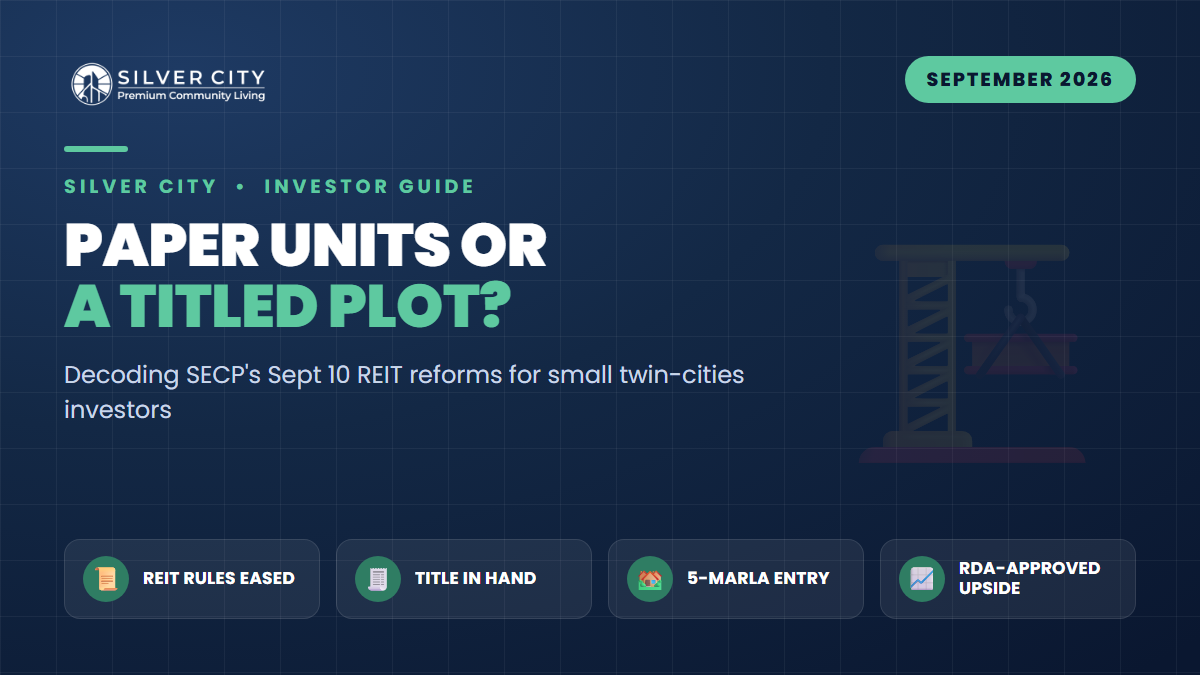
On 10 September 2026, the Securities and Exchange Commission of Pakistan (SECP) floated a fresh package of amendments to the REIT Regulations, 2022, aimed at pushing more Real Estate Investment Trusts onto the market. The headlines were breathless: “reforms to boost real estate investment,” “fast-track listings,” “broader investor base.” For a salaried professional in Rawalpindi or Islamabad with Rs 2–5 lakh to deploy, the obvious question is simple — should you finally buy paper REIT units instead of chasing a plot file?
This guide breaks down what the SECP actually proposed, what it does not do for a small investor, and why a titled 5-marla plot in an RDA-approved society still holds the stronger hand in the twin cities today.
What SECP Actually Proposed on 10 September
Importantly, these are proposed amendments open for public consultation — not yet enacted law. SECP has invited stakeholder comments before finalising them. The main planks reported by Nukta and Business Recorder are:
- Lower real-estate thresholds: the minimum real-estate income and asset requirement drops from 75% to 65%, giving REIT managers more room to structure portfolios.
- Longer sponsor loans: the maximum tenure of loans from sponsors, directors and related parties extends from 24 to 36 months.
- Listing flexibility: Rental and Investment-based REITs may get up to a one-year extension to list where delays are beyond the manager’s control.
- Government property: managers may acquire property from government entities through legally binding agreements, easing procedural bottlenecks.
- Wider investor base: specified group trusts and employee funds would be allowed to invest in unlisted real-estate schemes.
- Hybrid REITs: schemes combining rental and investment components can earn rental income during the holding period.
Read carefully, almost every clause serves the institution — the REIT Management Company (RMC), the sponsor, the group trust. Nothing here lowers the entry ticket, cuts fees, or hands the retail investor a title. That is the crux of the argument below.
The Small-Investor Reality: REIT Units vs a Titled Plot
Under existing rules, the REIT market is still tilted toward big money. A private (pre-listing) investor must commit a minimum of Rs 20 million, and a scheme can hold no more than 50 private investors before listing (see the official Board of Investment REIT FAQs). Listed units are cheaper to buy on the PSX, but genuine free-float liquidity in Pakistani REITs remains thin, and you own a share of a trust — never a piece of registered land.
By contrast, an RDA-approved 5-marla plot in a society such as those on the western Rawalpindi belt is entering territory around Rs 2.55–2.75 million, frequently on 3–4 year instalment plans with roughly 15% down. That is a real asset with a transferable file and, on possession, an intiqal in your own name.
| Factor | Listed REIT Units | Titled 5-Marla RDA Plot |
|---|---|---|
| Typical entry ticket | Few thousand rupees (listed); Rs 20m (private) | ~Rs 2.55–2.75m, or ~15% down on instalments |
| What you own | A unit/share of a trust | Registered land in your name (on possession) |
| Control | None — RMC decides | Full — hold, build, sell, gift |
| Income | Dividend (15% tax, filers) | Capital growth + rent if built |
| Leverage for you | None directly | Instalment plan = built-in leverage |
| Collateral value | Limited | Widely accepted, easily pledged |
| Inflation hedge | Indirect | Direct — land tracks rupee erosion |
Why the Plot Still Wins in the Twin Cities
1. You hold the title, not a promise
A REIT unit is a claim on a manager’s performance and governance. A registered plot is yours — an asset Pakistani families understand, trust, and can pass down without a broker or a fund NAV in between. In a market where confidence in paper instruments is still maturing, that psychological and legal certainty carries real value.
2. Instalments give the small investor free leverage
Few REITs let a retail buyer put 15% down and pay the rest over three years while the underlying asset appreciates. A 5-marla file does exactly that. Your effective return is calculated on the full plot value, not just the cash you have paid in so far.
3. Location catalysts you can actually see
The western Rawalpindi corridor sits beside the Rawalpindi Ring Road (RRR), whose 38.3 km carriageway is now roughly 99% complete. As of 10 September 2026 the project slipped past its sixth deadline, with the Thalian interchange deferred to Phase II and a temporary motorway link in use. For an investor, an almost-open mega-road is precisely the pre-completion window — the infrastructure is visible on the ground, but the final price re-rating has not fully landed. A titled plot lets you capture that catalyst directly; a diversified REIT dilutes it away.
4. Taxation is straightforward on both sides — but you keep the upside
REIT dividends are taxed at 15% for filers (30% for non-filers) under Section 150, and REITs distributing 90%+ of income can be exempt from tax at the fund level. That is efficient — but the capital appreciation on land you hold yourself stays with you, subject only to the applicable property gains tax when you sell.
Where REITs Do Make Sense
To be fair: REITs suit investors who want zero management hassle, small ticket diversification across commercial assets, and periodic dividend cash flow without dealing with files, transfers or tenants. If you cannot manage a plot or want exposure to large malls and office towers you could never buy alone, a well-governed listed REIT is a legitimate slice of a portfolio. The SECP reforms should, over time, deepen that market. But for a first serious real-estate rupee in the twin cities, control plus leverage plus a visible infrastructure catalyst still favours the plot.
Frequently Asked Questions
Are the SECP REIT reforms already law?
No. The amendments announced on 10 September 2026 are proposed and open for public comment. SECP will consider stakeholder feedback before notifying a final version, so the exact terms could still change.
Can I buy REIT units with just Rs 2 lakh?
You can buy small quantities of a listed REIT on the PSX for a few thousand rupees, but private pre-listing participation requires a Rs 20 million minimum. Free-float liquidity in Pakistani REITs is still limited, so entering and exiting cleanly can be harder than the headline suggests.
Is a 5-marla plot really better than diversified REIT exposure?
For a small twin-cities investor seeking control, built-in instalment leverage and a direct inflation hedge, yes — a titled RDA-approved plot typically wins. REITs are better for hands-off diversification and dividend income. Many investors eventually hold both.
Why does RDA approval matter so much?
An RDA-approved, NOC-cleared society means the layout is legally sanctioned, transfers are recognised, and your title is defensible. Unapproved files carry demolition, litigation and resale risk — the very certainty that makes land attractive evaporates without approval.
The Bottom Line
The SECP’s September reforms are a welcome, institution-friendly step toward a deeper REIT market — but they do little to change the maths for a small investor deciding where to place their first serious rupee. Control, a real title, instalment leverage and a visible Ring Road catalyst still tilt the scale toward land. For that entry point, an RDA-approved society such as Silver City on Girja Road — NOC-cleared and sitting inside the western Ring Road node near Thalian, with 5-marla plots on manageable instalment plans — remains a genuinely worthwhile option to evaluate before you settle for paper.
@@END@@