
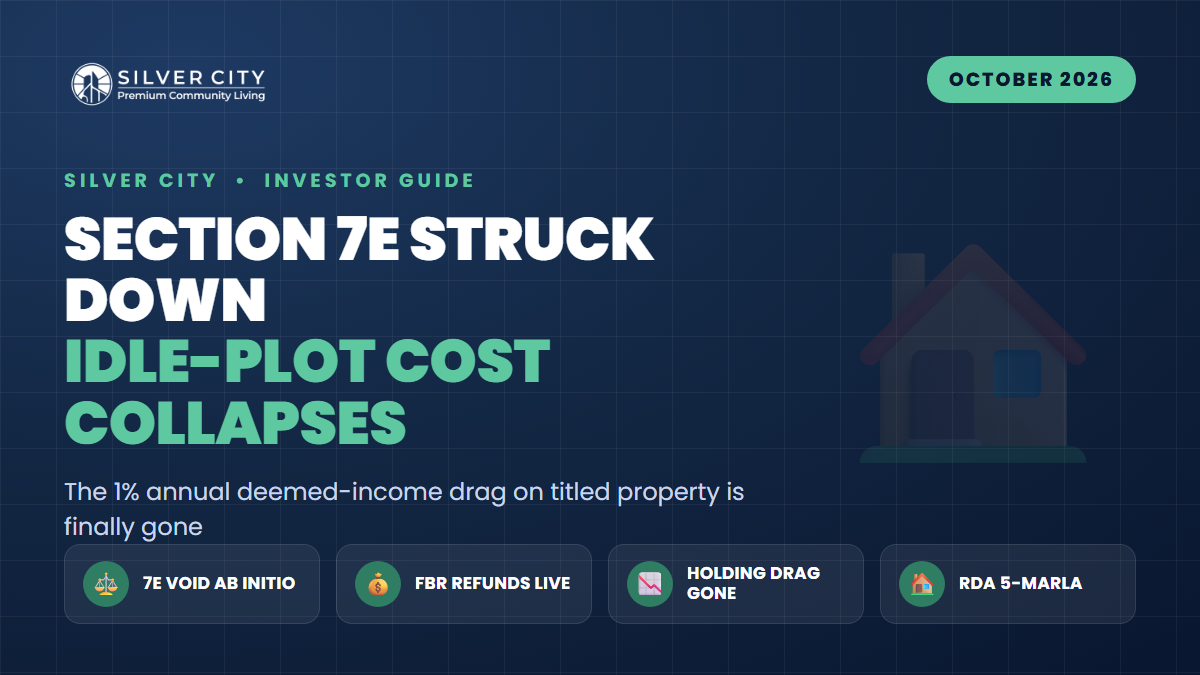
For three tax years, Pakistani property investors carried a quiet, recurring cost they could not avoid: Section 7E of the Income Tax Ordinance, 2001. It taxed you not on rent, not on a sale gain, but simply on the deemed income of owning immovable property. As of 2026, that levy is finished, struck down by the Federal Constitutional Court, formally omitted from the law by the Finance Act, 2026, and now backed by a live FBR refund instruction. For anyone holding a titled plot and waiting for the market to mature, the maths of patient ownership just improved materially.
What Section 7E Actually Taxed
Section 7E was inserted through the Finance Act, 2022 and took effect from tax year 2023. It created a legal fiction: resident persons were “deemed” to have earned income equal to 5% of the fair market value (FMV) of their capital assets in Pakistan, and that notional income was then taxed at 20%. The arithmetic worked out to roughly 1% of the property’s FMV, payable every single year, whether or not the asset produced a single rupee of real income.
Crucially, the first Rs25 million of aggregate FMV was exempt, along with carve-outs for one self-owned house, assets used in business, and certain other categories. So a single modest plot often fell below the threshold. But portfolio holders stacking several plots, or holding higher-value land, were squarely exposed. The table below shows why the drag mattered on idle holdings.
| Aggregate taxable FMV | Deemed income (5%) | Tax at 20% | Effective annual drag |
|---|---|---|---|
| Rs 30,000,000 | Rs 1,500,000 | Rs 300,000 | ~1% of value, every year |
| Rs 50,000,000 | Rs 2,500,000 | Rs 500,000 | ~1% of value, every year |
| Rs 100,000,000 | Rs 5,000,000 | Rs 1,000,000 | ~1% of value, every year |
On a five-year hold, that is roughly 5% of your capital gone to a tax on income you never received, a brutal carry cost for an asset class whose whole logic is patient appreciation.
The Three Events That Killed It
This was not a single announcement but a sequence, and investors should understand all three stages because they govern both your future liability and your refund rights.
| Date | Event | What it means for you |
|---|---|---|
| 7 May 2026 | Federal Constitutional Court declares Section 7E unconstitutional and void ab initio | All notices and proceedings under 7E set aside; the levy was void from inception |
| July 2026 | Finance Act, 2026 omits Section 7E entirely | The provision is gone from the statute going forward: no ambiguity |
| 23 Sept 2026 | FBR letter to LTOs, CTOs and RTOs on refunds | Field offices “shall not reject” revision requests; refunds to be processed expeditiously |
The Court’s reasoning was that Parliament had tried to do indirectly what it could not do directly, tax immovable property, a provincial subject, by disguising it as a federal income tax through a legal fiction. “Void ab initio” is the key phrase: legally, the tax is treated as though it never validly existed.
Why Idle-Plot Holding Cost Just Collapsed
Pakistan’s plot market runs on holding power. Investors buy land, sit through the development cycle, and sell once possession, infrastructure and demand mature. Section 7E attacked exactly that strategy by imposing an annual cash cost on dormant assets, effectively penalising you for being patient.
With 7E removed, the recurring tax line on simply owning titled property drops to zero. You still pay the normal transactional taxes (advance tax on purchase and sale, capital gains tax on an actual gain, and provincial stamp duty and transfer fees) but these are triggered by transactions, not by the calendar. The difference is structural: a self-storing, non-depreciating asset now has no annual bleed. For long-horizon holders and overseas Pakistanis parking remittances in land, the after-tax return profile is cleaner than it has been since 2023.
How to Claim Your Refund
If you paid tax under Section 7E in any year from tax year 2023 onward (or had it collected at the time of a property transaction) you can now recover it. The route runs through the FBR’s IRIS portal.
- Pull your records. Gather the returns and challans for each year you paid 7E, plus the property documents and the FBR valuation used.
- Revise the affected return. In IRIS, file a revised return for each year, removing the Section 7E deemed-income entry. The 23 September FBR instruction tells field offices not to reject revisions based on the FCC ruling.
- File the refund application. Once the revision shows a refund as due, submit the separate refund application in IRIS, citing the FCC judgment of 7 May 2026.
- Track and follow up. The FBR has directed that resulting refunds be processed promptly under applicable law. Keep the acknowledgement and follow up with your RTO if it stalls.
Because refund and revision procedures carry statutory time limits, do not sit on this. A tax practitioner can file the revisions efficiently if you held across multiple years or multiple properties.
What This Means for a 5-Marla Investor
Consider the entry-level end of the twin-cities market, an RDA-approved 5-marla in a society like Silver City on Girja Road near the Thalian interchange, currently in the roughly Rs2.55-2.75 million band. A single plot of this size was usually below the Rs25 million exemption, so many small buyers never paid 7E directly. But the removal still reshapes the bigger picture: investors who built portfolios of several plots, or held alongside other assets, crossed the threshold and felt the annual drag. Now they can scale holdings without the 1% yearly penalty, which tends to pull idle capital back into titled land rather than leaving it in instruments that are taxed every year.
Frequently Asked Questions
Do I still owe Section 7E for past years?
No. The Federal Constitutional Court declared the provision void ab initio on 7 May 2026, meaning it is treated as never having been validly in force, and the Finance Act, 2026 has omitted it entirely. Notices issued under it have been set aside.
Can I actually get my money back, or is this just theory?
You can claim it. The FBR’s 23 September 2026 letter directs Large Taxpayer Offices, Corporate Tax Offices and Regional Tax Offices not to reject return-revision requests based on the ruling, and to process resulting refunds expeditiously. The mechanism is a revised return plus a refund application in IRIS.
Does removing 7E mean property is now tax-free?
No. Transactional taxes remain, advance tax on buying and selling, capital gains tax on a genuine gain, and provincial stamp duty and transfer charges. What has ended is the annual deemed-income tax on merely owning the asset.
Is now a good time to hold rather than sell?
For patient investors, the economics have improved: there is no longer a recurring annual tax eroding an idle plot, so the cost of waiting for a market to mature has fallen. Your decision should still rest on location, development progress and your own horizon.
The end of Section 7E removes one of the few recurring costs that genuinely punished long-term plot ownership in Pakistan. For investors rebuilding a holding strategy around clean, titled land, an RDA-approved option such as Silver City in Rawalpindi (with its Ring Road corridor location and accessible 5-marla entry point) is worth putting on the shortlist. Verify your own numbers, file your refund promptly, and let the asset do what land does best: sit quietly and compound.