The rate-cut party is over — at least for now
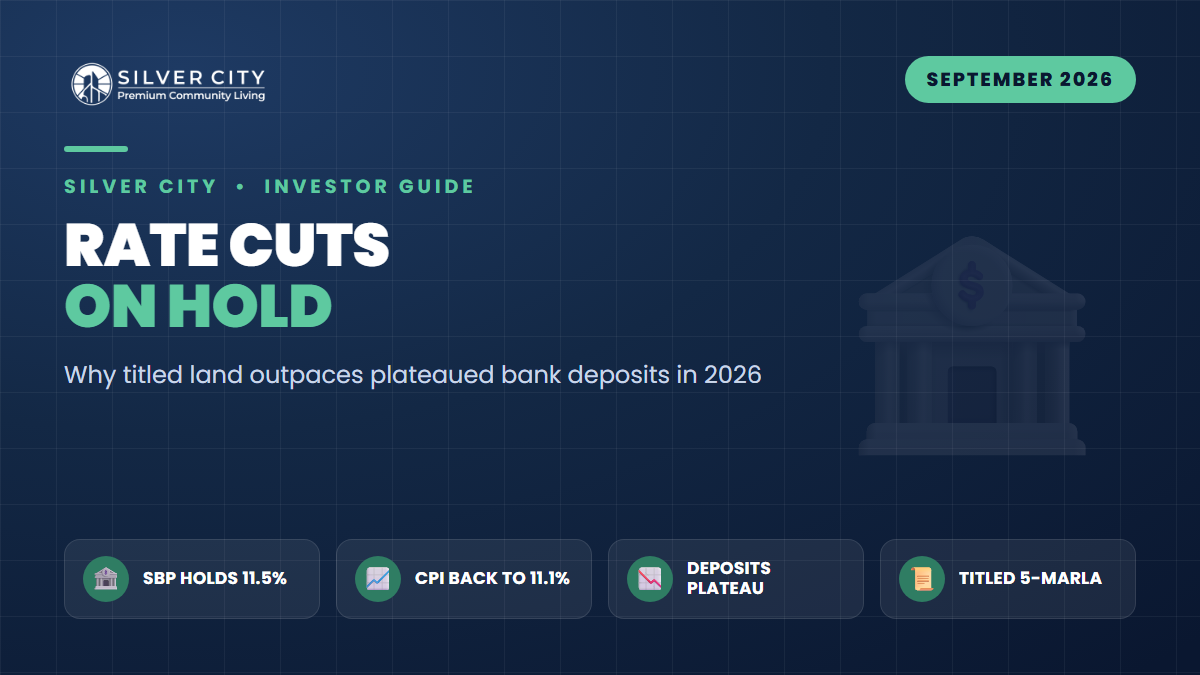
For most of 2025, Pakistani investors were pricing in one thing: cheaper money. After the State Bank of Pakistan (SBP) slashed its policy rate from a peak of 22% down to the low double digits, everyone from car buyers to plot investors expected the cuts to keep coming. That story stalled on 14 September 2026, when the Monetary Policy Committee (MPC) kept the policy rate unchanged at 11.5% — extending a run of holds rather than resuming the easing cycle.
The reason is written in the price data. National headline CPI inflation climbed back to 11.1% year-on-year in August 2026 (up from 9.2% in July), and weekly Sensitive Price Indicator (SPI) readings have pushed back toward double digits after a fuel and cooking-gas spike. When both the headline and the weekly basket are running hot again, the central bank has almost no room to cut without risking the rupee and its IMF commitments.
Why cheap financing won’t return soon
Investors hoping for a quick return to 8–9% mortgages should temper expectations. Several forces are keeping the SBP cautious:
- Inflation base effects have flipped. The ultra-low readings of mid-2025 (August 2025 CPI was just ~3.1%) made year-on-year comparisons look tame. Those favourable bases are gone, so even flat monthly prices now translate into double-digit annual inflation.
- Food and energy shocks. Flood-related supply disruptions and higher fuel and gas tariffs feed straight into the SPI, the basket that hits ordinary households first.
- IMF discipline. Under the ongoing programme, the SBP is expected to keep real interest rates comfortably positive. With inflation near 11%, an 11.5% policy rate leaves a razor-thin real cushion — leaving little space to cut.
- Rupee stability. Aggressive cuts risk capital flight and currency pressure. The MPC has signalled it prefers to wait for durable disinflation before moving again.
Translation for property buyers: the era of financing repricing lower every quarter is paused. If anything, the next few quarters look like a plateau, not a descent.
The problem with parking cash in the bank
A stalled rate cycle sounds like good news for savers — higher rates mean higher deposit returns, right? Not really. Bank deposits in Pakistan face three quiet leaks that turn “safe” money into a slow loss of purchasing power.
First, the SBP’s minimum deposit profit rule was narrowed from 1 August 2026 so that the guaranteed minimum profit rate now applies only to individual savings balances up to Rs10 million — anything above that earns whatever the bank chooses, often far less. Second, profit is taxed: withholding tax (15% for filers, higher for non-filers) plus applicable income tax eats into the headline rate. Third, and most important, inflation of ~11% quietly erodes the real value of your rupees every year.
| Where your Rs 2.6m sits | Indicative nominal return | After ~11% inflation (real) | Notes |
|---|---|---|---|
| Bank savings account | ~6% – 12% | Roughly flat to negative | Tax + inflation usually wipe out the gain |
| National Savings (Special Savings) | ~11% – 12.6% | Near zero real | Better than banks, still locked to inflation |
| Titled 5-marla plot (RDA-approved) | Capital appreciation + optional rent | Historically positive over 3–4 yrs | Inflation-linked hard asset, no monthly erosion |
Figures are indicative; deposit rates vary by bank, tier and account type, and land returns are not guaranteed. The point is the direction of travel: cash plateaus while a hard asset tracks inflation.
Why a titled 5-marla behaves differently
Land is an inflation hedge in a way a deposit can never be. When the cost of cement, steel, labour, fuel and developed land all rise — exactly what double-digit inflation measures — the replacement cost of a finished plot rises with them. A deposit’s principal is fixed in nominal rupees; a plot’s value is anchored to real construction and land economics.
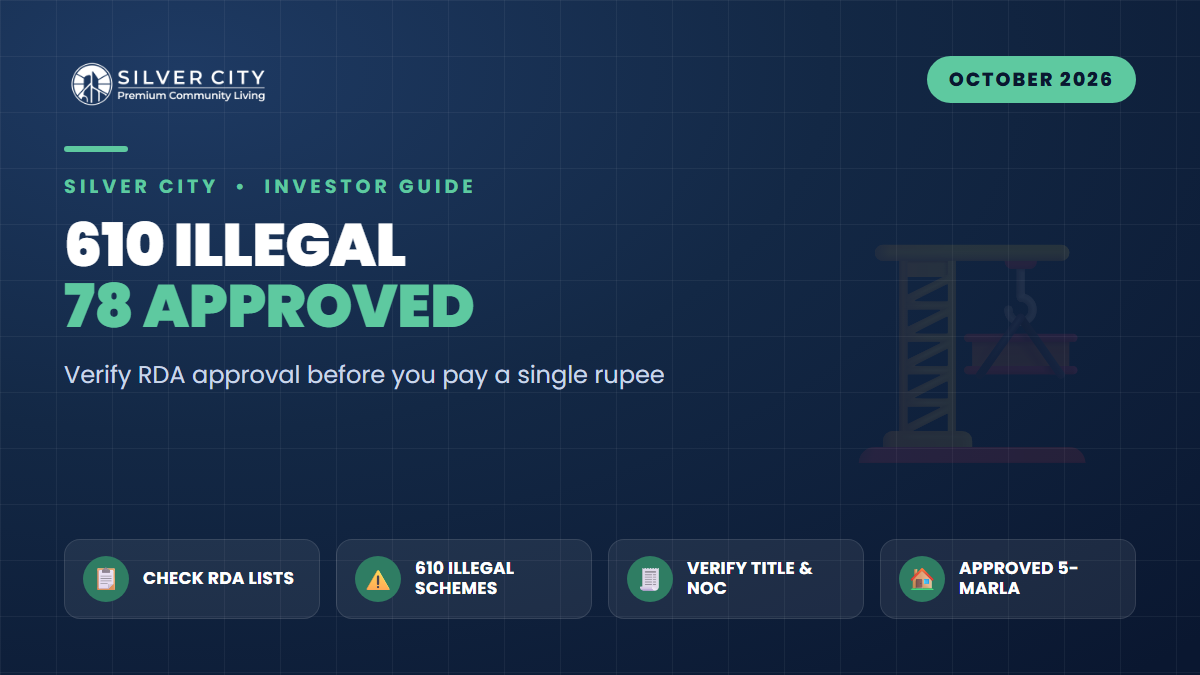
The word that matters most, though, is titled. In Rawalpindi, the single biggest risk to a property file is not price — it’s regulatory. Un-approved or “file-only” schemes can be stuck for years. A plot in an RDA-approved (NOC-cleared) scheme carries a clean, transferable title, which means it can be bought, sold, mortgaged or built on without the legal cloud that discounts illegal files.
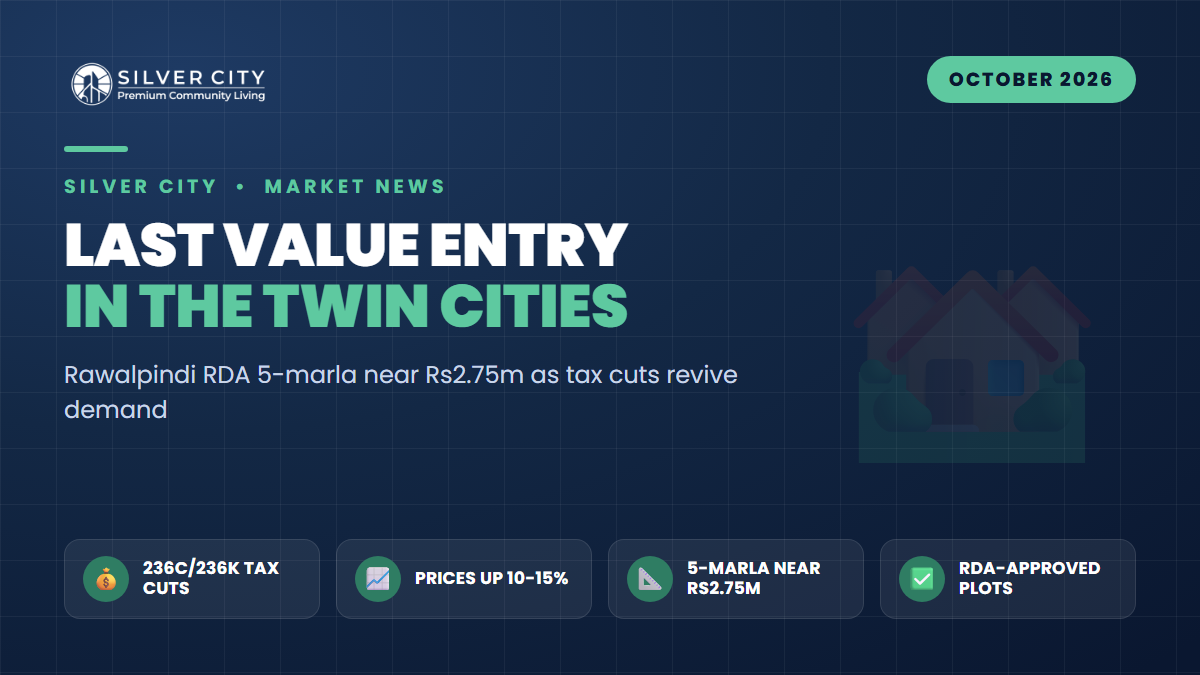
A 5-marla is the sweet spot for retail investors: large enough to build a small home or rent out, small enough to stay liquid and affordable on instalments. In the twin-cities belt, RDA-approved 5-marla plots currently sit in roughly the Rs 2.55–2.75 million band, often on flexible instalment plans.
| Plot size | Typical use | Indicative price band (twin cities, RDA-approved) | Payment style |
|---|---|---|---|
| 3.5 marla | Entry-level / rental | Below 5-marla band | Instalments |
| 5 marla | Home or hold-and-flip | ~Rs 2.55m – 2.75m | ~3–4 year instalments + down payment |
| 10 marla | Family home / upgrade | Higher tier | Instalments |
| 1 kanal | Premium / long-hold | Top tier | Instalments |
The instalment angle: buying without the mortgage
Here is the quiet advantage of a stalled rate cycle. Because expensive bank financing is exactly what’s keeping many buyers on the sidelines, developer instalment plans become the smarter route. A 5-marla on a 3–4 year plan lets you build equity in a hard asset without paying today’s high mortgage markup — you’re effectively using the developer’s schedule instead of the bank’s rate sheet. If and when SBP does eventually resume cutting, financed demand returns to the market and typically supports prices on plots bought early.
Frequently Asked Questions
Will the SBP cut rates again in late 2026?
Possibly, but not aggressively. With CPI back at 11.1% and the SPI near double digits, the MPC has kept the rate at 11.5% and signalled it wants durable disinflation before easing. Expect a plateau rather than a rapid return to single-digit financing — so don’t build an investment plan around cheap mortgages arriving soon.
Are bank deposits a bad idea entirely?
No — deposits are for liquidity and emergencies, not wealth growth. The issue is that after 15% withholding tax and ~11% inflation, the real return on most savings accounts is roughly flat to negative. Keep an emergency buffer in the bank, but don’t expect deposits to outpace inflation.
Why does “titled” matter so much in Rawalpindi?
Because the region has many un-approved or disputed files that can be frozen by regulators for years. An RDA-approved, NOC-cleared plot has a clean, transferable title, so the biggest risk — regulatory limbo — is already resolved. That security is why titled land holds and grows value while illegal files trade at a heavy discount.
Is a 5-marla too small to be worth it?
Not at all. A 5-marla is the most liquid, most affordable residential size for retail investors: easy to buy on instalments, easy to resell, and buildable into a home or rental. It captures inflation-linked land appreciation without the capital lock-up of a kanal.
The bottom line
With the SBP holding at 11.5% and inflation back in double digits, cash is quietly losing ground while cheap financing stays out of reach. A titled, RDA-approved 5-marla flips that equation: it’s an inflation-linked hard asset you can buy on instalments today and hold as financed demand eventually returns. For investors weighing exactly this trade-off, Silver City — an RDA-approved scheme on Girja Road near the Thalian interchange with 3.5, 5 and 10 marla and 1 kanal plots on flexible instalment plans — is a titled, twin-cities option genuinely worth considering.