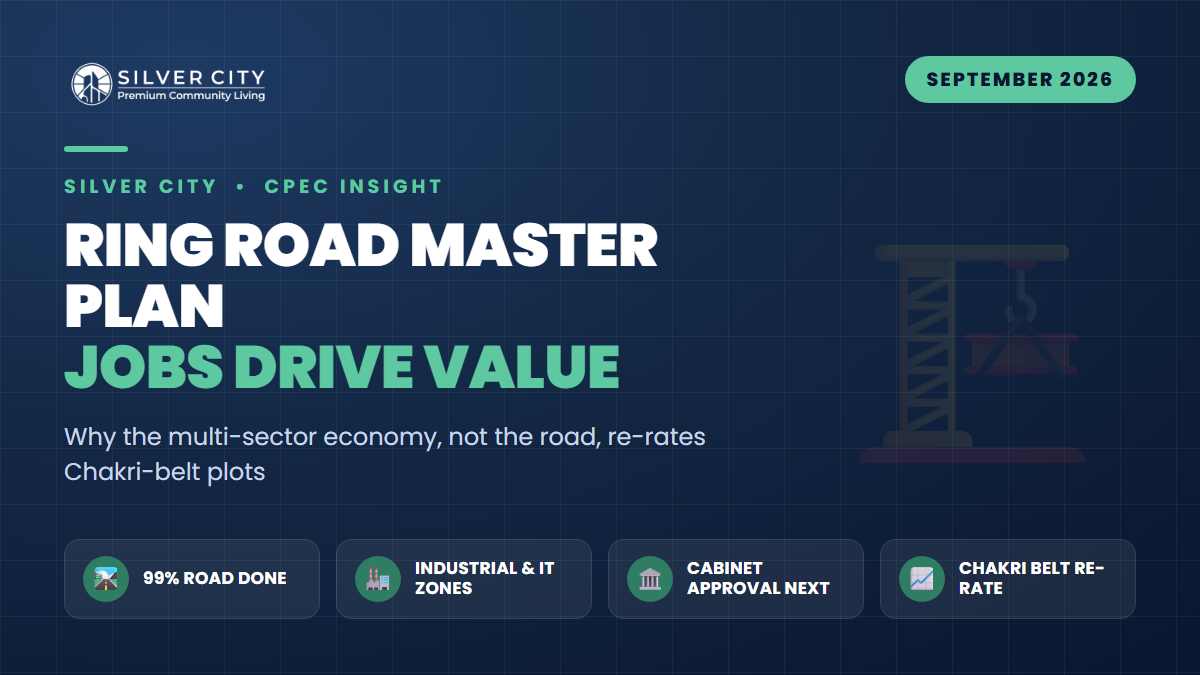
For three years, the story of the Rawalpindi Ring Road (RRR) has been about asphalt: how many kilometres are carpeted, which interchange opens next, and when the ribbon finally gets cut. That story is nearly over — the main carriageway is roughly 99% complete. But on 22 September 2026, a quieter and arguably more important story moved forward. A meeting chaired by Punjab Housing Secretary Noorul Amin Mengal, with Rawalpindi Commissioner Salman Ghani presenting, reviewed a comprehensive land-use master plan for the corridor — and agreed to send a summary to the provincial cabinet for final approval.
For property investors watching the Chakri belt near Silver City, this is the shift that matters. A road moves cars. A master plan that zones the corridor for industry, IT, health, and education moves jobs and people — and it is jobs and people, not tarmac, that create durable, repeat demand for plots.
What the September 22 Master Plan Actually Proposes
The plan covers the full ~38 km corridor from Banth Interchange on GT Road to Thalian Interchange on the M-2 Motorway. Prepared by a specialised land-use consultant, it carves the belt on both sides of the highway into dedicated economic and civic zones rather than leaving it to unplanned sprawl. Confirmed components include:
- Light and heavy industrial zones — the manufacturing and logistics backbone of the corridor.
- IT and technology zone — knowledge-economy floor space aimed at younger, higher-income workers.
- Health facilities / a “health city” — hospitals and allied medical services.
- Education zone — campuses and training/education centres.
- Sports and food sectors, wholesale markets, business hubs, a proposed dry port, bus terminals, recreational parks and a green buffer (urban forest) separating residential from commercial use.
- Planned residential communities woven between the economic zones.
The stated intent is to turn the corridor into “a new centre for regional trade, industry and investment” for northern Punjab — a description that lines up neatly with CPEC 2.0’s emphasis on industrialisation and special economic zones.
Why “Jobs-and-Population Base” Beats “The Road” as a Driver
A completed road is a one-time re-rating event. Once travel time drops, that gain is priced in and the curve flattens. A functioning multi-sector economy is a compounding one. Here is the mechanism, in plain terms:
- Industry and offices create payrolls. Factories, IT floors, a health city and campuses employ thousands of people who need to live within a reasonable commute.
- Payrolls create housing demand. That demand is recurring — it renews with every hiring cycle — not a single burst tied to an inauguration.
- Housing demand pulls plot absorption forward. End-user buyers (not just flippers) begin competing for plots in RDA-approved schemes near the zones, which deepens the market and steadies prices.
This is why seasoned investors distinguish between an infrastructure catalyst and an economic catalyst. The Chakri interchange being complete is infrastructure. The master plan seeding light/heavy industrial, IT, health and education employment nearby is economics — and economics is what keeps a location bid for a decade rather than a season.
The IMF Nuance: “Industrial Estate,” Not a Tax-Exempt SEZ
Here is the detail many marketing posts get wrong, and where an honest read helps you set realistic expectations. The corridor was originally pitched as a Special Economic Zone (SEZ) — a status that carries generous tax holidays and duty concessions. That version stalled. Under Pakistan’s current IMF programme, the broad tax exemptions and incentive packages that define an SEZ cannot legally be extended, because they erode the revenue base the IMF is protecting.
So in May 2026 the Punjab Industrial Estates Development and Management Company (PIEDMC) approved an industrial estate instead — a model that requires no statutory tax exemptions and therefore cleared its board where the SEZ did not. Land is to be acquired and offered to manufacturers at comparatively affordable rates to pull investment in.
What this means for you: the jobs, factories and population base are still coming — the demand engine is intact. What you should not underwrite is a headline “tax-free SEZ” premium, because that specific fiscal incentive is not on the table while the IMF conditions hold. Treat any brochure promising SEZ-grade tax breaks with caution; the durable driver is employment and agglomeration, not a tax holiday.
Corridor Status & Timeline at a Glance
| Item | Detail (as of Sep 2026) |
|---|---|
| Corridor length | ~38 km (Banth, GT Road → Thalian, M-2) |
| Design | Access-controlled, six lanes, 120 km/h design speed |
| Main carriageway | ~99% complete (carpeting done; drains, retaining walls, ramps pending) |
| Interchanges complete | GT Road Banth, Chak Beli Khan, Adiala Road, Chakri Road |
| Deferred | Thalian interchange (temporary two-way motorway link for now) |
| Revised PC-I cost | ~Rs 51 billion |
| Land-use master plan | Reviewed 22 Sep 2026; summary going to provincial cabinet |
| Economic model | PIEDMC industrial estate (not tax-exempt SEZ) due to IMF conditions |
What This Means for Chakri-Belt Plots Near Silver City
The Chakri Road interchange is already complete and directly anchors the belt where Silver City and its neighbours sit. That gives Chakri-side plots two layers of support that Thalian-side land does not yet have: a finished interchange plus proximity to the very zones the master plan is proposing.
Practical takeaways for investors:
- Prioritise access. Plots within a short drive of a completed interchange (Chakri, Adiala) carry less execution risk than land banking on the deferred Thalian ramp.
- Underwrite jobs, not just the road. Ask where the industrial, IT and health zones fall relative to a scheme — nearness to employment is the compounding driver.
- Insist on RDA approval and NOC. Cabinet approval of the master plan will tighten scrutiny of unapproved layouts; approved, NOC-cleared schemes are the safer holding.
- Set expectations honestly. Price the belt on employment-led demand, not on an SEZ tax break that IMF terms currently rule out.
Frequently Asked Questions
Is the Rawalpindi Ring Road finished?
The main carriageway is roughly 99% complete as of September 2026 — carpeting is essentially done, with remaining work on drains, retaining walls and interchange ramps. Four interchanges (Banth, Chak Beli Khan, Adiala, Chakri) are complete; the Thalian interchange has been deferred and is temporarily served by a two-way link onto the motorway.
Will the corridor be a tax-free Special Economic Zone?
Not currently. The SEZ version, which would carry tax holidays, could not proceed under Pakistan’s IMF programme. PIEDMC instead approved an industrial estate in May 2026 — the same jobs and manufacturing base, but without the statutory SEZ tax exemptions. Be sceptical of any listing that advertises SEZ-grade tax breaks.
Why does the land-use master plan matter more than the road itself?
A road delivers a one-time gain in travel time. The master plan zones the corridor for industry, IT, health and education — sectors that create ongoing payrolls and therefore recurring housing demand. That employment-driven demand is what sustains plot values over the long run, rather than a single inauguration spike.
Which side of the corridor is safer for investors right now?
The Chakri belt currently has the edge: its interchange is already complete and it sits close to the proposed economic zones. Thalian-side land may catch up once its interchange is built, but it carries more timing risk today.
The Bottom Line
The 99%-complete road grabs headlines, but the September 22 land-use master plan — light and heavy industrial, IT, health and education zones now heading to the Punjab cabinet — is the durable, compounding driver re-rating the Chakri belt. Just underwrite it correctly: bet on the multi-sector jobs-and-population base, not on an SEZ tax break that IMF conditions have taken off the table. For investors who want exposure to this belt with lower execution risk, Silver City — an RDA-approved, NOC-cleared scheme on the Chakri–Thalian growth corridor — remains an option worth serious consideration. As always, verify the latest cabinet decision, plot pricing and approvals directly before committing.