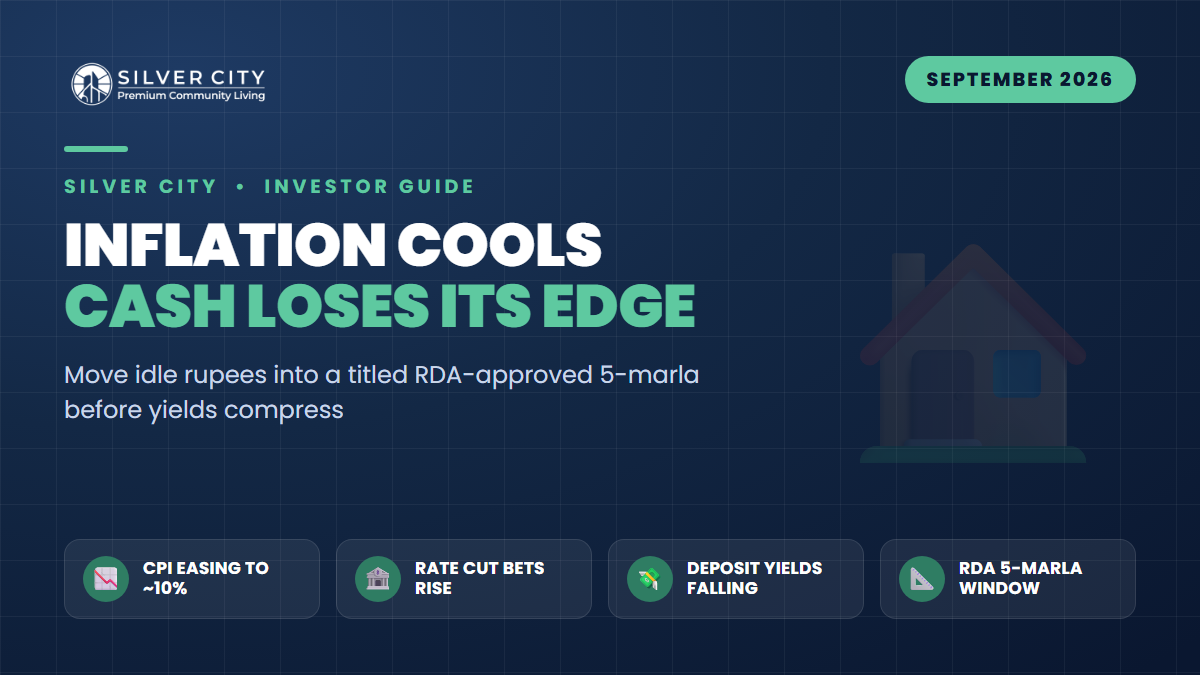
The number every Pakistani saver should be watching drops on 1 October 2026: the Pakistan Bureau of Statistics September Consumer Price Index (CPI) reading. Consensus estimates put it in the ~10.25–10.75% band, down from 11.15% in August 2026. That single deceleration is quietly rewriting the calculus for anyone holding rupees in a savings account — and it is why idle cash, not property, is now the riskiest place to sit.
What the September CPI easing actually signals
August’s 11.15% headline was a shock — inflation had run near 3.1% a year earlier and sits well above the State Bank of Pakistan’s (SBP) medium-term target of 5–7%. A cooling September print does not fix that overnight, but it breaks the upward momentum. For the SBP’s Monetary Policy Committee (MPC), a falling trend is exactly the kind of data that reopens the door to easing.
The MPC has held the policy rate at 11.5% for three consecutive meetings — most recently on 14 September 2026. The next decision lands on 26 October 2026, just weeks after the September CPI release. If the disinflation holds and energy pressures stay contained, market bets on a rate cut at that meeting — or shortly after — sharpen considerably. And a rate cut is good news for borrowers, but bad news for savers.
Why a rate cut punishes the person holding cash
Bank deposit and savings returns in Pakistan move with the policy rate. When the SBP cuts, banks reprice profit rates on savings and term deposits downward — usually within weeks. Today’s roughly 9–10% deposit returns already barely keep pace with ~10% inflation, meaning the real (inflation-adjusted) return on your cash is already close to zero or negative.
The picture gets worse from two directions:
- Yields compress. A single 100 basis-point cut can shave a full percentage point off new deposit and savings offers.
- The safety net shrank. Since 1 August 2026, the SBP’s minimum profit rate rule applies only to individual savings balances up to a Rs10 million monthly average — larger balances no longer enjoy a guaranteed floor, so banks can offer less.
Put plainly: the rupee sitting in your account is a wasting asset. It loses purchasing power to inflation while earning a return that is set to fall.
Cash versus a titled plot: the real-return gap
The table below illustrates why hard, titled land tends to outperform idle cash through a rate-cutting cycle. Figures are indicative for a Rs2.75 million lump sum in a high-inflation, falling-rate environment.
| Factor | Idle cash / savings deposit | Titled RDA-approved 5-marla plot |
|---|---|---|
| Nominal return trend | ~9–10%, falling as rate cuts land | Tracks land demand + development milestones |
| Real return vs ~10% CPI | Near zero or negative | Historically an inflation hedge |
| Effect of an SBP cut | Yield compresses further | Cheaper financing can lift plot demand |
| Tangibility | Digital balance, erodes silently | Physical, transferable, titled asset |
| Entry today | N/A | ~15% down, balance over 3–4 years |
Property is not risk-free and it is less liquid than a deposit. But in a cycle where cash is guaranteed to earn less while prices keep climbing, a titled plot converts a depreciating balance into a held, appreciating asset.
The window: enter before the crowd does
Rate cuts do not only cut deposit yields — they also make plot financing cheaper and pull fence-sitters back into the market. That demand typically firms up plot prices. The advantage sits with buyers who move before the cut is confirmed, while entry prices and installment terms are still set against today’s tighter conditions. Once easing is priced in, both the cash-return advantage and the current entry point start to close.
Why Silver City fits the moment
Silver City is an RDA-approved (NOC-cleared) housing society on Girja Road, near the Thalian Interchange on the M-2 Motorway and within the Rawalpindi Ring Road catchment. RDA approval matters because it is the single biggest protection against the file-trading and litigation risk that plagues unapproved schemes — a titled, transferable plot in an approved society is a genuine asset, not a speculative paper file.
The 5-marla category is the sweet spot for redeploying idle cash: large enough to build or resell, small enough to enter without leverage. Indicative current terms:
| Item | Indicative detail (5-marla) |
|---|---|
| Plot size | 5 marla (approx. 125 sq yd) |
| Typical price band | ~Rs2.55–2.75 million |
| Down payment | Around 15% to book |
| Installment tenure | 3–4 years (36–48 months) |
| Status | RDA-approved, titled, transferable |
Always confirm the live price list, category (residential/commercial), block availability and any possession or transfer charges directly with Silver City before booking, as terms are revised periodically.
Frequently Asked Questions
Is the September CPI number confirmed yet?
No. The official September 2026 CPI is released by the Pakistan Bureau of Statistics on 1 October 2026. The ~10.25–10.75% range reflects market and analyst estimates ahead of that release, following August’s confirmed 11.15%. Verify the final figure on the PBS website when published.
Will the SBP definitely cut rates at the next meeting?
Nobody can guarantee it. The MPC held the policy rate at 11.5% on 14 September 2026 and meets next on 26 October 2026. Easing inflation raises the probability of a cut, but the MPC also weighs energy prices, the exchange rate and IMF programme conditions. The point for savers stands either way: deposit yields are more likely to fall than rise from here.
Why choose a 5-marla plot over a term deposit or government securities?
A term deposit locks in a return that is set to decline and, above Rs10 million, no longer carries a minimum-rate floor. A titled 5-marla plot is a tangible, inflation-hedging asset you can hold, build on, or resell — and installment plans let you enter without paying the full amount upfront. It is less liquid, so keep an emergency buffer in cash and invest surplus funds.
How do I confirm Silver City is genuinely RDA-approved?
Ask for the society’s RDA/NOC documentation, confirm the specific block or phase is covered, and cross-check against the Rawalpindi Development Authority’s approved-schemes list. Insist that the plot is titled and transferable in your name, and retain all payment receipts and the transfer letter.
The bottom line
A cooling September CPI is welcome relief for the economy — but it is a warning shot for savers. As rate-cut bets build ahead of the 26 October MPC decision, deposit and savings returns are set to compress while inflation keeps nibbling at purchasing power. Redeploying idle rupees into a hard, titled asset is the logical hedge, and a Silver City 5-marla — RDA-approved, transferable, and available on a 3–4 year installment plan — is a well-placed option worth evaluating while today’s entry terms still hold. Confirm current pricing and approval status directly with the developer before you commit.