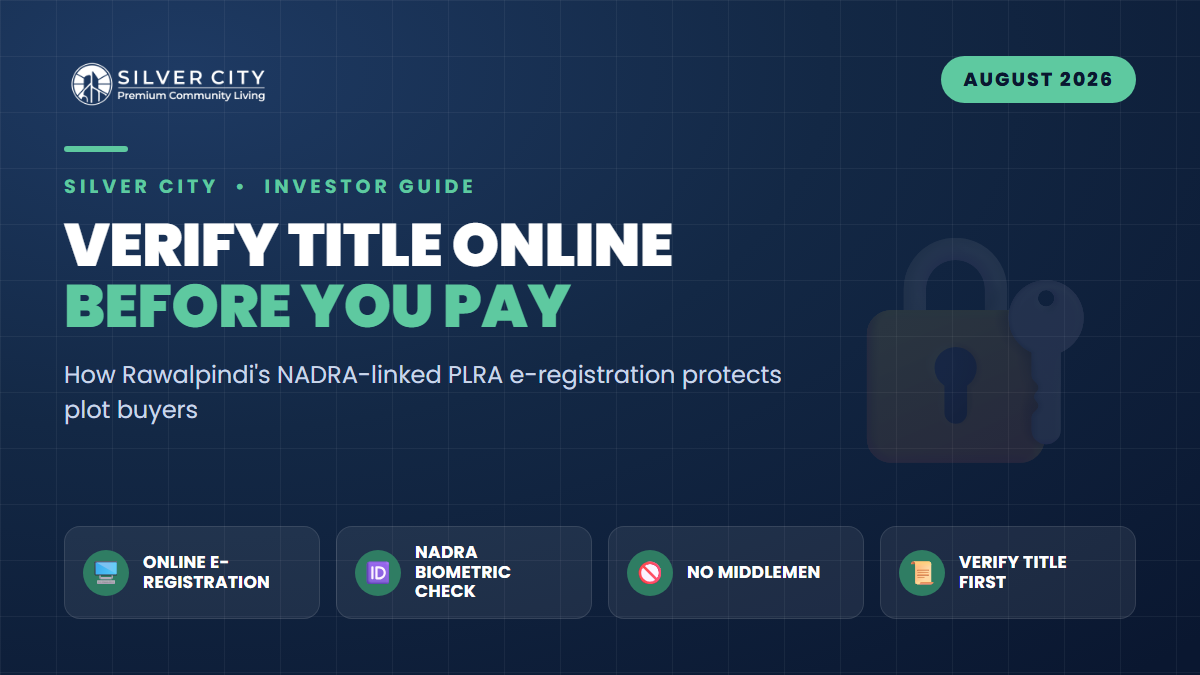
For decades, buying a plot in and around Rawalpindi meant trusting a chain of intermediaries (the property dealer, the “file mover,” and sometimes the patwari) with little way to independently confirm that the seller actually owned what they were selling. Punjab’s digital land-reform push has changed the equation. Under the Punjab Land Records Authority (PLRA), deed registration now runs through an online e-registration / Registration of Deeds (ROD) system linked to NADRA biometric verification, and ownership can be checked online before a single rupee of token money changes hands.
This is the single most important shift for anyone eyeing plots in the Silver City corridor: you can now do meaningful due diligence yourself, at home, using nothing more than a CNIC and a phone.
What Actually Changed Under PLRA
The old model relied on manual registers held by the sub-registrar and paper Fard (ownership record) issued by the patwari. Both were slow and easy to manipulate. PLRA’s reforms replace this with three connected pieces:
- Online Fard / record checking, verify ownership and land status from the official portal using a CNIC or property details.
- e-Registration (ROD portal), the sale deed is drafted, fees are calculated and paid through banking channels, and the registration is recorded digitally.
- NADRA biometric verification, the buyer, the seller, and the witnesses confirm their identity by thumb impression, cross-matched against NADRA’s database, so an impostor cannot sign in someone else’s name.
Because the deed, the parties’ biometrics, and the payment trail are all recorded electronically, the transaction leaves a tamper-resistant chain. That is precisely what squeezes out the middleman: when the state verifies identity and title directly, there is far less a “fixer” can add, or fake.
Verify Title Online: Before Paying Token
Here is the buyer-first workflow every Silver City-area purchaser should follow, in order.
- Check the record online first. Visit the PLRA online Fard portal (onlinefard.punjab-zameen.gov.pk) or the ROD portal (rodportal.punjab-zameen.gov.pk). Select the Rawalpindi district and the relevant tehsil/mauza, enter the property identifiers (Khasra/Khewat) or the owner’s CNIC, and pull the current record.
- Match name, share and area. Confirm the seller’s name matches their CNIC exactly, that their ownership share covers the full plot, and that the area matches the file you were shown.
- Read the mutation (Intiqal) history. The transfer history should be clean and continuous. Gaps, disputes, or a recent suspicious transfer are red flags.
- Screen for encumbrances. Ask specifically whether the plot is mortgaged, gifted, under litigation, attached, or subject to any charge.
- Only now pay token. If (and only if) the online record confirms clean, undisputed ownership in the seller’s name, proceed to a written token/bayana agreement.
- Book the e-registration slot. The deed is prepared on the ROD system, government dues are calculated on the DC (valuation table) value, and a biometric appointment is set.
- Complete biometric registration. Buyer, seller, and witnesses appear, verify by thumbprint against NADRA, dues are paid through the approved channel, and the registered digital deed is issued.
A note for private housing-society plots
Silver City is an RDA-approved private housing society, so at the file/allotment stage the transfer is recorded in the society’s own transfer office (verify the file, NDC, and dues directly with management). The PLRA Fard and e-registration steps above apply to titled land and to the eventual sale-deed/registry stage. Smart buyers verify both: the society’s records and the government land record for the underlying parcel.
Indicative Costs and Timeline
Government charges are levied on the higher of the DC valuation-table value or declared value, and rates change with each budget, always confirm the live figure at the sub-registrar or via an official calculator before you sign.
| Charge | Who pays | Indicative rate (2025-26) |
|---|---|---|
| Stamp duty | Buyer | ~1% of value (urban Punjab; confirm current) |
| Registration fee | Buyer | ~1% (subject to caps) |
| Corporation / TMA fee | Buyer | ~1% |
| FBR advance tax to 236K | Buyer | 3% filer · 6% late-filer · 12% non-filer |
| FBR advance tax to 236C | Seller | 3% filer · 6% late-filer · 10% non-filer |
| Online Fard fee | Buyer | Nominal (a few hundred rupees) |
236K and 236C are advance, adjustable withholding taxes, not final liabilities, being an active filer materially lowers your cost, which is a strong reason to file before you buy.
| Stage | Old manual system | PLRA e-registration |
|---|---|---|
| Title verification | Days, via patwari | Minutes, online by CNIC |
| Identity check | Visual / signature | NADRA biometric thumbprint |
| Fee payment | Cash, off-record risk | Digital, receipted |
| Deed issuance | Weeks | Hours to a few days |
Buyer Red Flags to Watch
- A seller who resists biometric verification or wants a “third party” to appear on their behalf.
- Online record showing a different owner, a smaller share, or a fresh, unexplained mutation.
- Pressure to pay large token/cash before any record check “to hold the plot.”
- For society files: no clean No-Demand Certificate (NDC) or unpaid development dues.
Frequently Asked Questions
Can I really verify ownership before paying token?
Yes. Using the PLRA online Fard/ROD portals you can pull the current owner, share, area and mutation history for titled land in Rawalpindi district using the CNIC or Khasra/Khewat numbers, before committing any money. For a society plot, pair this with a direct check of the society’s transfer records.
Does e-registration completely remove property dealers?
It removes the dealer’s gatekeeping power over identity and title, and it removes off-record “fixing.” A reputable dealer can still help you find and negotiate a plot. But you are no longer forced to trust anyone for verification, because the state now confirms identity biometrically and records the deed digitally.
What is the NADRA biometric step and why does it matter?
At registration, the buyer, seller and witnesses give thumb impressions that are matched against NADRA records. This makes benami (proxy) sales and forged-signature fraud far harder, protecting genuine buyers from paying for a plot the “seller” never owned.
How does filer status change my cost?
For 2025-26 the buyer’s 236K advance tax is roughly 3% for active filers versus 12% for non-filers, with a 6% late-filer tier, a large gap on a multi-million-rupee plot. Becoming an active filer before purchase is one of the cheapest ways to cut your total transfer cost.
The Bottom Line
Punjab’s NADRA-linked PLRA e-registration hands power back to the buyer: verify title online, insist on biometric registration, pay government dues through official channels, and keep the digital deed. Do that, and the middleman’s leverage largely disappears. For the Rawalpindi corridor, this transparency rewards buyers who choose properly documented, approved projects. Which is why an RDA-approved society like Silver City is worth serious consideration: clean approvals plus disciplined online verification give you a plot you can actually stand behind.