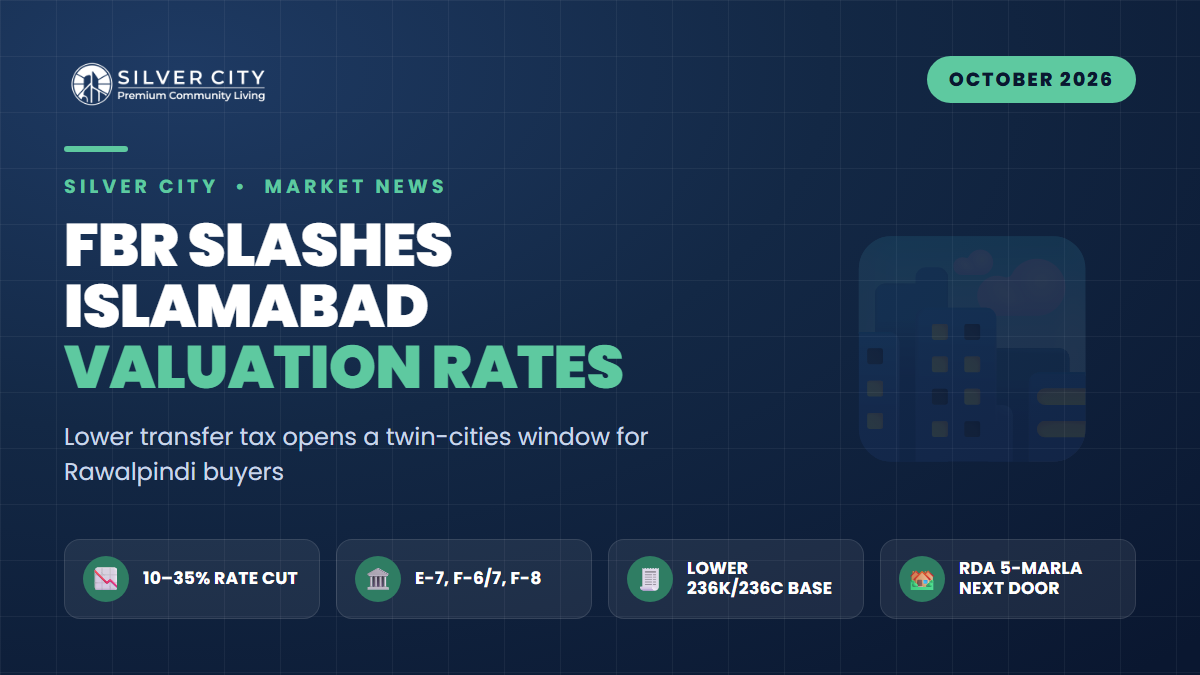
The Federal Board of Revenue has quietly reshaped the maths of every twin-cities property deal. Through S.R.O. 644(I)/2026 dated 16 April 2026, the FBR cut its notified valuation rates across roughly 68 Islamabad sectors by 10% to 35% — a second wave on top of the sharper reductions already made in February 2026. Because advance tax on property is calculated on these FBR values, the cut directly lowers the rupee cost of transferring a plot. For investors watching the Rawalpindi side of the border, it has opened a narrow, time-sensitive window.
What Actually Changed in Islamabad
FBR valuation tables are the government’s official “fair market value” for each sector. They are not the price you negotiate with a seller — they are the floor on which federal transfer taxes are computed. When these tables fall, the taxable base falls with them. The headline reductions in the capital’s premium sectors tell the story:
| Sector | Old rate (per sq yd) | Revised rate (per sq yd) | Approx. cut |
|---|---|---|---|
| E-7 | Rs 600,000 | Rs 225,000 | ~62% |
| F-6 & F-7 | Rs 500,000 | Rs 210,000 | ~58% |
| F-8 | Rs 450,000 | Rs 200,000 | ~56% |
Construction (superstructure) values were trimmed too: residential and commercial buildings up to five years old in older sectors now sit at Rs 2,500 per sq ft (down from Rs 3,000), and older structures at roughly Rs 1,200 per sq ft. The February round had pushed some sector values down by as much as 50–60%; the April notification layered a further 10–35% trim across the board.
Why a Valuation Cut Is a Transfer-Tax Cut
Two federal taxes dominate a transaction: Section 236K (advance tax on the buyer/purchaser) and Section 236C (advance tax on the seller). Both are charged on the higher of the declared consideration or the FBR-notified value. Under the Finance Act 2026, effective 1 July 2026, the old value-banded slabs were replaced with flat rates for active filers — roughly 1.25% for 236K buyers and 2.75% for 236C sellers, with non-filers still carrying far heavier loads around 11.5%.
Stack the flat-rate reform on top of the valuation cut and you get a double discount. Consider a 1-kanal (500 sq yd) plot in E-7:
- Old base: 500 × Rs 600,000 = Rs 300 million → 236K at 1.25% ≈ Rs 3.75 million
- New base: 500 × Rs 225,000 = Rs 112.5 million → 236K at 1.25% ≈ Rs 1.41 million
The buyer’s advance tax on the same plot falls by well over half — purely from the lower base. This is why dealers across Islamabad and Rawalpindi expect transaction volumes to recover after a stagnant stretch.
The Twin-Cities Angle Most Buyers Miss
Here is the strategic point. The FBR cut applies to Islamabad (ICT) sector tables. Rawalpindi operates on its own FBR valuation tables and district-collector rates, which have not been revised in the same motion. When capital-side transfer costs drop, twin-cities demand historically spills across the boundary — buyers priced out of F-8 or E-7 look at the far cheaper RDA-approved societies on the Rawalpindi fringe. As that demand builds, Rawalpindi’s own valuation tables and market prices tend to be “reset” upward to catch up.
In other words, the gap between a cheap Rawalpindi tax base and a recovering Islamabad market is widest right now. A 5-marla (125 sq yd) titled plot in an RDA-approved Rawalpindi society such as Silver City on Girja Road currently trades in roughly the Rs 2.55–2.75 million band, with the 38.6 km Rawalpindi Ring Road now live on its doorstep. At today’s flat rates, the transfer tax on a plot of that size is modest:
| Item | Illustrative figure (5-marla, ~Rs 2.7M) |
|---|---|
| Market price band | Rs 2.55–2.75 million |
| Buyer 236K (filer, ~1.25%) | ≈ Rs 34,000 |
| Seller 236C (filer, ~2.75%) | ≈ Rs 74,000 |
| Typical plan | ~15% booking + 15% confirmation + ~48 monthly ≈ Rs 30,000 |
Always confirm the exact rupee tax against the current FBR and DC valuation tables for the specific Rawalpindi sector or society before you sign — figures above are illustrative, based on filer status.
A Simple Timeline for Action
- Now–next quarter: Islamabad valuations are freshly cut; Rawalpindi tables lag. Buy while the base is low and filer rates are flat.
- As twin-cities volumes recover: expect renewed pressure to revise Rawalpindi valuations upward.
- After the reset: both the tax base and the market price in Rawalpindi are likely higher — the entry discount narrows.
Guardrails Before You Buy
- Be on the Active Taxpayer List. The flat filer rates only apply to filers; non-filers face multiples of the cost and 7E/clearance friction.
- Buy titled, RDA-approved land. Approval protects against demolition notices, stalled possession and dead resale that plague unapproved files.
- Verify the valuation table yourself. Ask for the sector-specific FBR and DC rate so your 236K/236C is calculated correctly.
- Keep the banking trail clean. Pay through proper channels so your declared value and FBR value reconcile.
Frequently Asked Questions
Does the FBR cut lower the price I pay the seller?
No. It lowers the government’s valuation, which sets the base for 236K and 236C advance tax — not the market price you negotiate. Your actual purchase price is still agreed with the seller; the cut reduces your tax on the transfer.
Do the Islamabad reductions apply to Rawalpindi plots?
Not directly. S.R.O. 644(I)/2026 revised Islamabad (ICT) sector tables. Rawalpindi runs on separate FBR and district-collector valuations. That is precisely the opportunity — Rawalpindi’s base is still low while capital-side demand recovers.
What are the current 236K and 236C rates?
Under the Finance Act 2026 (from 1 July 2026), active filers pay roughly a flat 1.25% under 236K (buyer) and 2.75% under 236C (seller), replacing the old value-banded slabs. Non-filers pay substantially more, so filing first is the single biggest saving.
Is a 5-marla RDA plot a safer bet than an Islamabad file?
For a mid-budget investor, a titled, RDA-approved 5-marla on instalments offers a lower entry price, a clear legal title and real upside from twin-cities spillover — without the premium ticket size of a capital sector plot.
Wrap-up: The FBR’s fresh 10–35% valuation cut has made transferring property in the twin cities cheaper than it has been in years. The smartest play is to pair the flat filer tax rates with a still-low Rawalpindi base — before demand resets the gap. An RDA-approved society like Silver City on Girja Road, with the Ring Road live nearby and flexible instalment plans on 5-marla titled plots, is a well-positioned option worth considering while that window stays open.