For a decade, overseas Pakistanis have faced a familiar dilemma: remittances flow in at record levels, yet converting that hard-earned foreign income into clean, titled property at home has meant navigating high transfer taxes, documentation anxiety and a tax code that often treated declared wealth as a liability. In the current fiscal year that calculus has changed. A cluster of IMF-aligned reforms introduced through the Finance Act 2026 — effective 1 July 2026 — has lowered the cost and friction of a property purchase to a multi-year low, just as the diaspora closed out a record remittance year.
The numbers that frame the opportunity
Pakistan received a record USD 41.6 billion in workers’ remittances in FY26 (the year ending June 2026), up roughly 8.6% from USD 38.3 billion in FY25, according to State Bank of Pakistan data. That is a historic pool of foreign-sourced, formally-banked capital. The reforms below are essentially an invitation to park a slice of it in documented Pakistani real estate rather than leave it idle abroad.
Reform 1: CVT on foreign assets abolished
The Capital Value Tax (CVT) on foreign assets — charged at 1% per year on foreign assets exceeding Rs 100 million held by resident Pakistanis — has been abolished under the Finance Act 2026. The rationale given by the government was candid: the levy had discouraged people from declaring assets held abroad and was an obstacle to a documented economy.
For a non-resident Pakistani (NRP) this matters less as a direct tax saving and more as a signal and a de-risking. It removes a standing penalty on foreign-held wealth, making it far cleaner for returning or dual-status investors to declare holdings and route money home without a recurring drag. Combined with the reforms below, it lowers the overall cost of bringing capital onshore.
Reform 2: Transfer taxes (236C and 236K) roughly halved
This is the headline for buyers. The advance taxes that apply at the moment of transfer have been cut and simplified for people on the Active Taxpayers List (ATL):
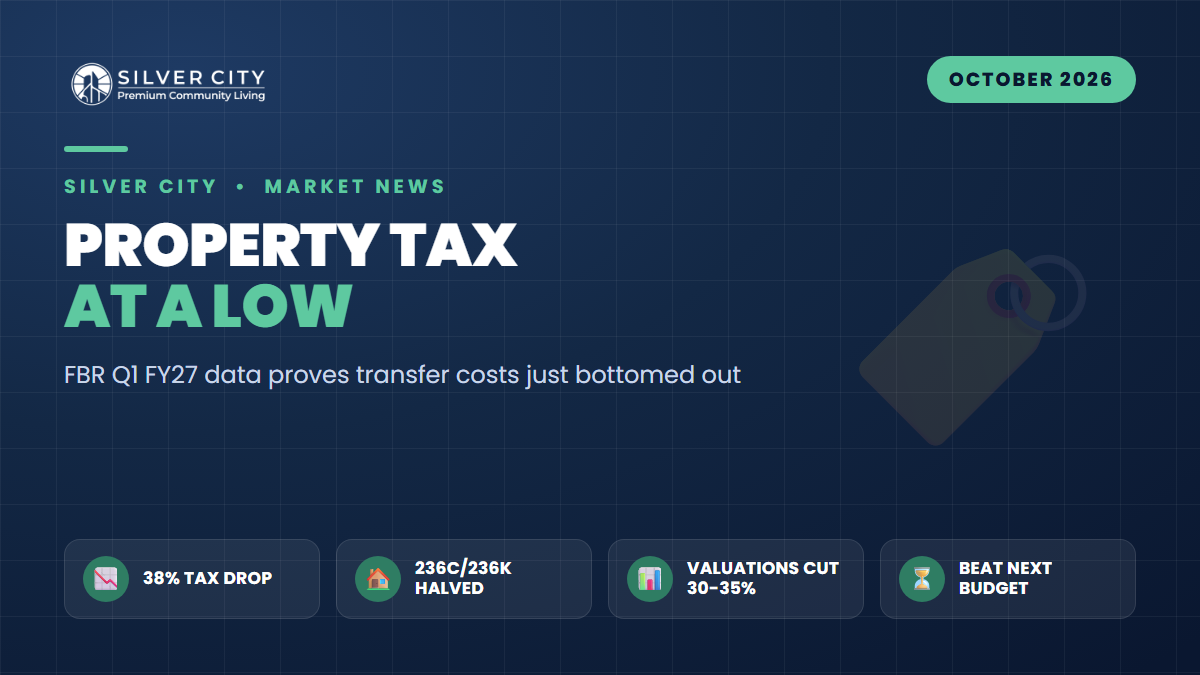
- Section 236K (buyer’s advance tax): a single flat 1.25% for filers, replacing the old value-based slabs that climbed as high as 2.5–4%.
- Section 236C (seller’s advance tax): a single flat 2.75% for filers, down from rates that reached 5.5%.
The value tiers for filers were scrapped entirely, so the rate no longer rises with the price of the plot. Non-filers, by contrast, still face punitive rates (10.5% and up on purchases), which is precisely why a documented, filer-status purchase is the sensible route.
| Levy | Old filer rate | New filer rate (FY27) | On a Rs 5,000,000 plot |
|---|---|---|---|
| 236K — Buyer advance tax | up to 2.5% | 1.25% flat | Rs 62,500 (was up to Rs 125,000) |
| 236C — Seller advance tax | up to 5.5% | 2.75% flat | Rs 137,500 (was up to Rs 275,000) |
| CVT on foreign assets | 1% per year | Abolished | Rs 0 |
These advance taxes are adjustable against your final liability, not sunk costs — but the lower withholding materially improves cash flow at the point of sale.
Reform 3: Roshan Apna Ghar — the clean, repatriable channel
The mechanism that ties it together is the Roshan Digital Account (RDA) and its housing product, Roshan Apna Ghar. An NRP with a NICOP or Pakistan Origin Card can open an RDA entirely online, usually within about 48 hours, without visiting a branch or embassy. Crucially, these accounts are funded only through formal foreign remittances — no local credits — which is what makes the principal, and any proceeds on a later sale, repatriable back out of Pakistan.
Roshan Apna Ghar then lets you buy, build or renovate residential property, either outright from your RDA balance or through financing (banks advertise up to 85% against a mortgage, or higher against funds kept under lien, in both conventional and Islamic modes, for tenors up to 25 years). For a straightforward 5-marla plot, most NRPs simply pay cash from the RDA — the account is as much a compliance tool as a financing one, because it gives you a clean, traceable source-of-funds trail that satisfies both your bank abroad and the FBR.
Why a 5-marla titled RDA plot specifically
A 5-marla plot (~125 square yards / ~1,125 sq ft) is the sweet spot for diaspora entry: large enough to build a family home later, small enough to be the most liquid resale ticket in the twin cities, and modestly priced so the whole purchase sits inside the lowest tax and valuation band. The word that matters most, though, is titled.
Buy only in a scheme approved by the Rawalpindi Development Authority (RDA). RDA approval means the layout is sanctioned, the land is clear and the file/allotment you hold is a genuine, transferable title rather than a speculative “file” in an unapproved scheme. For an overseas buyer who cannot physically inspect every document, this is the single biggest guard against the fraud stories that plague Pakistani real estate.
A clean purchase, step by step
| Step | Action | Typical timeline |
|---|---|---|
| 1 | Open a Roshan Digital Account (NICOP/POC) | ~48 hours |
| 2 | Remit funds into the RDA from abroad | 1–3 days |
| 3 | Verify the scheme’s RDA approval & confirm filer status | Before booking |
| 4 | Pay/transfer; 236K deducted at 1.25% (filer) | At transfer |
| 5 | Collect stamped transfer/allotment in your name | Weeks, scheme-dependent |
Frequently Asked Questions
Do overseas Pakistanis get the low 1.25% buyer rate?
The 1.25% rate under 236K applies to persons on the Active Taxpayers List (filers). Non-resident Pakistanis holding a POC/NICOP can generally access filer treatment for property transactions, but you should confirm your exact status with your bank and the FBR before transfer, as non-filer rates are several times higher.
Can I take my money back out of Pakistan later?
Yes — that is the core advantage of routing the purchase through a Roshan Digital Account. Because the funds entered through formal foreign remittance channels, both the capital and the proceeds of a future sale are repatriable, subject to the applicable taxes on gain at the time of sale.
Does abolishing CVT on foreign assets directly save me money as an NRP?
Not usually as a line-item saving, since CVT on foreign assets targeted resident individuals. Its removal matters because it ends a recurring penalty on declared foreign wealth and signals a liberalising, IMF-backed direction — lowering the overall friction of bringing money home and declaring it cleanly.
Why insist on RDA approval instead of a cheaper unapproved file?
Unapproved files can be cheaper but carry title, demolition and transfer risk that an overseas buyer cannot easily monitor. An RDA-approved scheme gives you a sanctioned layout and a genuine transferable title — the difference between an asset and a dispute.
The bottom line
Halved transfer taxes, no CVT drag on foreign assets, a repatriable Roshan channel and a record remittance year have lined up at the same moment. For an NRP, the cleanest way to use that window is a small, liquid, fully-titled plot in an RDA-approved scheme — and Silver City, an RDA-approved housing society in Rawalpindi, is one such option worth shortlisting as you compare verified schemes. Do your own due diligence, confirm filer status, and let the documentation do the protecting.