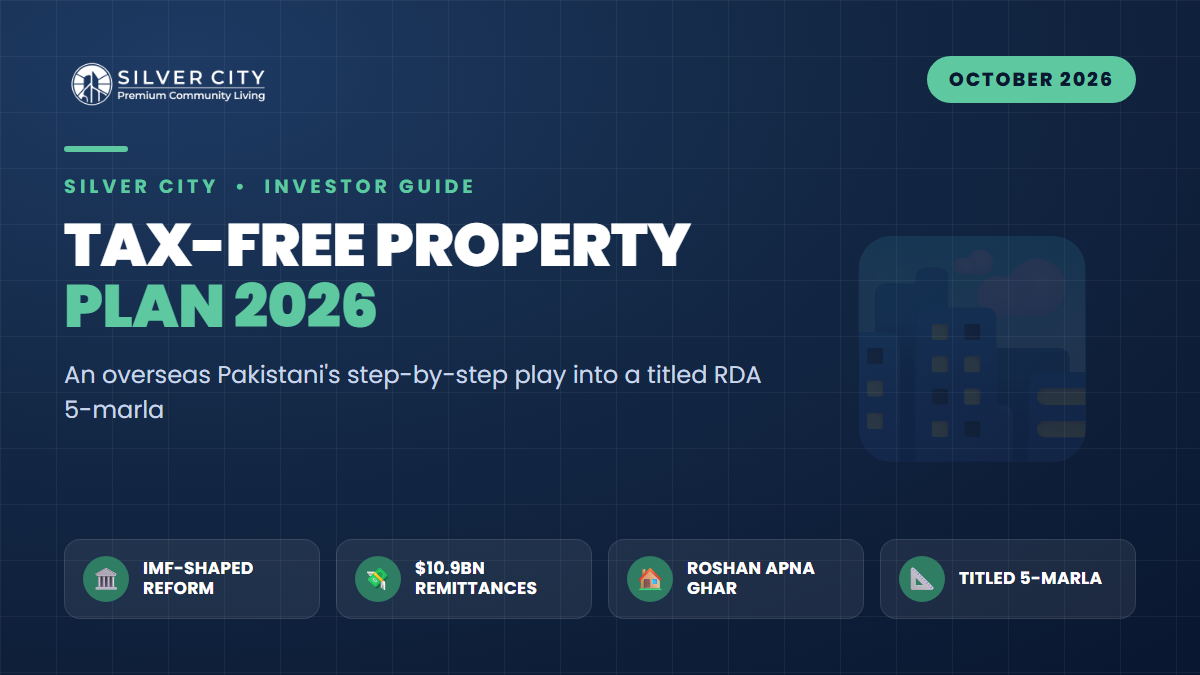
Three forces have lined up in late 2026 that rarely move together: a documentation-friendly tax regime negotiated with the IMF, a fully-repatriable mortgage product built specifically for non-resident Pakistanis, and a record wave of remittances. For an overseas investor who files a Pakistani tax return, this is an unusually clean window to convert foreign-currency savings into a titled, RDA-approved plot — tax-efficiently and with a clear exit.
What actually changed in 2026
On 8 May 2026 the IMF Executive Board completed the third review of Pakistan’s 37-month, roughly $7 billion Extended Fund Facility (EFF), unlocking around US$1.1 billion plus about US$220 million under the Resilience and Sustainability Facility. The reform package the government committed to includes a deliberately documentation-tilted property tax structure — sharply lower rates for filers, minimal relief for non-filers — and mandatory escrow accounts for primary (first-sale) real-estate transactions. Commentators have branded this the “Tax-Free Property Investment Plan 2026,” though the accuracy is in the detail: it is not literally zero tax, it is a regime engineered so that documented, filing investors pay dramatically less.
Meanwhile, remittances hit a record. Workers sent home $10.9 billion in Q1-FY27 (July–September 2026), up roughly 14.7% from $9.5 billion a year earlier, with September alone at about $3.6 billion — Saudi Arabia ($899m), the UAE ($749m), the UK ($515m) and the US ($306m) leading. That liquidity is exactly the fuel this play runs on.
The three transaction taxes you must understand
The whole “tax-free” thesis collapses the moment you buy as a non-filer. Here is the 2026 picture for the two advance taxes (adjustable against your final liability) and capital gains tax (CGT):
| Tax | Who pays | Filer rate (2026) | Non-filer rate |
|---|---|---|---|
| 236K (advance, on purchase) | Buyer | 1.25% flat | 10.5% / 14.5% / 18.5% by value band |
| 236C (advance, on sale) | Seller | 2.75% flat | 11.5% flat |
| CGT (Section 37) | Seller | 15% flat* | Slab rates, min 15% |
*Flat 15% applies to property acquired on or after 1 July 2024. The “late filer” middle tier for 236C/236K has been abolished, so the gap between filer and non-filer is now binary and brutal — a non-filer can pay up to roughly 15× the filer buyer rate. The single highest-ROI action an overseas investor can take is getting onto the Active Taxpayer List (ATL) before executing the deal.
Roshan Apna Ghar: the repatriable financing piece
Roshan Apna Ghar is the State Bank-backed home-finance facility attached to the Roshan Digital Account (RDA). It matters here for one reason above all: free repatriation — funds routed through an RDA can be sent back abroad at any time without SBP approval, so your capital is never trapped. Typical terms across participating banks (HBL, UBL, Meezan, Bank Alfalah, Standard Chartered and others):
- Finance up to 99% of value if savings are kept under lien, or up to 85% against a mortgage.
- Up to Rs 30 million for purchase, Rs 20 million for construction.
- Tenure of 3 to 25 years, with conventional and Shariah-compliant (Diminishing Musharakah) variants.
- Concessional pricing, roughly 1–2% below standard domestic housing-loan rates.
For a 5-marla plot-and-build ambition, you don’t need the full Rs 30m ceiling — but the repatriability and the ATL status that comes with operating through an RDA are what make the tax math work.
The step-by-step play
- Open a Roshan Digital Account. It is fully online, needs no visit to Pakistan, and is the gateway to both repatriable funds and filer status.
- Get on the ATL. File (or register and file) so your name sits on the Active Taxpayer List before any transfer. This alone converts your 236K from double-digit to 1.25%.
- Choose a titled, RDA-approved society — not a file. An unapproved “file” carries no legal title, sits outside the escrow protection the 2026 plan mandates, and is far harder to repatriate cleanly on exit.
- Transact through escrow. For primary sales this is now the standard; insist on it and keep every banking channel traceable so the funds qualify as remittance-sourced.
- Pay via RDA and retain proof. This preserves your ability to repatriate sale proceeds and gains later.
- Hold, then exit as a filer. When you sell, your 236C is 2.75% and CGT a flat 15% — versus a non-filer stack that can exceed 26% in combined friction.
Why a 5-marla, and the numbers
A 5-marla plot is the sweet spot: low enough ticket size to deploy a single quarter’s savings, liquid on resale, and comfortably inside the lowest non-filer value band even if circumstances change. In RDA-approved societies around Rawalpindi, 5-marla residential plots have recently been quoted near Rs 2.55–2.75 million on four-year plans.
| Item | Indicative figure (2026) |
|---|---|
| 5-marla plot price | Rs 2.55–2.75 million |
| Down payment (≈20–25%) | Rs 315,000–400,000 |
| Monthly instalment | ≈ Rs 30,000 over 3–4 years |
| 236K as a filer (1.25%) | ≈ Rs 32,000–34,000 |
| 236K as a non-filer (10.5%) | ≈ Rs 268,000–289,000 |
That last contrast — roughly Rs 33,000 versus Rs 280,000 on an identical plot — is the entire “tax-free” story in one line.
Frequently Asked Questions
Is the 2026 plan really “tax-free”?
No — the label is marketing shorthand. It is a documentation-first regime: filers pay sharply reduced advance taxes (1.25% to buy, 2.75% to sell) and a flat 15% CGT, while non-filers get almost no relief. The “free” only materialises if you are on the ATL and transact through traceable, escrow-backed channels.
Can I get my money back out of Pakistan after I sell?
Yes, if you route funds through a Roshan Digital Account. RDA balances are freely repatriable without prior SBP approval, which is precisely why buying through the RDA/Roshan Apna Ghar framework — rather than informal cash — protects your exit.
Do I have to travel to Pakistan to do any of this?
No. The RDA is opened and operated entirely online, home finance is processed digitally, and reputable RDA-approved developers handle remote booking, transfer and documentation for overseas clients.
Why insist on an RDA-approved, titled plot instead of a cheaper file?
A file is an allocation promise with no legal title; it falls outside the 2026 escrow safeguards and is hard to repatriate or finance. A titled, approved plot gives you clean ownership, mortgage eligibility, escrow protection and a documented paper trail the tax regime now rewards.
The bottom line
The 2026 reforms, repatriable Roshan Apna Ghar financing and record remittance liquidity reward exactly one profile: the documented, filing, titled-asset investor. If you are deploying a quarter’s overseas savings into a 5-marla, prioritise approval and title above a slightly lower sticker price. Silver City, an RDA-approved housing society on Girja Road in Rawalpindi with 5-marla plots in the Rs 2.55–2.75 million range on multi-year plans, is one such titled, approved option worth shortlisting — always confirm current pricing, plan terms and your own tax position directly before committing.