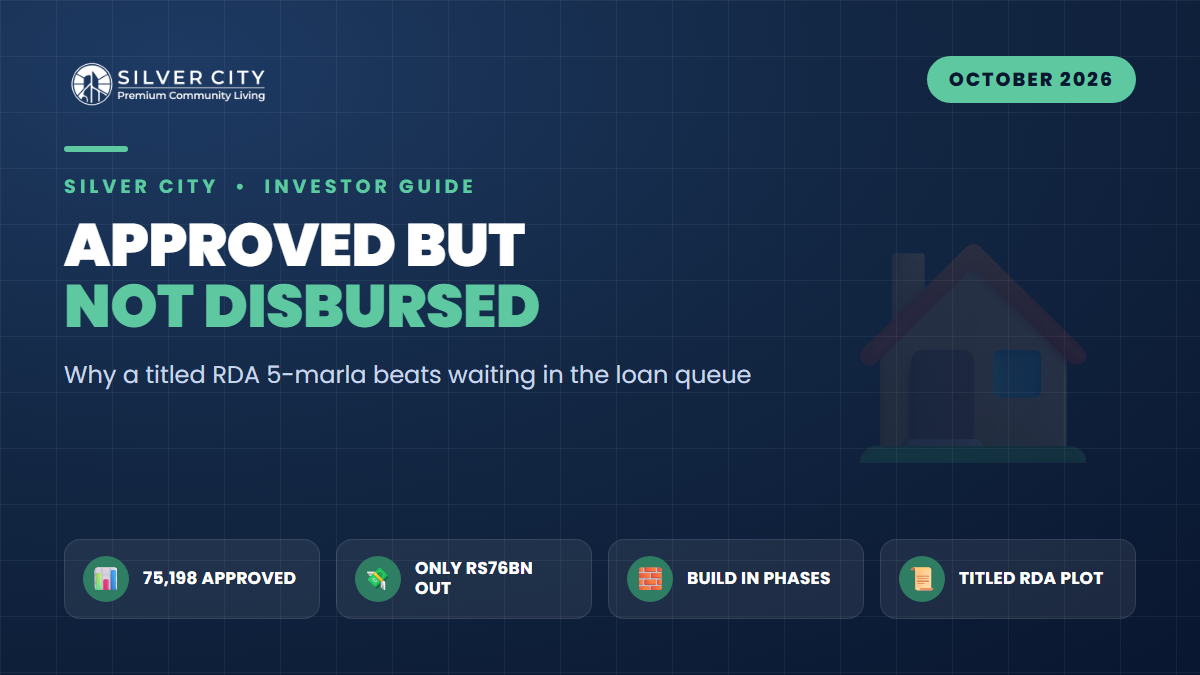
The headline sounds like a housing revolution: under the Prime Minister’s Apna Ghar programme, officials confirmed on 14 October 2026 that 75,198 home loans worth Rs448 billion have been approved. But read the second number in the same briefing and the picture changes — only Rs76 billion has actually been disbursed, to roughly 14,000 beneficiaries. In plain terms, more than 80% of approved applicants are still waiting for money to land, and the disbursed amount is about 17% of what was sanctioned.
For a Pakistani investor, that gap between “approved” and “in my account” is the whole story. This article explains why securing a titled, RDA-approved 5-marla plot you can build in phases is a more reliable wealth path than queuing for subsidised finance — even after the welcome expansion of the loan cap to Rs10 million.
The approval–disbursement gap, in numbers
A loan approval is a promise. Disbursement is cash. The two are separated by property due diligence, mortgage registration, valuation, builder milestones and bank liquidity — and that is where thousands of files are stuck.
| Metric (as reported 14 Oct 2026) | Figure |
|---|---|
| Loans approved | 75,198 |
| Value of approved loans | Rs448 billion |
| Amount actually disbursed | Rs76 billion |
| Beneficiaries who received funds | ~14,000 |
| Approved applicants still awaiting disbursement | ~61,000 (≈81%) |
| Government target for the year | Rs700 billion for 125,000 units |
The government is actively trying to fix the bottleneck. Required documents have been cut from 25 to just five (transfer and possession letter, site plan, mortgage permission letter and mortgage registration), and banks now face a 15 working-day processing cap. Participating banks reportedly include JS Bank, Askari Bank, Allied Bank, Habib Metro, Bank of Khyber and MCB Islamic. These are real improvements — but they speed up approval, not the deeper disbursement and construction-milestone queue.
What the new Rs10 million cap actually changes
In the linked affordable-housing track (Mera Ghar Mera Aashiana), the ECC raised the loan ceiling from Rs3.5m to Rs10 million — an increase of roughly 180% — alongside a fixed 5% end-user mark-up for the first 10 years (the state covers the gap to KIBOR+3%). Eligible unit sizes were widened to about 10 marla / 2,720 sq ft for houses and 1,500 sq ft for flats.
This is genuinely good news for end-users. But note what it does and does not do for an investor:
- It raises your debt, not your certainty. A bigger cap means a bigger mortgage you still have to qualify for, service at 5% (then re-priced), and wait on.
- It targets built units, not raw plots. The subsidy is designed around a completed house or flat — you typically need a ready property or an approved construction arrangement, which pulls you back into the milestone queue.
- It does not shorten the disbursement line. A higher ceiling can actually attract more applicants into the same bottleneck.
The phased-build alternative on a titled RDA plot
Now compare the other route. You buy a titled, RDA-approved 5-marla plot on an instalment plan, take possession of a transferable asset, and build the house in phases as your own cash flow allows — grey structure first, then finishing, room by room. No bank milestone sign-offs, no 15-day (or 15-month) waits, no re-pricing risk after year ten.
At a society like Silver City on Girja Road near the Thalian interchange, a 5-marla plot currently sits in roughly the Rs2.55–2.75 million band on 3–4 year instalment plans, with an indicative monthly instalment near Rs30,000 and a typical structure of 15% booking plus 15% confirmation.
| Factor | Apna Ghar loan queue | Titled RDA 5-marla, phased build |
|---|---|---|
| Approval ≠ cash | ~81% approved still awaiting disbursement | Asset transfers to your name on plan completion |
| Control of timeline | Bank + builder milestones | You set the build pace |
| Entry cost | Down payment + full mortgage liability | ~15% booking (≈Rs0.4m) to start |
| Monthly outflow | ~Rs33,000 over 20 years (indicative, Rs5m) | ~Rs30,000 over 3–4 years, then build |
| Rate risk | 5% fixed 10 yrs, then re-priced | Fixed plot price locked at booking |
| Upside | Capped by subsidised unit rules | Full capital gain on plot + built value |
Why phasing wins for an investor
- You own something immediately. A titled plot is a declarable, saleable, collateral-grade asset from day one — not a pending file.
- Construction is modular. Grey structure, roofing, then finishing can each be funded from salary, rent, or business income over 12–36 months, avoiding a single large debt.
- You keep the whole upside. Plot appreciation plus the value you add by building both accrue to you, not to a subsidised-resale cap.
- You can still use Apna Ghar later. A titled, built property is exactly the kind of collateral the scheme prefers — so you can tap financing from a position of strength, not from the back of the queue.
A sensible hybrid strategy
- Secure a titled RDA 5-marla now on instalments to lock today’s price.
- Complete transfer and get possession — your asset is now declaration-ready.
- Build the grey structure from own funds in phase one.
- Once the structure exists, apply for Apna Ghar financing (up to Rs10m, 5% for 10 years) to finish — now you are a strong, collateralised applicant rather than a paper file waiting on disbursement.
Frequently Asked Questions
Does an approved Apna Ghar loan guarantee I’ll get the money?
No. The 14 October 2026 figures show 75,198 approvals worth Rs448bn but only Rs76bn disbursed to about 14,000 people. Approval is a sanction; disbursement depends on property documentation, mortgage registration, valuation, construction milestones and bank liquidity — which is where most files currently wait.
Does the new Rs10 million cap make the loan route clearly better?
It improves affordability for end-users (bigger ceiling, 5% fixed for 10 years, larger eligible unit sizes), but it does not shorten the disbursement queue and increases your total debt. It is best used to finish a property you already control, not as a substitute for owning a titled asset.
Can I use Apna Ghar financing on a plot I’m still paying in instalments?
The scheme is built around completed or under-construction units with clear title and mortgage-able documents. That’s why securing a titled plot first and building the grey structure makes you a far stronger candidate when you do apply.
How much do I need to start a Silver City 5-marla?
Typically about 15% booking — roughly Rs0.4 million on a plot in the Rs2.55–2.75m band — followed by confirmation and monthly instalments near Rs30,000 over 3–4 years. Confirm current rates and inventory directly with the society before booking.
The bottom line
The Apna Ghar expansion is good policy, but an approval you can’t yet draw is not a house. A titled, RDA-approved 5-marla plot you build in phases gives you an owned asset today, full control of your timeline, and the option to use subsidised financing later from a position of strength. For investors who want certainty over a place in line, Silver City — an RDA-approved society on Girja Road near the Thalian interchange — is an affordable, phase-friendly option well worth considering as the foundation of that strategy.