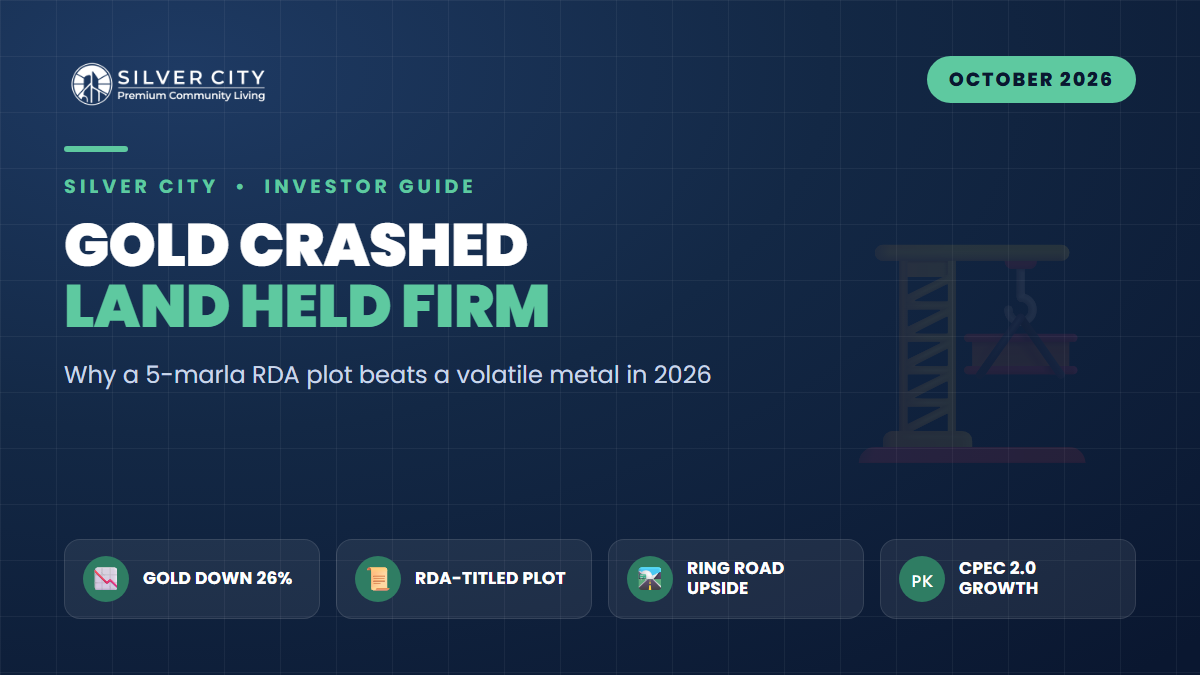
For most of 2025 and early 2026, gold felt like a one-way bet. Then the one-way bet turned. After touching a record near $5,608/oz in January 2026, the metal has retraced hard — trading around $4,164/oz on 19 October 2026, a decline of roughly 26% from the peak. For a Pakistani family that bought near the top in tolas, that is not an abstract chart; it is real rupee capital sitting in a drawdown.
This article is not an argument that gold is worthless. It is an argument about volatility — and about what a conservative Pakistani investor can do with capital that is tired of swinging on Federal Reserve headlines, dollar moves and global risk sentiment. The case here is specific: rotating a portion of drawdown-hit gold into a non-volatile, RDA-titled 5-marla plot on Rawalpindi’s growth corridor, where value compounds on physical infrastructure rather than global mood.
What Actually Happened to Gold in 2026
Gold’s 2026 round-trip is a textbook reminder that “safe haven” and “stable price” are not the same thing. The metal ran to record highs on inflation fears and geopolitical stress, then gave back a quarter of its value in months as sentiment cooled. Below is the recent October trajectory in US-dollar terms.
| Date (2026) | Gold (USD/oz) | Move vs Jan peak (~$5,608) |
|---|---|---|
| Jan (record) | ~5,608 | — |
| 13 Oct | ~4,182 | −25.4% |
| 14 Oct | ~4,095 | −27.0% |
| 16 Oct | ~4,168 | −25.7% |
| 19 Oct | ~4,164 | −25.8% |
For Pakistani buyers there is a second layer of risk. Local tola prices move on both the international ounce and the rupee-dollar rate — so a stable global price can still mean a volatile local price, and vice versa. You are effectively exposed to two markets you do not control. Add dealer spreads, purity disputes, making/wastage charges on jewellery, and the storage and theft risk of holding physical metal at home, and the “simple” asset starts to look complicated.
Why a Titled Plot Behaves Differently
Land on an approved, developing corridor does not reprice every 15 minutes. Its value is anchored to tangible, local drivers: road access, utilities, nearby development, demand from end-users who want to build, and the credibility of the approving authority. These move slowly and tend to move up as infrastructure is delivered — the opposite of a sentiment-driven metal.
The critical word is titled. In the Rawalpindi–Islamabad market, the distinction between an RDA-approved scheme on a sanctioned Layout Plan (LOP) and an unapproved “file” sold on speculation is the difference between an asset and a liability. RDA (Rawalpindi Development Authority) approval means the layout, land use and development standards have been sanctioned — the foundation for a clean transfer and a registered title in your name.
Gold vs an RDA-Titled 5-Marla Plot: Side by Side
| Factor | Physical Gold | RDA-Titled 5-Marla Plot |
|---|---|---|
| Daily price volatility | High (global + PKR/USD) | Low; moves with local development |
| Drawdown in 2026 | ~−26% from peak | Infrastructure-linked, upward bias |
| Income/utility | None | Can build, rent, or self-occupy |
| Storage/security risk | Theft, purity disputes | Registered title; no storage risk |
| Entry size | Any amount | Instalments (booking + monthly) |
| Leverage of public spend | No | Yes — Ring Road, CPEC 2.0 |
The Infrastructure Tailwind: Ring Road and CPEC 2.0
A plot only compounds if something is happening around it. Two forces are converging on Rawalpindi’s western growth belt.
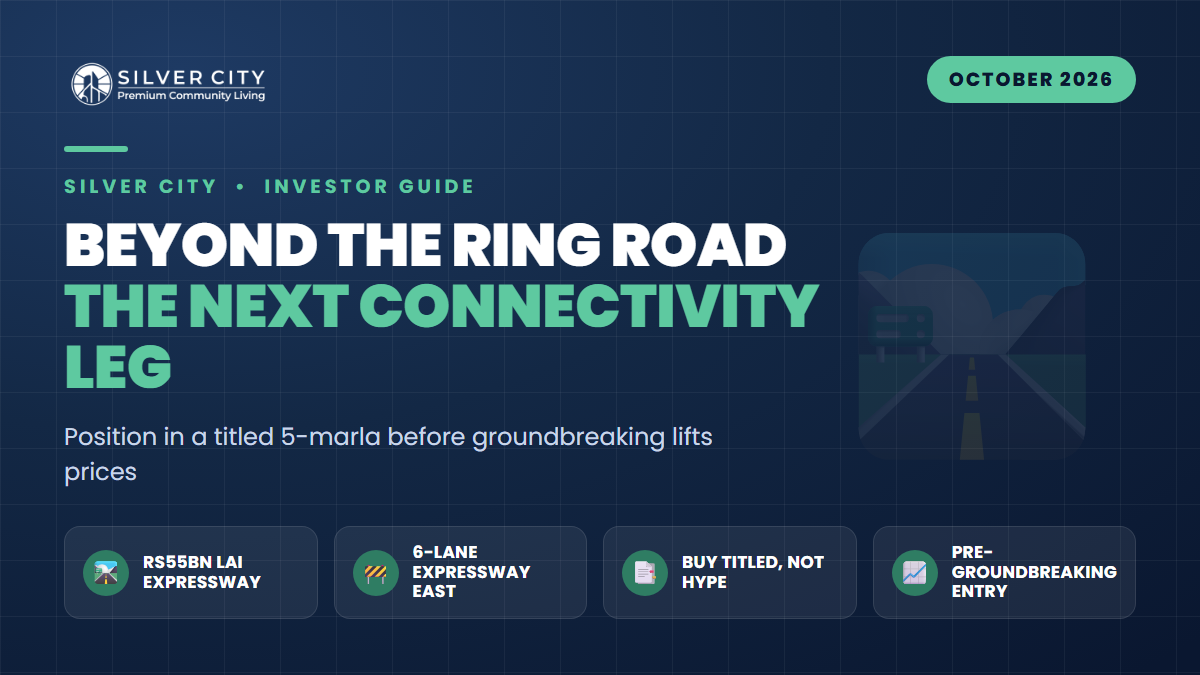
Rawalpindi Ring Road. The 38.3 km corridor is in its final stretch — reported at roughly 99% complete on the main carriageway as of September 2026, with flyovers, interchanges, subways, signage and streetlights in place and toll-plaza and finishing works among the last items before opening to traffic. Once operational, it will divert heavy traffic off GT Road, Peshawar Road and Murree Road, and dramatically improve access to schemes along the Girja Road / Thalian interchange belt. Travel-time reduction is one of the most reliable land-value catalysts in any market.
CPEC 2.0. The second phase has shifted from pure infrastructure toward industry, agriculture, IT and jobs — with the number of Special Economic Zones reported to have surged from seven to 44. More industrial activity in the northern corridor supports population, employment and housing demand around Rawalpindi over the medium term.
A Practical Rotation Plan
You do not need to sell every gram. A measured rotation lets you reduce volatility while keeping some metal exposure.
- Size the drawdown. Calculate how much of your gold was bought above today’s price. That is the capital most exposed to “hope it recovers.”
- Verify before you buy. Confirm the scheme’s RDA approval and NOC status, and that your specific plot number sits on the sanctioned Layout Plan — not just that “the society” is approved.
- Prefer instalments to time entry. A booking-plus-monthly structure lets you deploy gradually rather than in one lump at an uncertain moment.
- Keep a liquidity buffer. Retain some gold or cash for emergencies; property is less liquid than metal, which is a feature for discipline but a constraint in a crunch.
- Get everything in writing. Payment plan, transfer timeline, possession schedule and development charges — documented.
As a reference point, standard 5-marla residential plots in RDA-approved Silver City have been quoted in the region of Rs 2.55–2.75 million, typically on plans of around 15% booking + 15% confirmation + 48 monthly instalments (roughly Rs 30,000/month). Always confirm current pricing and plan terms directly, as these change.
Frequently Asked Questions
Is now a bad time to buy gold if it has already fallen?
Possibly — or it could fall further; nobody controls the next Fed decision or dollar move. That uncertainty is exactly the point. The rotation argument is not “gold will crash more,” it is “I want a meaningful share of my capital in an asset that does not swing on global sentiment at all.” A titled plot removes that variable.
What does “RDA-titled” actually protect me from?
It protects you from buying a speculative “file” in an unapproved scheme that may never be regularised, may face demolition of non-compliant structures, or may be impossible to transfer cleanly. An RDA-sanctioned Layout Plan is the basis for a registered title in your name — the legal substance behind the plot.
Property is illiquid — isn’t gold easier to sell?
Gold is more liquid, yes, and you should keep some for that reason. But illiquidity also enforces discipline: you are far less likely to panic-sell a plot during a scary week than to dump metal at a loss. For long-horizon capital, slower is often safer.
How do the Ring Road and CPEC 2.0 affect my plot’s value?
Both raise accessibility and economic activity around the corridor. A near-complete Ring Road cuts travel time and opens the Girja Road / Thalian belt to more buyers and builders; CPEC 2.0’s industrial and SEZ focus supports jobs and housing demand. Neither guarantees returns, but both are concrete, local drivers — unlike the global forces that move gold.
The Bottom Line
Gold’s 26% round-trip in 2026 is a clean illustration of a metal that can protect and punish within the same year. For Pakistani investors who want their capital to compound on something they can see — roads, interchanges, industrial zones — rather than on overnight sentiment, rotating drawdown-hit holdings into titled land is a rational, conservative move. Among the options on Rawalpindi’s emerging Ring Road corridor, Silver City is an RDA-approved, titled 5-marla scheme worth putting on your shortlist — verify its approval, confirm your plot on the sanctioned Layout Plan, and buy on terms that match your cash flow.
@@HTML@@