A policy window that rarely opens for property buyers
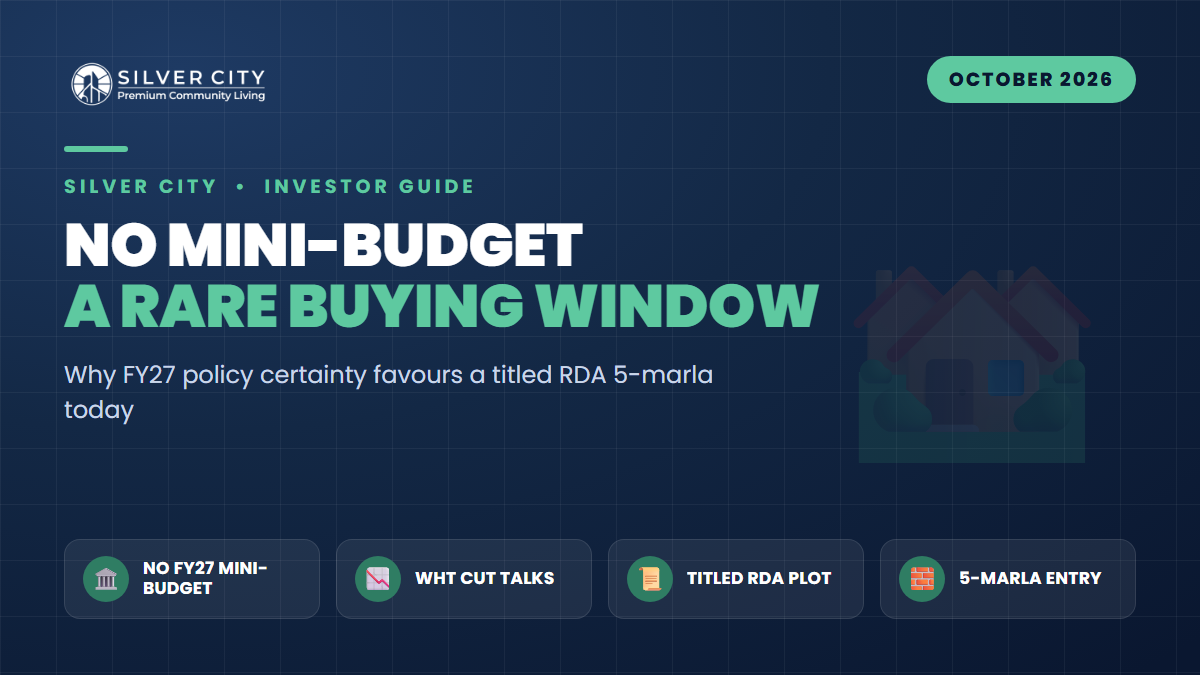
For most of the last three years, Pakistani property investors have planned around a single fear: the mid-year “mini-budget.” Whenever revenue fell short of IMF targets, Islamabad reached for supplementary taxes — and real estate, being visible and easy to tax, was usually first in line. That risk has now eased. Following the latest round of talks concluded in early October 2026, the government has effectively averted a mini-budget for FY27. The Federal Board of Revenue (FBR) met its July–September collection target, revenue growth has run ahead of plan, and officials have signalled that no additional tax measures are required this fiscal year.
At the same time, the FBR has told the National Assembly’s Standing Committee on Finance that it is actively negotiating with the IMF to further reduce withholding tax (WHT) on property transactions under Sections 236C (seller) and 236K (buyer) of the Income Tax Ordinance, 2001. Put those two facts together and you get something unusual in Pakistani real estate: a stretch of months where transaction taxes can realistically only hold or fall — not rise. That asymmetry is the whole argument for acting now.
What actually changed in FY27
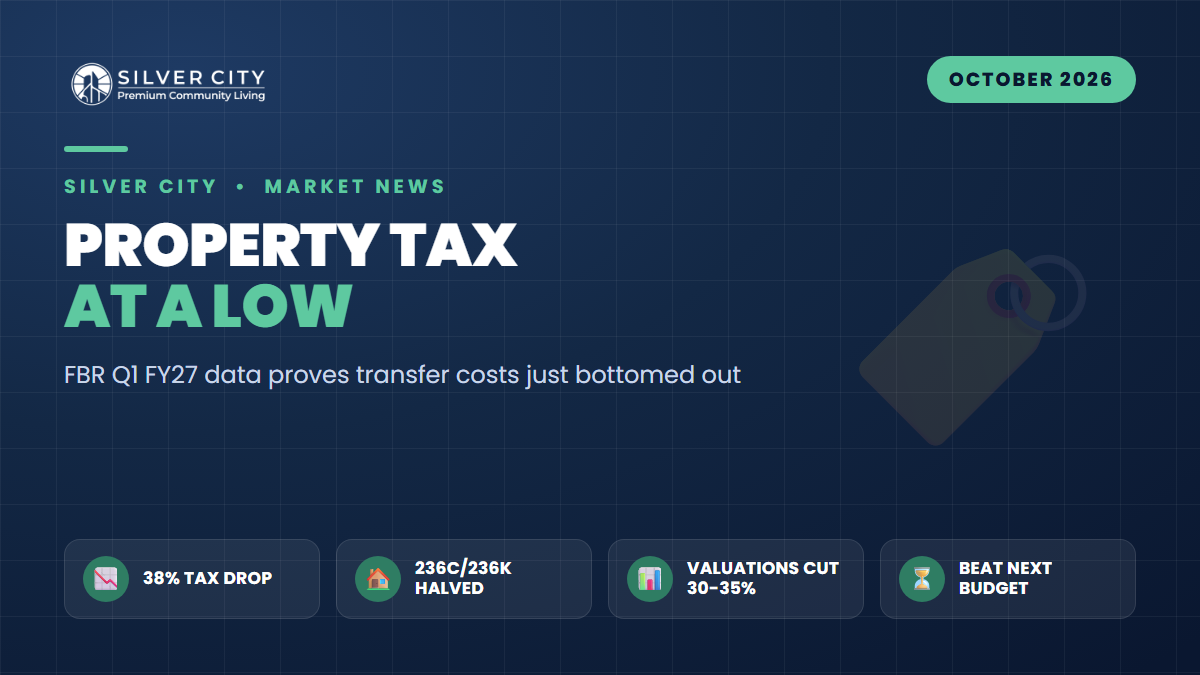
The Finance Act 2026 already simplified property taxation. For a tax filer, the buyer’s WHT under 236K is now a flat 1.25% and the seller’s WHT under 236C is a flat 2.75%, regardless of value. Non-filers pay dramatically more — the buyer slab runs from 10.5% up to 18.5% on the highest-value deals — which keeps the filer advantage enormous. On top of this, the FBR revised down the notified (FBR) valuation tables by roughly 30%–35% across Rawalpindi, Islamabad, Faisalabad, Multan and other cities from 22 April 2026, which mechanically lowered the rupee tax on every transaction even before any rate cut.
The negotiation now underway is about cutting the filer rates further to revive transaction volumes and attract overseas-Pakistani money. The IMF has been cautious and no final figure is agreed. For an investor, the direction of travel matters more than the exact number: you are entering a market where the official posture is relief, not extraction.
Illustrative cost of a titled 5-marla (filer)
| Line item | Basis | On a Rs 2,750,000 plot |
|---|---|---|
| Buyer WHT (236K, filer) | 1.25% flat | Rs 34,375 |
| Stamp duty + registration (Punjab, indicative) | ~3% combined | Rs 82,500 |
| Society transfer / documentation | Fixed, per society schedule | Rs 25,000–45,000 |
| Indicative title-transfer overhead | — | ~Rs 1.4–1.6 lakh |
Figures are indicative for a filer and will vary with the final deed value, locality and the society’s own schedule; a non-filer would pay many times the WHT shown. The point is scale: on a 5-marla at today’s valuations, the entire transaction-tax layer is modest — and shrinks further if the FBR secures its cut.
Why a 5-marla, and why titled
The 5-marla plot (125 sq yd) is the workhorse of the twin-cities market. It is the entry ticket for salaried buyers, the easiest size to resell, and the standard unit under affordable-housing and bank financing schemes. In RDA-approved Rawalpindi societies, standard 5-marla residential plots currently trade in roughly the Rs 2.0–3.5 million band, with entry-level corridor plots around Rs 2.55–2.75 million on 36–48 month instalment plans.
The word that must not be skipped is titled. A plot’s safety comes from its paperwork, not its brochure. Before moving money, confirm:
- RDA approval / NOC status — the layout is sanctioned by the Rawalpindi Development Authority, not merely “approval pending.”
- Allocation/intimation and a clean transfer letter in the society’s register against the exact plot number.
- FBR filer status for both parties, so you pay 1.25% not the non-filer slab.
- No dispute or double-sale — verify the plot physically exists on the ground and is not sitting under a right-of-way or amenity reservation.
A titled, RDA-cleared 5-marla is a liquid, bankable asset. An un-approved file is a lottery ticket, and the tax window does nothing to protect you from a bad title.
Why “idle rupees” is the real risk
With the rupee broadly stable and the policy rate easing through 2026, cash parked in a savings account is quietly losing ground to inflation, and gold — after a sharp run — carries its own volatility. Land in a growth corridor has historically absorbed rupee erosion while you wait. The FY27 setup adds a timing edge on top of that: lower notified valuations, flat filer WHT, an active push to cut it further, and no mini-budget hanging over the year. These conditions do not usually arrive together, and they do not last — once transaction volumes recover, both prices and the government’s appetite for relief tend to reverse.
How the window could play out
| Period | Likely state of play | Investor read |
|---|---|---|
| Now – Q2 FY27 | No new taxes; WHT cut under negotiation; valuations still revised-down | Best entry: lock price and title |
| Mid FY27 | Possible WHT reduction confirmed; sentiment improves | Early buyers benefit from lower entry price |
| Late FY27 onward | Volumes recover, prices firm up | Window narrows; entry costs rise |
Frequently Asked Questions
Has the property withholding tax already been cut for FY27?
Not yet. The Finance Act 2026 set flat filer rates of 1.25% (buyer, 236K) and 2.75% (seller, 236C), and the FBR has told parliament it is negotiating a further reduction with the IMF. No final cut is agreed, so treat today’s rates as the ceiling you are planning around — any change is expected to lower them, not raise them.
What does “no mini-budget for FY27” mean for me as a buyer?
It means the government has signalled it will not introduce new supplementary taxes this fiscal year after meeting its first-quarter revenue target and concluding IMF talks. For property, the recurring mid-year risk of a surprise transaction tax has receded — giving you a rare stretch of policy certainty to transact in.
Why does being a filer matter so much on a 5-marla?
The gap is enormous. A filer buyer pays 1.25% under 236K; a non-filer pays a slabbed rate that starts around 10.5% and climbs to 18.5% on high-value deals. On any plot, becoming an active filer before you transact is the single cheapest way to protect your return.
Is an RDA-approved plot really safer than a cheaper un-approved file?
Yes. RDA approval means the layout is legally sanctioned, which protects resale value, enables bank financing, and sharply reduces the risk of demolition, double-sale or disputed title. A lower sticker price on an un-approved file usually reflects that hidden risk, not a bargain.
The takeaway
FY27 has handed Pakistani property investors something they rarely get: certainty that taxes won’t rise this year, plus a live effort to cut them further — all while FBR valuations sit 30–35% below their old levels. In that window, the disciplined move is to convert idle, inflation-exposed rupees into a titled, liquid, entry-level asset. Among RDA-approved options on the Rawalpindi Ring Road corridor, Silver City — an NOC-cleared society on Girja Road near the Thalian interchange, offering 5-marla plots on multi-year instalment plans — is one worth shortlisting and verifying for yourself before the window narrows.