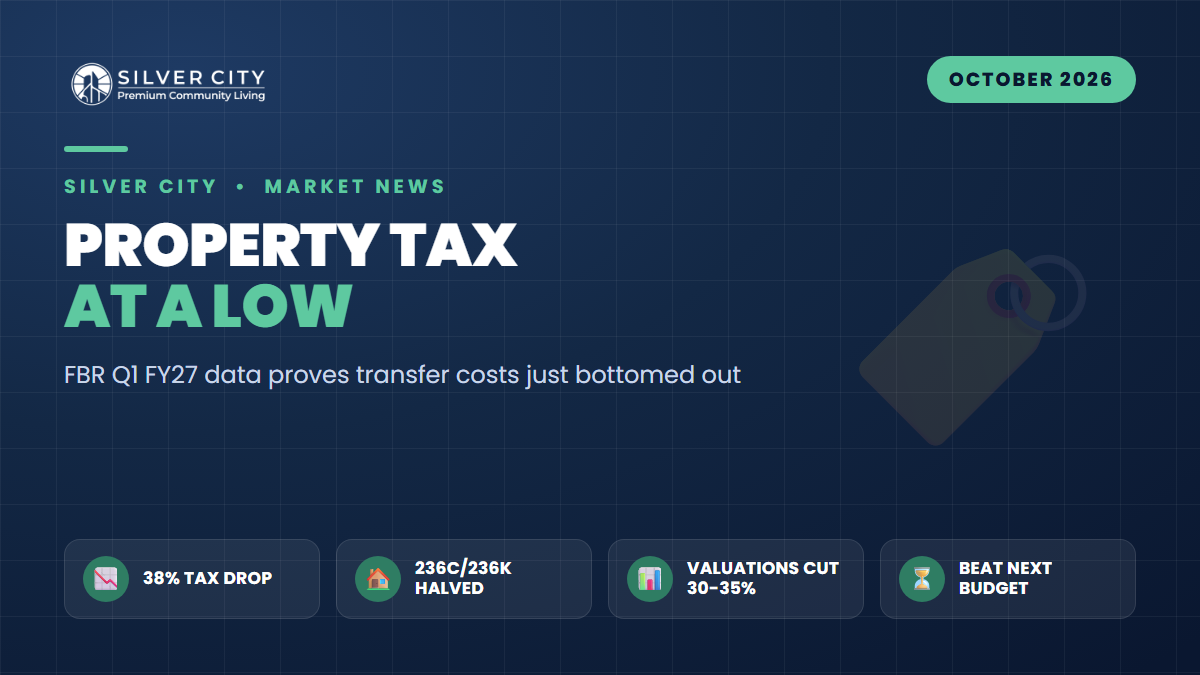
For three years, high transaction taxes froze Pakistan’s property market. In the first quarter of FY27 (July–September 2026), the numbers finally confirmed what buyers had been waiting to hear: the cost of transferring a titled plot has collapsed. According to Federal Board of Revenue (FBR) data, income-tax collection from the real-estate sector fell 38% year-on-year to Rs35.2 billion, a drop of roughly Rs22 billion versus the same quarter last year.
That headline looks like bad news for the exchequer — but for an investor eyeing a 5-marla plot in an RDA-approved society in Rawalpindi, it is the clearest possible signal that the cost to buy and transfer is at a multi-year low right now. Here is what changed, what it saves you in rupees, and why the window may not stay open past the next budget.
What the FY27 Budget Actually Changed
The sharp fall in collection is not because fewer people are transacting — it is because the government deliberately slashed the tax rates and the values those rates apply to. Three changes in the Finance Act 2026 (effective 1 July 2026) drove the decline:
- Advance tax on purchase (Section 236K) cut sharply. The buyer’s advance tax moved to a low tiered scale (roughly 0.5%–1.25% for active taxpayers, depending on the value band), down from the 2.5%+ that filers routinely paid before.
- Advance tax on sale (Section 236C) consolidated to a low flat rate of around 2.75% for sellers, roughly half the top 5.5% band that applied in the prior regime.
- FBR valuation tables revised down 30%–35%. Because 236C and 236K are charged on the FBR-notified value (or the declared value, whichever is higher), cutting the valuation base reduces the tax even where the percentage is unchanged — a double discount.
On top of this, the Capital Value Tax (CVT) on the holding of foreign assets was abolished, a direct relief for overseas Pakistanis repatriating funds into property. The FBR’s own breakdown shows the mechanism clearly: advance tax collected on property sales shrank 42% to Rs23 billion, while collections on purchases fell 31% to Rs12.2 billion.
What It Saves You on a Titled 5-Marla
The table below is an illustrative comparison for a titled 5-marla plot transacted at Rs5,000,000 by a filer (active taxpayer). Your actual figures depend on the FBR-notified value for the specific society and the current value band, so treat this as a directional guide, not a quotation.
| Cost component | Old regime (FY26) | New regime (FY27) | Approx. saving |
|---|---|---|---|
| 236K advance tax (buyer, filer) | ~2.5% = Rs125,000 | ~1.25% = Rs62,500 | Rs62,500 |
| 236C advance tax (seller, filer) | ~5.5% = Rs275,000 | ~2.75% = Rs137,500 | Rs137,500 |
| Effect of 30–35% lower FBR valuation base | Full base | Reduced base | Compounds the above |
| Combined buyer + seller tax | ~Rs400,000 | ~Rs200,000 | ~Rs200,000 |
On a single modest 5-marla transaction, a buyer and seller together are saving on the order of Rs200,000 in federal advance tax alone — before you even factor in the lower valuation base, which can shave tens of thousands more off stamp duty and registration where those are also value-linked. For a Rs10 million file, the absolute saving roughly doubles.
A Note on Filer vs Non-Filer Status
These low rates are the filer rates. Non-filers and late-filers still face substantially higher advance tax and, in many bands, restrictions on purchasing above certain thresholds. The single highest-return move before any transaction remains getting your name on the Active Taxpayer List (ATL) — it is the difference between paying the headline low rate and a multiple of it.
Why the Window May Be Temporary
Pakistan’s tax policy is set annually in the June federal budget, and the FY27 cuts were explicitly designed to revive a stalled sector. The problem for policymakers is visible in the very data that benefits you: a Rs22 billion hole in one quarter. When the FBR misses its annual target — as revenue shortfalls tend to force — property transaction taxes are historically one of the first levers pulled back up, because they are easy to administer and politically low-cost.
That makes the current setup a classic policy-driven window:
- Rates are low now because the government chose stimulus over collection.
- Valuations are low now because the tables were just revised down.
- Both can be reversed in a single budget line next June, and the 30–35% valuation cut in particular is the kind of concession that is quietly clawed back.
If you have been sitting on the fence waiting for “the right time,” the FY27 data is the right time, documented in the government’s own numbers. Transacting before the FY28 budget (June 2027) locks in today’s low transfer cost on a titled asset.
How to Act Without Getting Burned
- Insist on a titled, RDA-approved plot. The tax savings only matter on a property you can actually transfer in the registrar’s office. Unapproved or litigation-prone files carry risks that dwarf any tax saving.
- Confirm the current FBR valuation for the exact society and phase before you sign — the 30–35% cut varies by location.
- Verify ATL status for both parties and time the transfer while you are an active filer.
- Keep the banking trail clean — route the full consideration through banking channels to satisfy source-of-funds rules, especially for overseas remitters benefiting from the CVT relief.
Frequently Asked Questions
Is the 38% drop in tax collection bad for property prices?
No — the drop reflects lower tax rates and valuations, not falling demand. Lower transaction friction typically supports prices and liquidity over time, because more buyers can afford to enter and sellers can exit without a punishing tax bill.
Do these low rates apply to non-filers too?
The low 236K/236C figures quoted here are filer (ATL) rates. Non-filers pay significantly higher advance tax and face purchase restrictions in higher value bands. Register as a filer and appear on the ATL before transacting to capture the full benefit.
Will the cuts definitely be reversed next year?
Nothing is guaranteed, but tax relief tied to a specific stimulus — and costing Rs22 billion a quarter — is historically among the first measures revised when the FBR faces a revenue shortfall. Treat the current rates as a window, not a permanent setting.
Why does a 5-marla plot make sense in this window?
A 5-marla titled plot is the most liquid, most financeable entry size in Rawalpindi–Islamabad. The lower the ticket, the more end-buyers can afford it, so it transacts fastest — exactly what you want when the goal is to buy low on tax now and resell cleanly later.
The Bottom Line
The FY27 FBR data is rare hard evidence rather than sales talk: transfer taxes on titled property are genuinely at a multi-year low, driven by halved 236C/236K rates, a 30–35% valuation cut, and the abolition of CVT on foreign assets. If you have been planning to buy, doing it in this fiscal year — before the next budget potentially revises rates back up — meaningfully lowers your entry cost. For investors looking at a titled, RDA-approved 5-marla in Rawalpindi, Silver City on the Islamabad side of the GT Road corridor is one such RDA-approved option worth shortlisting, letting you convert today’s tax window into a clean, transferable asset.