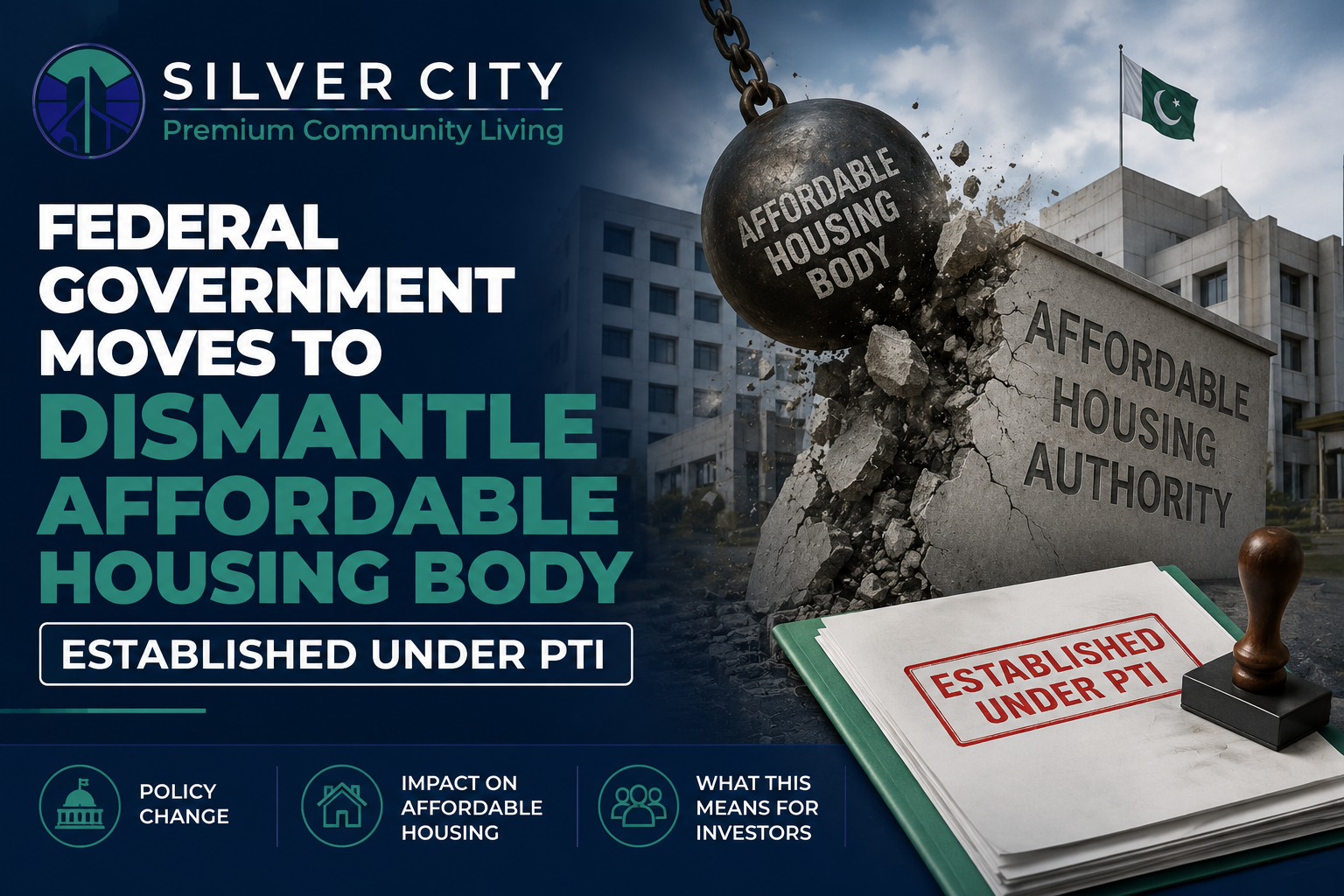
The federal government is pressing ahead with plans to abolish the Naya Pakistan Housing and Development Authority (NAPHDA), after the Federal Cabinet formally endorsed a proposal to wind the body down as part of its ongoing institutional rightsizing drive. The move sets in motion a legislative process to repeal the NAPHDA Act, 2020 — the law that brought the authority into existence during Imran Khan’s tenure as prime minister.
What Was NAPHDA?
Established through an Act of Parliament in 2020, NAPHDA was designed to tackle Pakistan’s long-standing affordable housing deficit by planning, building, and overseeing residential projects for lower-income segments of the population. Under the legislation, the sitting prime minister was named patron of the authority, underscoring the political weight the initiative carried at the time of its launch.
How the Dissolution Decision Unfolded
The process leading to this outcome began following the departure of NAPHDA’s chairman. When officials first raised the question of appointing a replacement in February 2023, the prime minister stepped in and directed that the authority present a full performance and progress report to the Economic Coordination Committee (ECC) before any leadership decision was made.
After receiving the briefing, the ECC asked NAPHDA to produce a comprehensive business plan in close coordination with the Capital Development Authority (CDA) and the Finance Division. The matter was subsequently referred to the Cabinet Committee on Rightsizing, which examined it thoroughly before recommending that the authority be wound up. The Federal Cabinet formally approved that recommendation on April 9, 2026.
A draft NAPHDA (Repeal) Act, 2026 — cleared by the Law and Justice Division — has since been drawn up and is awaiting parliamentary consideration.
A Look at What NAPHDA Delivered
Despite the controversy surrounding its closure, NAPHDA leaves behind a measurable footprint. The authority rolled out projects across several cities — including Islamabad, Lahore, Sargodha, Chiniot, and Nowshera — with a combined target of constructing roughly 122,507 housing units through partnerships spanning both the public and private sectors.
Working alongside the Akhuwat Foundation, the authority helped develop close to 28,000 housing units. A further 31,000-plus units were facilitated through individual financing arrangements under the Mera Pakistan Mera Ghar scheme, which offered subsidised loans to eligible homebuyers.
The authority also collaborated with the Workers Welfare Fund, CDA, the Federal Government Employees Housing Authority (FGEHA), and development bodies in Punjab and Khyber Pakhtunkhwa on additional residential schemes.
On the financing side, government-backed schemes channelled approximately Rs. 120 billion in housing loans through private commercial banks by June 2022 — a figure that represented a notable shift towards greater private sector involvement in Pakistan’s housing finance market. The programme was later put on hold during the caretaker government’s tenure.
What Comes Next: PM’s Apna Ghar Programme
The dissolution of NAPHDA runs parallel to a broader reorientation of the government’s housing strategy. Authorities say the focus is now shifting to the recently unveiled Prime Minister’s Apna Ghar Programme, which aims to extend affordable homeownership through concessional financing and subsidised loan mechanisms — a model that differs in structure from NAPHDA’s project-based approach.
Officials have been at pains to stress that closing the authority does not signal a retreat from affordable housing as a policy priority. They argue that new financing instruments and updated policy tools will carry the agenda forward, even as the institutional vehicle that once drove it is being dismantled.