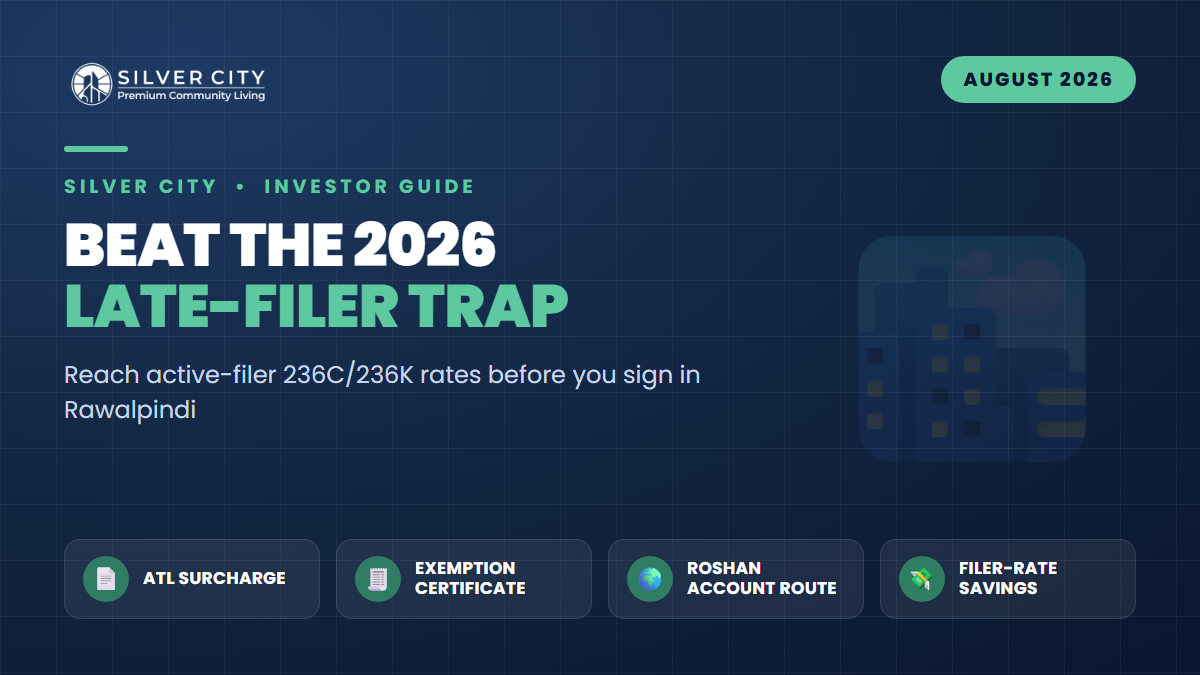
Most Rawalpindi buyers know there are two withholding taxes on a property deal: 236K on the purchaser and 236C on the seller. What far fewer understand in 2026 is that “I filed my return” is no longer enough to unlock the cheapest rate. The Income Tax Ordinance now recognises a distinct middle tier — the late filer — and if you filed even one day after the deadline, FBR can load an elevated 236K/236C on your transfer, sitting well above the active-filer rate and only just below the non-filer penalty.
For an investor buying in an RDA-approved scheme, this is a six-figure mistake that is entirely avoidable if you fix your status before the transfer is executed at the society office or sub-registrar. Here is exactly how the trap works and the concrete steps to escape it.
Filer, Late-Filer, Non-Filer: Three Tiers, Not Two
Pakistan’s tax system now sorts every buyer and seller into three buckets:
- Active filer — return filed by the due date and name appearing on the Active Taxpayer List (ATL). Lowest rates.
- Late filer — return filed, but after the deadline. Technically a filer, but penalised with elevated property-tax rates for that cycle.
- Non-filer / non-ATL — not on the list at all. Highest, banded rates.
Under the Finance Act 2026 the government simplified the headline slabs: the buyer’s 236K is now a flat 1.25% for anyone on the ATL, whatever the property is worth, and the seller’s 236C is a flat 2.75% for filers. Non-filers, by contrast, face banded rates that climb to roughly 10.5%–18.5% on 236K and around 11% on 236C. The late filer lands in between — meaningfully above the flat filer rate but below the non-filer ceiling.
What the Trap Costs on a Real Rawalpindi Purchase
Consider a buyer purchasing a plot with a declared/FBR value of PKR 20 million (2 crore) in an RDA-approved society off Girja Road or the Adiala corridor. The buyer’s 236K alone moves like this:
| Status | 236K (buyer) | 236C (seller) | Buyer’s 236K on PKR 20m |
|---|---|---|---|
| Active filer | 1.25% (flat) | 2.75% (flat) | PKR 250,000 |
| Late filer | Elevated (between filer & non-filer)* | Elevated* | ~PKR 700,000+ (illustrative) |
| Non-filer / non-ATL | ~10.5% (value ≤ 50m) | ~11% | PKR 2,100,000 |
*Exact late-filer percentages are set by FBR’s notified rate card and should be confirmed for your slab and transfer date before signing.
The punchline: the gap between active-filer and late-filer status on a single mid-size plot can be several hundred thousand rupees — yet the cost to fix the status is a fraction of that. That asymmetry is the whole reason to act before the deal.
The ATL Surcharge Route (Resident Buyers)
If you missed the return deadline, you are not permanently locked out. Section 182A lets you restore ATL status by paying a late-filing surcharge alongside your return. The catch for 2026: that surcharge was sharply increased with effect from 1 July 2026 — from PKR 1,000 to PKR 25,000 for an individual (PKR 50,000 for AOPs and PKR 100,000 for companies).
Even at PKR 25,000, this is trivial next to the property-tax gap above. The steps:
- File the overdue return for the relevant tax year through the FBR IRIS portal.
- Generate a PSID and pay the PKR 25,000 Section 182A surcharge.
- Confirm your name appears on the ATL — the list is refreshed and your active status must be live before the transfer is recorded.
- Time the deal. Execute the transfer only once ATL reflects active status, so the collecting authority applies the 1.25%/2.75% rate.
Important nuance that keeps this a “trap”: restoring ATL status through the surcharge does not always erase the late-filer classification for that cycle. Where the elevated rate still applies, the cleanest fix is to be an on-time active filer next cycle — so plan your purchase timing around the return calendar, not the other way round.
The Exemption-Certificate Route
Buyers with genuine grounds — including non-residents and those whose income is already taxed or exempt — can approach the Commissioner Inland Revenue for a certificate under the relevant exemption provisions. Filed through IRIS with supporting documents (CNIC/NICOP/POC, proof of funds, non-resident evidence), an approved certificate instructs the withholding agent to collect at the reduced rate or nil, rather than the default higher slab. Allow lead time: verification is not instant, so start weeks before your intended transfer date.
The Overseas Roshan-Account Route
This is the strongest option for the Rawalpindi diaspora buyer. FBR policy allows non-resident Pakistanis holding a valid NICOP or POC to pay 236C/236K at active-filer rates even if they are not on the ATL — provided the purchase is routed through official banking channels, specifically a Roshan Digital Account (RDA) or other documented non-resident account. Steps:
- Open an RDA with a participating bank (fully remote; NICOP/POC based).
- Remit the purchase funds into the RDA so the payment is traceable through banking channels.
- Present NICOP/POC and RDA proof to the withholding agent/society so filer-rate 236K is applied.
- Keep evidence of non-resident status and the banking trail for any later FBR verification.
The result: an overseas investor sidesteps both the non-filer penalty and the late-filer trap without needing to be on the ATL at all.
Timeline: When to Act
| Step | Ideal timing before transfer |
|---|---|
| File return / clear late-filing surcharge | 3–4 weeks |
| Confirm live ATL status | 1–2 weeks |
| Apply for exemption certificate (if used) | 3–6 weeks |
| Open RDA & remit funds (overseas) | 2–4 weeks |
| Execute transfer at active-filer rate | Day 0 |
The annual return deadline is 30 September 2026. Filing on or before that date is the single cheapest way to guarantee active-filer treatment for the cycle — no surcharge, no late-filer premium.
Frequently Asked Questions
I already filed my return — why am I still charged a higher 236K?
Because filing late puts you in the “late filer” tier, not the active-filer tier. The collecting authority reads your status at the moment of transfer; if you filed after the deadline, the elevated rate can still apply for that cycle even though you are technically a filer.
Does paying the PKR 25,000 ATL surcharge instantly give me filer rates?
It restores your ATL (active) status, which is essential. But in cases where the separate late-filer classification still attaches for the year, the reduced flat rate may not fully apply until you are an on-time filer. Confirm your exact status with a tax adviser and check the live ATL before signing.
I’m an overseas Pakistani with no Pakistani return — can I still get filer rates?
Yes. With a valid NICOP or POC and the purchase routed through a Roshan Digital Account or documented non-resident banking channel, FBR allows 236C/236K at active-filer rates even without ATL membership.
What if the deal is urgent and I can’t wait for ATL to update?
Either delay the transfer date until active status is live, or pursue an exemption certificate / RDA route. Paying the non-filer or late-filer rate “to be safe” usually costs far more than the few weeks of waiting.
The Takeaway
In 2026 the difference between active-filer and late-filer status can swing your Rawalpindi withholding tax by hundreds of thousands of rupees, while the fix — an on-time return, a PKR 25,000 surcharge, an exemption certificate, or an RDA remittance — costs a small fraction of that. Sort your status before you sign, never after. If you are choosing where to deploy that capital, an RDA-approved society like Silver City (silvercity.pk) keeps your documentation clean and your transfer compliant — a sound base from which to buy at the correct, active-filer rate.
@@END@@