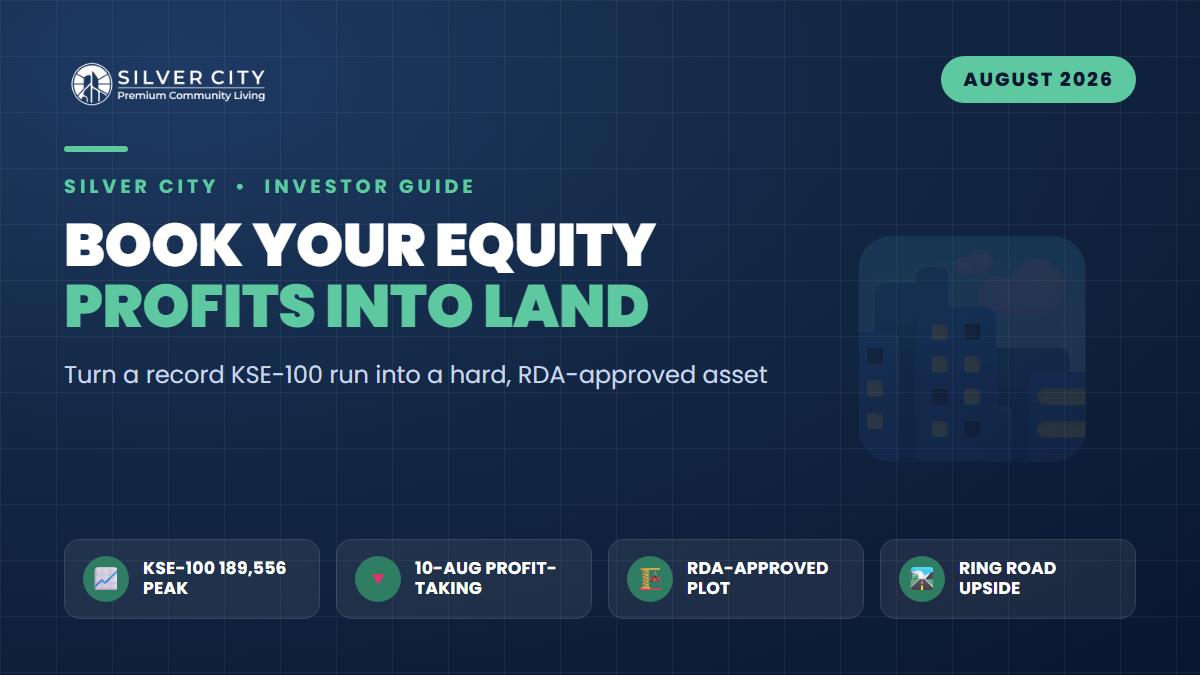
On the trading session that ended 10 August 2026, the KSE-100 slipped to around 180,886 points, off roughly 0.30% as investors booked profits after the benchmark had printed a fresh all-time high of 189,556. Over the trailing twelve months the index is still up close to 65% (64.89%)—an extraordinary run that has quietly made many Pakistani equity holders far richer on paper than they realise.
Paper is the operative word. A gain you have not booked is a loan the market can call back at any time. The healthy, unemotional question after a year like this is not “how high can it go?” but “what portion of this windfall should I move into something that cannot gap down 3% before lunch?” For a growing number of Rawalpindi–Islamabad investors, the answer is a hard asset: an RDA-approved Rawalpindi plot.
Why a Record High Is the Right Time to Talk About Rotation
Rebalancing is not market-timing. Nobody is asking you to call the top or exit equities entirely—the KSE-100’s structural story (falling policy rates, a stabilising rupee, and improved external buffers) remains intact. Rotation is simply refusing to let one asset class balloon into an unplanned overweight. When a single sleeve of your net worth rises 65% in a year, its share of your portfolio has swelled well beyond your original plan, and with it your risk.
The discipline is straightforward: skim the gain, not the principal. Book a defined slice of your realised profit—say 20–30%—and redeploy it into an asset whose return driver is completely different from the stock market’s. Land in a well-located, approved society answers to population growth, infrastructure, and construction demand, not to daily foreign-flow sentiment or a single quarterly result.
The correlation argument in plain terms
- Different clock: Equities reprice by the second; developed land reprices by the development milestone—an interchange opening, a possession announcement, a utilities roll-out.
- No margin call: A plot cannot be liquidated against you overnight in a panic. Volatility that terrifies leveraged traders simply does not reach it.
- Inflation pass-through: Pakistani land has historically tracked or beaten inflation over multi-year holds, protecting the purchasing power of a booked gain.
A Simple Framework: Turning Booked Gains Into Ground
Below is an illustrative way to think about redeploying a realised KSE-100 profit into plot options in the Rawalpindi corridor. Figures are indicative of publicly advertised 2026 plans and should be confirmed with the developer before you commit.
| Plot size | Indicative total price | Booking / down payment | Monthly instalment | Best suited to |
|---|---|---|---|---|
| 3.5 Marla | ~PKR 18.95 lac | ~PKR 2.0 lac | ~PKR 20,000 | First entry; small booked profit |
| 5 Marla | ~PKR 15–19 lac | ~PKR 3.75 lac | ~PKR 22,900 (3-yr) | Core residential hold |
| 10 Marla | On request | Tiered | 4-year plan | Larger rotation; family home |
| 1 Kanal | On request | Tiered | 4-year plan | End-user villa; higher ticket |
The instalment structure matters here. You do not need to liquidate your entire equity gain in one go. A common disciplined approach is to use the booked profit to cover the booking plus a buffer of instalments, then let ongoing income or staggered future profit-taking service the balance—keeping the rest of your capital compounding in the market.
Why the Rawalpindi Corridor, Specifically
The single biggest driver reshaping plot values north-west of Rawalpindi is the Rawalpindi Ring Road (RRR)—a roughly 38–40 km, six-lane corridor running from GT Road near Rawat to the Thalian Interchange near Islamabad International Airport, with RDA as the principal stakeholder. As of mid-2026 the project has advanced to hand-over to the Punjab government, with several interchanges (Banth, Chak Beli Khan, Adiala, Chakri) reported complete or near-complete and the Thalian interchange sequenced into a later phase.
Interchanges behave like price anchors: they compress travel time and make movement predictable, which pulls commercial and mixed-use demand toward them once access turns reliable. Land sitting near Thalian therefore captures a double premium—existing motorway and airport proximity today, plus the anticipated RRR connectivity as the network completes.
The three checks before you deploy a rupee
- Approval status: Buy only where the layout is RDA-approved. Approval protects you from the demolition and no-transfer risk that plagues illegal schemes.
- Location logic: Prioritise access—distance to a working interchange, the airport, and main arteries like Girja Road—over glossy renderings.
- Developer delivery: Look for evidence of on-ground development (roads, boundary, utilities), a clear possession timeline, and a transfer process you can verify at the society office.
Managing the Real Risks—Honestly
Land is not magic. It is illiquid: you cannot sell a Marla the way you sell 50 shares, and an exit can take weeks or months. File and transfer paperwork must be verified independently, not taken on a dealer’s word. Instalment plans assume you can sustain the monthly outflow even if life changes—so size the commitment to income, not to optimism. And “RDA-approved” applies to specific, named phases; always confirm the exact block you are buying is inside the approved boundary. None of these are reasons to avoid land—they are reasons to buy carefully, which is precisely the mindset that a disciplined profit-rotation demands.
Frequently Asked Questions
Should I sell all my KSE-100 holdings to buy a plot?
No. This is about rebalancing, not exiting. The index’s medium-term story remains constructive. The disciplined move is to book a defined slice of your gains—commonly 20–30%—and redeploy that into a hard asset, while leaving your core position invested to keep compounding.
Is a plot really safer than stocks after a 65% year?
“Safer” is the wrong frame—it is different. Land carries its own risks (illiquidity, paperwork, developer delivery) but its return driver is uncorrelated with daily equity sentiment, and it cannot be margin-called or gap down overnight. Holding both smooths the ride of your overall net worth.
Why does RDA approval matter so much?
RDA approval is your legal shield. Approved layouts are far less exposed to the demolition, sealing, and blocked-transfer risks that unapproved schemes face. It also supports resale value and financing, because future buyers demand the same assurance you should.
How does the Rawalpindi Ring Road affect plot prices near Thalian?
Completed interchanges compress travel time and anchor demand. As the RRR network and the planned Thalian interchange come online, well-located approved plots in that catchment stand to benefit from improved access and commercial pull—an upside that trades on a different timeline than the stock market.
The Wrap-Up
A near-65% year and a fresh 189,556 peak, followed by 10-August profit-taking, is exactly the kind of moment that separates disciplined investors from lucky ones. Booking a portion of that windfall into ground you can walk on is not pessimism about equities—it is prudence about concentration. For that rotation, an RDA-approved, instalment-friendly society in the high-growth Thalian corridor is worth shortlisting, and Silver City—RDA-approved, positioned near the Thalian Interchange and Islamabad International Airport with 3.5, 5, 10 Marla and 1 Kanal options on multi-year plans—is one such option worth evaluating on its own merits. Verify the phase, the paperwork, and your own cash-flow before you commit, then let a paper gain become a permanent asset.