Pakistan Just Changed How Petrol Is Priced — Here’s Why Plot-Holders Should Care
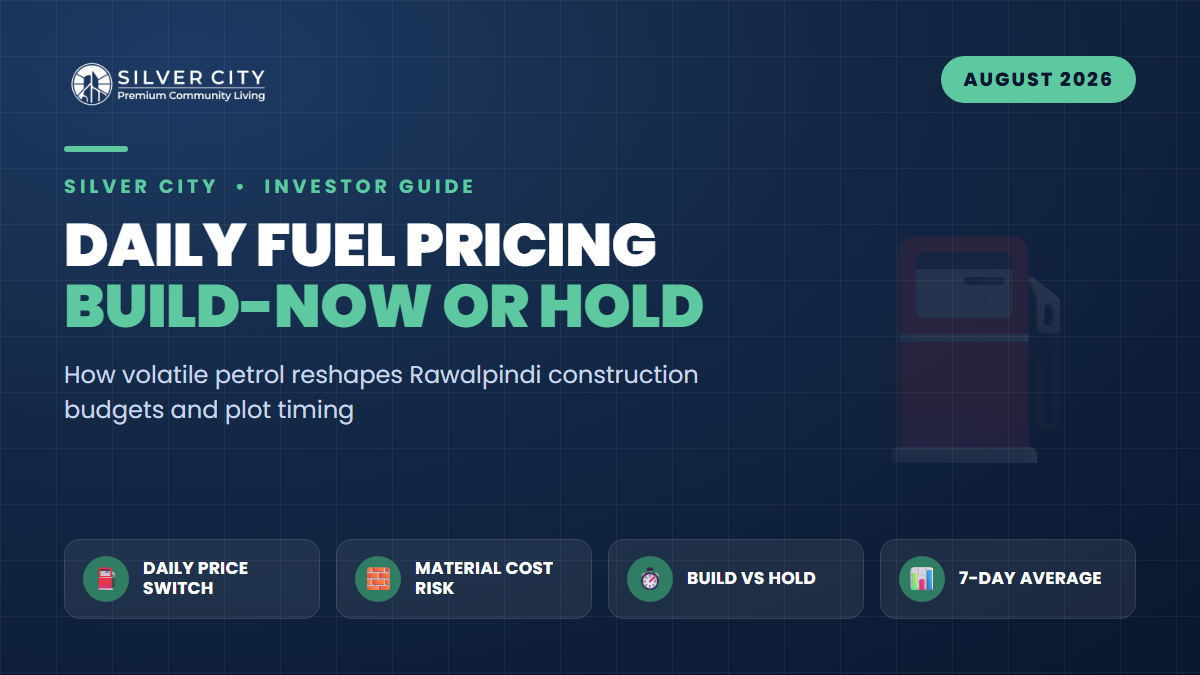
For years, Pakistanis budgeted around a familiar rhythm: fuel prices moved once a fortnight, usually announced on a Friday evening. As of August 2026, that rhythm is gone. Following federal cabinet approval, the Oil and Gas Regulatory Authority (OGRA) now revises petroleum prices on a daily basis, publishing ex-depot rates on its website each day without prior approval from the Prime Minister or the federal government.
The new formula uses a seven-day rolling average of international refined-product prices — specifically the Platts Arab Gulf assessments for Motor Spirit (MS-92 RON) and High-Speed Diesel (HSD 10 ppm) — combined with freight and the rupee-dollar exchange rate. For a Rawalpindi plot-holder weighing whether to start construction now or hold the plot, this is not a headline to skim past. Diesel powers the trucks, mixers, and generators behind every bag of cement and every tonne of steel delivered to your site. When fuel moves daily, so does the delivered cost of building.
From Friday Certainty to Daily Drift
The switch does not, by itself, make fuel more expensive. A seven-day rolling average is designed to smooth spikes, passing international changes through gradually rather than in one shock. The real change is frequency and predictability. Under the old system you knew your diesel cost was locked for roughly two weeks; you could time a bulk material order around a known number. Now the number drifts a little most days.
To put recent movement in context, petrol settled around Rs 327.62 per litre effective 8 August 2026, after a Rs 2.20 cut — and the days around it saw a Rs 4.45 rise and separate diesel cuts of Rs 1.50–2.00. Small individual moves, but they now arrive continuously. For a self-build stretched over six to nine months, that continuous drift is what quietly erodes a fixed budget.
How Fuel Volatility Reaches Your Construction Budget
Diesel is embedded in construction costs in three layers, and daily pricing touches all of them:
- Freight to site: Rawalpindi already carries a freight differential over Lahore — retail cement can run Rs 50–150 per bag higher here purely on transport. Volatile diesel widens that gap unpredictably.
- Manufacturing pass-through: Cement and steel plants run on energy. Sustained fuel rises feed into ex-factory prices weeks later.
- On-site machinery: Concrete mixers, generators (essential during load-shedding), and pumps all burn diesel directly.
Here is where a mid-2026 Rawalpindi budget roughly sits, so you can see what a fuel-driven swing does to it:
| Material | Typical unit rate (2026) | Rawalpindi note |
|---|---|---|
| Cement (OPC) | Rs 1,430–1,550 / 50 kg bag | Rs 50–150/bag above Lahore on freight |
| Steel (rebar) | Rs 235–252 / kg | Bulk delivery sensitive to diesel |
| Bricks (A/C class) | Rs 14,000–18,000 / 1,000 | Kiln fuel + cartage exposure |
| Petrol (reference) | ~Rs 327.62 / litre (8 Aug 2026) | Set daily via 7-day average |
A 10-marla grey structure consuming, say, 2,000 cement bags and 8–10 tonnes of steel can see its material bill swing by several hundred thousand rupees across a build cycle if fuel-linked costs drift 5–8% — precisely the kind of drift daily pricing makes routine rather than exceptional.
Build Now vs. Hold: A Timing Framework
The daily regime does not deliver a single verdict; it sharpens the questions. Use this decision guide:
- If your design and finances are ready — lean toward building now. Volatility rewards those who can lock costs. Fix your cement and steel quantities, negotiate delivered (not ex-factory) rates, and buy the volatile bulk items — cement, rebar, bricks — early in the cycle rather than in monthly dribs.
- If you are still 6–12 months from readiness — hold the plot, not the cash. A Rawalpindi plot in an RDA-approved scheme is itself an inflation hedge; land typically appreciates while your rupees do not. Holding is the disciplined choice when you cannot yet control build execution.
- If you are mid-construction — shorten your exposure window. Front-load material procurement, keep a 7–10% fuel-contingency buffer in the budget, and phase generator-heavy work to avoid peak-price stretches.
The underlying principle: daily pricing punishes long, loosely-budgeted builds and rewards tightly-scoped, quickly-executed ones.
Practical Tactics to Blunt the Volatility
- Get written, dated, delivered quotes valid for a fixed window — push suppliers to absorb short-term diesel drift, not you.
- Bulk-order the diesel-sensitive materials together to consolidate freight rather than paying cartage repeatedly.
- Track OGRA’s daily rate the way you’d track a currency — a sustained upward trend is a signal to accelerate procurement.
- Contract labour and materials separately so a contractor cannot pad a lump sum with a hidden fuel margin.
- Keep a contingency line of 7–10% specifically for fuel-linked cost creep.
Frequently Asked Questions
Does daily petrol pricing mean construction will definitely get more expensive?
Not automatically. The seven-day rolling average smooths spikes and can pass on decreases just as quickly as increases — petrol was actually cut to around Rs 327.62 in early August 2026. The bigger effect is unpredictability, which makes fixed long-term budgets harder to hold than the price direction itself.
Should I delay buying a plot until fuel prices stabilise?
Delaying a plot purchase and delaying construction are different decisions. Land in an RDA-approved scheme generally appreciates and hedges inflation, so holding a plot is rarely the losing move. It is the build timing — not the land purchase — that the daily fuel regime should influence most.
How much should I budget as a fuel-cost buffer?
For a typical Rawalpindi self-build, a 7–10% contingency on the material and transport portion of your budget is prudent under daily pricing. Lock delivered rates early and buy the diesel-sensitive items (cement, steel, bricks) in bulk to shrink the exposure that buffer has to cover.
Where can I check the official daily rate?
OGRA publishes ex-depot petroleum prices on its official website (ogra.com.pk), typically updated at midnight PST. Treat it as a live input to your procurement calendar rather than a once-a-fortnight event.
The Bottom Line
OGRA’s move to daily, seven-day-average pricing rewards investors who plan tightly and act decisively. If you’re build-ready, lock your costs and move; if you’re not, hold your land and prepare. Either way, owning the right plot first is what gives you the freedom to time the build well. A plot in an RDA-approved society such as Silver City combines that regulatory security with steady appreciation potential — making it a genuinely sensible base from which to navigate a more volatile construction market. As always, reconfirm current material and fuel rates before finalising any order.