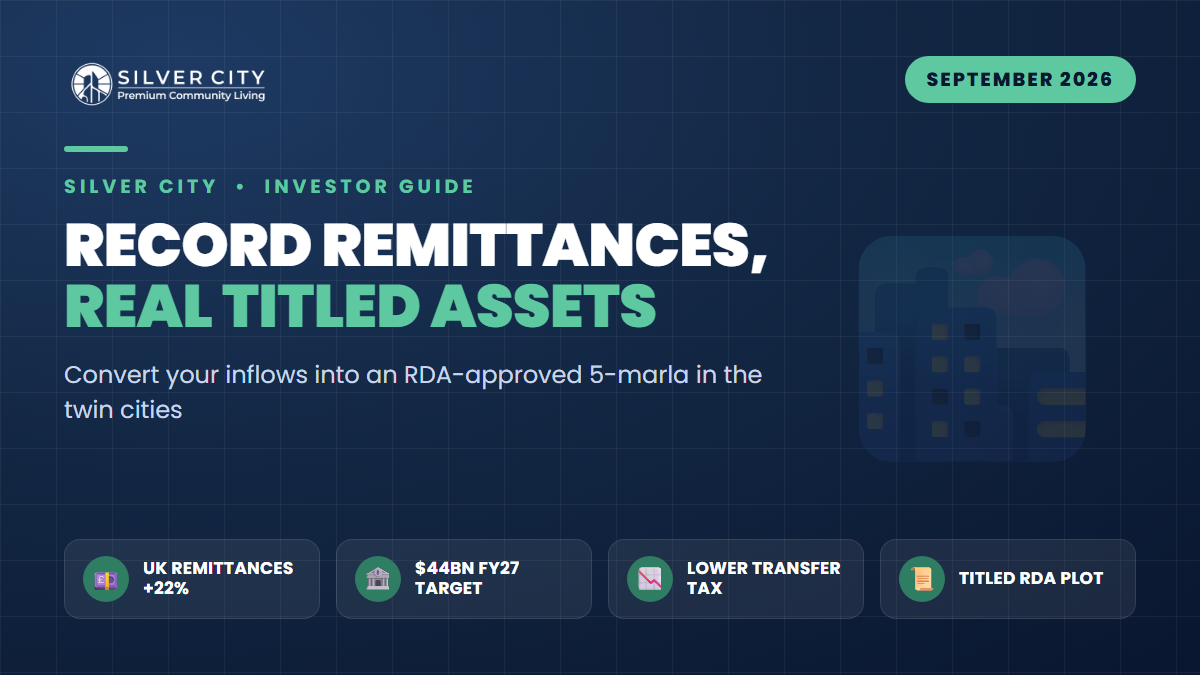
Pakistan opened FY27 with a headline number that grabbed every finance desk: workers’ remittances reached a record $7.3 billion in July–August 2026, up from $6.4 billion a year earlier — a 14.7% year-on-year rise. July delivered roughly $3.63 billion and August $3.66 billion, with the August figure alone up 16.5% YoY. Topline Securities projects full-year FY27 remittances near $43.7 billion.
That inflow is a national lifeline for the current account. But for the individual overseas Pakistani sending it, the harder question is personal: where does that money actually end up? A growing share lands in Roshan Digital Account (RDA) balances and Naya Pakistan Certificates (NPCs) — instruments that are excellent for yield and liquidity, but that remain, by design, freely repatriable cash. That is exactly the “can Pakistan keep diaspora long-term capital?” debate: money that can leave tomorrow is not the same as money anchored in the ground.
The Debate: Liquid Balances vs. Anchored Capital
By August 2026, cumulative RDA inflows had reached about $13.9 billion across 900,000+ accounts. Of that, roughly $2.13 billion has already been repatriated back out, while about $8.77 billion was utilised inside Pakistan. In other words, a meaningful slice of diaspora money treats Pakistan as a high-yield parking lot, not a home for long-term wealth.
NPCs currently pay attractive rates — roughly 11.75–12.75% on PKR tenors and 6.75–7.75% on USD tenors across 13 participating banks. Those returns are real. But three risks sit underneath them for a long-horizon investor:
- Rupee erosion: PKR-denominated coupons can be outrun by currency depreciation over multi-year horizons.
- Reinvestment risk: When a certificate matures, prevailing rates may be far lower.
- No asset accumulation: A matured certificate returns cash — not a deed, not a house, not a build-ready plot in a growth corridor.
A titled, RDA-approved plot flips that logic. It is a hard asset in your name, it can compound through corridor development (roads, interchanges, utilities), and — critically — the RDA channel now explicitly supports residential and commercial real-estate transactions for non-resident Pakistanis, keeping the whole flow documented and legal.
A 5-Step Framework: Surge to Title
- Split the surge, don’t spend it. Treat your remittance/RDA balance in two buckets: a liquid reserve (emergency + short-term needs) that stays in NPCs, and a “conversion tranche” earmarked for a hard asset.
- Size the target. A 5-marla plot in an RDA-approved Rawalpindi society is the sweet spot for diaspora budgets — small enough to buy outright or on a short instalment plan, liquid enough to resell.
- Verify approval before you wire. Confirm the society and the specific block are RDA-approved and that the file has a clean chain of title. This is where documented RDA payments protect you.
- Pay through the RDA rail. Route the purchase from your RDA so the transaction is traceable, tax-compliant, and repatriable if you ever exit — you keep the flexibility NPCs gave you, but now attached to an asset.
- Take possession and get the title transferred. The endgame is an intiqal/registry transfer in your name — not just an allotment letter. Titled possession is what converts “balance” into “wealth.”
The Numbers: What a Conversion Tranche Buys
Using current Rawalpindi market listings on the Girja Road / Thalian corridor, here is how a modest slice of a two-month remittance surge maps to real plots:
| Option | Indicative Price (PKR) | Approx. USD* | Best For |
|---|---|---|---|
| 3.5 Marla plot | ~1.8–2.1 million | ~$6,400–7,500 | First entry / lowest ticket |
| 5 Marla plot | ~2.55–2.75 million | ~$9,100–9,800 | Core diaspora sweet spot |
| 10 Marla plot | ~4.8–5.5 million | ~$17,000–19,600 | Family home / larger build |
| 1 Kanal plot | ~10.35 million | ~$37,000 | Premium / long hold |
*Illustrative conversion near PKR 280/USD; verify the live interbank rate on your transaction date. Prices are market listings and shift with corridor progress.
Many RDA-approved societies also offer 4-year instalment plans (monthly outlays in the low tens of thousands of rupees), so a single month’s remittance can comfortably cover a down payment plus several instalments — without touching your NPC reserve.
Timeline: Turning This Quarter’s Inflow Into a Deed
| Stage | Action | Typical Window |
|---|---|---|
| Weeks 1–2 | Open/activate RDA; confirm balance and remittance credit | Same week |
| Weeks 2–4 | Shortlist RDA-approved society, verify block approval & title | 2–3 weeks |
| Weeks 4–6 | Book plot, pay down payment via RDA, sign agreement | 1–2 weeks |
| Months 2–48 | Instalments (if applicable), then possession & title transfer | Per payment plan |
Why the Twin-Cities Corridor Fits This Moment
Rawalpindi’s Girja Road / Thalian Interchange belt sits near the New Islamabad International Airport and the developing Ring Road network. RDA (Rawalpindi Development Authority) approval matters here because it is the single best guard against the “file society” traps that have burned unwary overseas buyers. Approval means the layout, land, and utilities are regulated — the difference between an asset that appreciates and a dispute that drains your remittance gains.
Frequently Asked Questions
Is buying property through an RDA better than just holding Naya Pakistan Certificates?
They serve different goals. NPCs (11.75–12.75% PKR / 6.75–7.75% USD) are ideal for liquid, repatriable yield. A titled RDA-approved plot is for long-term, inflation-resistant wealth accumulation in your name. Most disciplined investors keep a liquid NPC reserve and convert a separate tranche into a hard asset — you don’t have to choose only one.
Can I legally pay for a plot using my Roshan Digital Account?
Yes. The RDA framework now supports residential and commercial real-estate transactions for non-resident Pakistanis. Paying through the RDA keeps the purchase documented, tax-compliant, and repatriable if you later sell — a major advantage over informal cash routes.
Why insist on an RDA-approved society specifically?
RDA approval confirms the society’s land, layout, and no-objection status with the Rawalpindi Development Authority. It sharply reduces the risk of illegal layouts, disputed land, or stalled possession — the most common losses overseas buyers face. Always verify approval for the exact block, not just the society name.
How much of my remittance surge should I convert into property?
There’s no fixed rule, but a common approach is to keep 6–12 months of needs plus an emergency buffer liquid in NPCs, then earmark a defined “conversion tranche” for a hard asset. A 5-marla plot’s modest ticket size — often coverable via a down payment and 4-year instalments — makes it a low-stress first conversion.
Wrap-Up
A record $7.3 billion in two months proves the diaspora’s earning power. The unanswered question is whether that capital stays — and the honest answer depends on individual choices, not slogans. Idle, repatriable balances are easy to withdraw; a titled plot in a regulated corridor is not. If you want the FY27 surge to become durable wealth rather than a number that flows back out, an RDA-approved option like Silver City on the Girja Road / Thalian corridor is worth serious consideration — verify the block’s approval and title, pay through your RDA, and finish with a deed in your name.