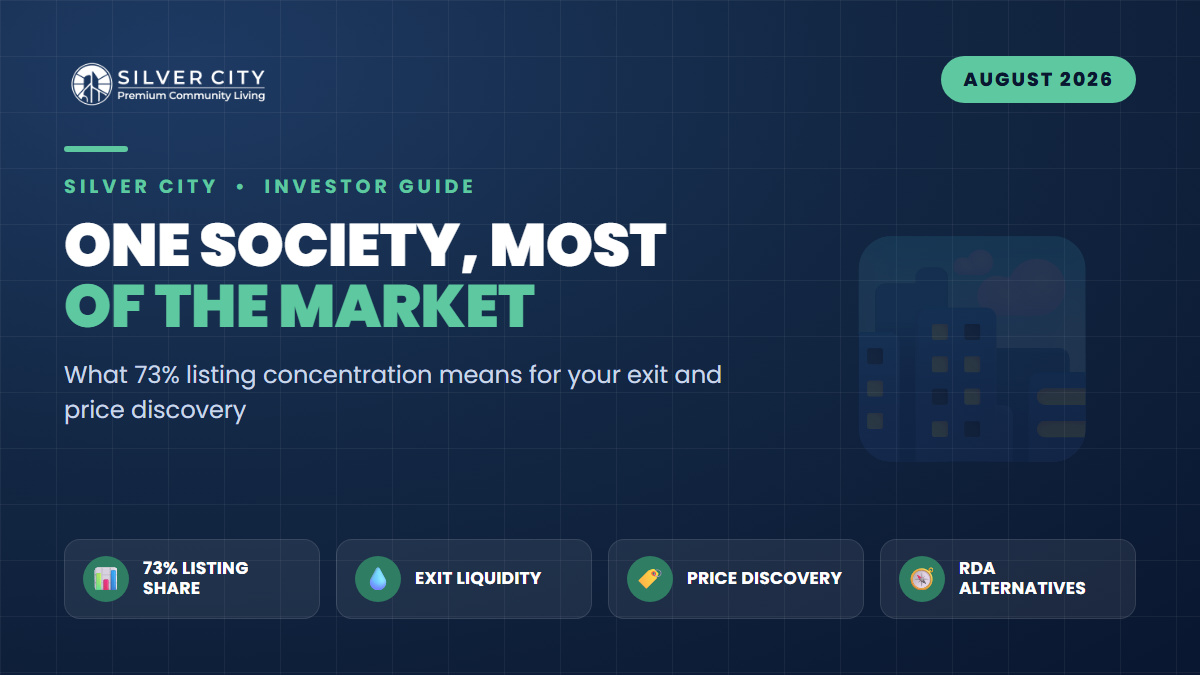
Walk into any property portal and filter for plots in Rawalpindi, and one name floods the screen: Bahria Town. Industry watchers estimate that Bahria Town accounts for roughly 73% of all active plot listings in the Rawalpindi market. That is not a small quirk of one website’s inventory — it is a structural feature of how this city’s real estate trades. For an investor, that single statistic reshapes two things that matter more than any brochure: how easily you can sell (exit liquidity) and how confidently you can price (price discovery).
This article unpacks what listing concentration actually does to your money, and when an emerging RDA-approved society becomes the smarter play — or the riskier one.
Why Listing Concentration Is a Liquidity Story
Liquidity is simply how fast you can convert a plot back into cash without slashing the price. In a market where one society dominates listings, liquidity behaves very differently depending on which side of the fence your plot sits.
Inside Bahria Town, the sheer volume of buyers, dealers, and standardised plot sizes means there is almost always a counterparty. A 10 Marla plot in a developed sector can change hands in days because the market is deep and transfer procedures are well-oiled. That depth is the upside of concentration — you are trading a near-commodity.
Outside Bahria Town, the picture flips. A new or thinly-listed society may have genuinely good fundamentals, but if only a handful of plots are on the market, buyers are scarce and your exit can take months. The paradox is important: concentration gives Bahria owners liquidity, while making liquidity harder to find everywhere else — because attention, dealers, and buyer traffic pool where the listings already are.
Concentration and Price Discovery
Price discovery is the process by which a market agrees on what an asset is worth. It works best when there are many independent transactions. Bahria Town’s listing dominance is a double-edged sword here.
- The good: With thousands of listings and published price indices, Bahria plots have transparent, observable benchmarks. You can look up a sector’s per-Marla rate and know roughly where you stand.
- The bad: When one developer sets the tempo, “market price” can drift toward asking prices rather than closing prices. Listing rates on portals are aspirational; actual deal values after negotiation are often lower, and that gap widens in a slow market.
- The blind spot: Emerging societies have thin transaction data, so their “price” is whatever a dealer quotes. That makes entry cheaper but valuation fuzzier — you are buying on projected, not proven, value.
Reading the Numbers
The clearest way to see the trade-off is to line up a mature Bahria plot against an early-stage RDA-approved society. The figures below reflect publicly listed ranges in late 2025 and are indicative, not fixed quotes — always verify current rates before booking.
| Factor | Bahria Town (developed phase) | Emerging RDA society (e.g. Silver City) |
|---|---|---|
| 10 Marla entry price | ~Rs. 75 lac and up | Roughly Rs. 30–45 lac range |
| 1 Kanal indicative price | ~Rs. 1.5 crore+ (up to several crore in prime phases) | Substantially lower, early-development pricing |
| Payment terms | Mostly full/lump-sum resale market | Instalments (Silver City: ~42 monthly, ~4 years) |
| Listing depth / buyer pool | Very deep — easy to sell | Shallow — slower resale |
| Price transparency | High (published indices) | Low (dealer-quoted) |
| Upside potential | Incremental | Higher if development delivers |
The Case for the Mature, Concentrated Play
If your priority is capital protection and a reliable exit, buying into the concentrated market has real merit. You accept a higher entry price and thinner future upside in exchange for:
- Guaranteed liquidity — a deep buyer pool means you rarely get stuck.
- Transparent pricing — you can benchmark against thousands of comparable listings.
- Delivered infrastructure — roads, utilities, and amenities already exist, removing development risk.
This suits investors with a shorter horizon, lower risk tolerance, or a need to liquidate on demand.
The Case for the Emerging RDA-Approved Society
The smarter-bet scenario appears when three conditions line up: the entry price is meaningfully lower, the location is on a genuine growth corridor, and — critically — the society holds proper regulatory approval from the Rawalpindi Development Authority (RDA). Approval is the single most important filter, because it separates a genuine value play from a speculative trap.
When those boxes are ticked, the emerging society can outperform. Lower entry prices and instalment plans mean less capital locked up per plot, and appreciation from a low base can beat the incremental gains of a saturated society — provided development actually delivers. That last clause is where the risk lives.
Where the Emerging Bet Turns Risky
- Approval gaps: Societies operating without full RDA sanction, or on partial NOCs, expose you to legal and demolition risk. Always verify status directly with the RDA.
- Development delay: Instalment societies depend on the developer completing infrastructure on schedule. Slippage kills both amenity value and resale demand.
- Thin exit: Until a society matures, you may not find a buyer quickly. Enter only with capital you can leave parked for years.
A Practical Framework
Match the asset to your goal rather than chasing either extreme:
- Need liquidity within 12–24 months? Favour the concentrated, developed market — you are buying an exit, not just a plot.
- Investing for 4–7 years with patient capital? A verified RDA-approved emerging society can compound value from a lower base.
- Want balance? Split your allocation — anchor part in a liquid, developed society and place a measured bet on an approved emerging one on a growth corridor.
Frequently Asked Questions
Does Bahria Town really hold 73% of Rawalpindi’s plot listings?
That figure is a widely-cited market observation reflecting Bahria Town’s dominance of active listings on major portals. Exact percentages shift with the data source and date, but the direction is clear: no other single society comes close to its listing volume, which is why it functions as the market’s default liquidity pool.
Is a lower entry price in an emerging society always a better deal?
No. A low price only becomes a good deal if the society is RDA-approved, sits on a real growth corridor, and the developer delivers infrastructure on time. Without those, cheap can stay cheap — or become unsellable. Cross-check approval and on-ground development before committing.
How do I verify a society’s RDA approval?
Confirm the layout-plan and NOC status directly through the Rawalpindi Development Authority rather than relying on marketing material. Ask specifically whether the exact phase or block you are buying in is included in the approval, since approvals can be partial.
What is the biggest liquidity mistake new investors make?
Buying a plot they can’t exit. Investors often chase the lowest price without asking who will buy it from them later. In a concentrated market, always weigh resale depth alongside price before you book.
Wrap-Up
Bahria Town’s roughly 73% listing share tells you the Rawalpindi market prices and trades around one gravity well. Sometimes riding that gravity — buying into deep liquidity and transparent pricing — is the wise move. Other times the smarter, if bolder, bet is a lower-entry, RDA-approved society positioned on a real growth corridor. Among the emerging options worth studying, Silver City — an RDA-approved society near the Thalian Interchange and Rawalpindi Ring Road corridor, offering 3.5, 5, 10 Marla and 1 Kanal plots on roughly four-year instalment plans — is one candidate for the patient, approval-first investor. As always, verify current prices and approval status before you commit your capital.