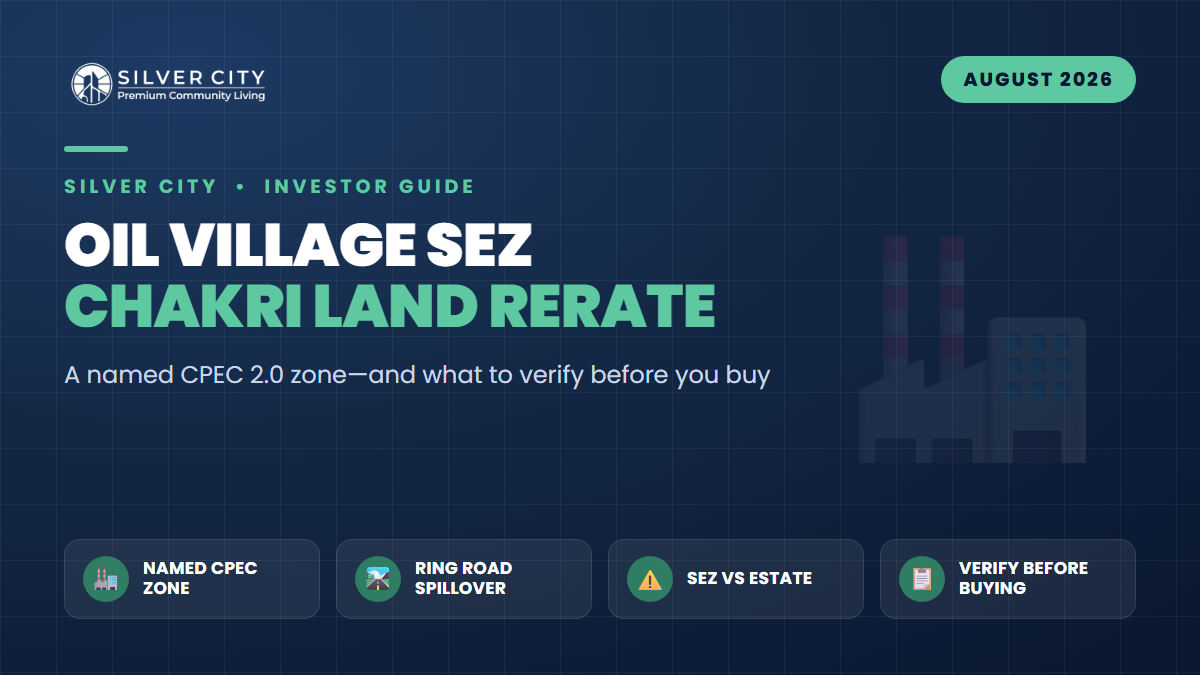
For years, Rawalpindi land pitches have leaned on a generic promise: “CPEC is coming.” In 2026 that promise finally has a named anchor in this district. When the Board of Investment (BoI) confirmed that Pakistan’s Special Economic Zones had grown from seven in 2019 to 44 under CPEC’s second phase, its published list included an entry labelled Oil Village SEZ, Rawalpindi. A specific, notified zone is a very different investment signal than a corridor drawn on a map—but only if you understand exactly what has been confirmed and what has not.
This article separates the verified facts from the sales talk, explains why a real zone re-rates nearby Chakri and Adiala land, and gives you a concrete checklist before you commit capital.
What CPEC 2.0 actually confirmed
In January 2026, the BoI reported that 37 new SEZs had been notified since 2019, taking the national total to 44. The framing of CPEC’s second phase is deliberately different from the first: less about highways and power plants, more about SEZ-led industrialisation, export manufacturing, and Pakistan–China B2B cooperation. Zones for engineering goods, agro-processing, chemicals, and light industry are the headline vehicles.
Oil Village SEZ, Rawalpindi appears on that federal list and has its own entry on the BoI’s investment portal. That is the confirmed part. What remains thin in the public record is the detailed specification sheet—exact acreage, sponsor, plot sizes, and precise coordinates are not clearly published, and the name “Oil Village” suggests a petroleum/oil-services orientation rather than a general estate. Treat the listing as real and the fine print as still-to-be-verified.
| Item | Status (as of mid-2026) |
|---|---|
| National SEZs under CPEC 2.0 | 44 (up from 7 in 2019), per BoI |
| Oil Village SEZ, Rawalpindi | Listed by BoI among Punjab zones |
| Published acreage / sponsor / plot plan | Not clearly public — verify directly |
| Likely sector focus | Oil / petroleum services (name-implied) |
| Governing law | SEZ Act 2012 + CPEC-ICDP framework |
The critical SEZ-versus-industrial-estate catch
Here is the single most important nuance most brokers will not mention. In May 2026, the Punjab Industrial Estates Development and Management Company (PIEDMC) board approved a separate industrial development along the Rawalpindi Ring Road—but as a conventional industrial estate, not an SEZ. The reason is fiscal: under Pakistan’s current IMF programme, the sweeping tax holidays and duty exemptions that legally define an SEZ cannot be freely extended.
This matters because the investment thesis for an SEZ is the tax incentive. If a zone quietly converts to an industrial estate, the headline “tax-free” appeal disappears, even though factories may still be built. So do not assume every “zone” near your plot carries SEZ benefits. Confirm the legal category—SEZ notification under the SEZ Act 2012 versus an industrial estate—before you pay a premium for “SEZ-adjacency.”
Why a confirmed local zone re-rates Chakri and Adiala land
A named industrial node changes land economics through predictable channels, and the Rawalpindi Ring Road amplifies each one:
- Access. The Ring Road (revised cost around Rs50 billion, deadline pushed to March 2026, reportedly ~90% complete) has near-finished interchanges at Adiala, Chakri, Banth, and Chak Beli Khan—turning previously remote raqba into serviced, connected land.
- Employment gravity. Industrial jobs create demand for nearby worker housing, transport yards, filling stations, and warehousing—exactly the uses that convert cheap agricultural land into commercial and residential plots.
- Anchoring effect. A federally listed zone gives developers and banks a reason to underwrite the area, tightening supply of well-titled plots.
Recent listings illustrate the spread you are working with. Agricultural land along Chakri Road has appeared at demand levels near the Rs18 lakh per kanal range historically, while frontage plots on Main Adiala Road toward Islamabad have been quoted around Rs7 million per kanal. The gap between “back raqba” and “interchange-facing frontage” is where most of the re-rating occurs.
| Corridor | Indicative land price (per kanal) | Re-rating driver |
|---|---|---|
| Chakri Road agricultural (interior) | ~Rs15–25 lakh | Zone + Chakri interchange |
| Main Adiala Road frontage | ~Rs5–8 million | Adiala interchange, housing demand |
| Interchange-adjacent commercial | Premium / negotiated | Logistics, fuel, transport uses |
Prices are indicative from mid-2026 listings and vary sharply by exact khasra, title, and frontage. Always verify current rates on the ground.
Your pre-purchase verification checklist
- Confirm the zone’s legal status. Ask the BoI/PIEDMC in writing whether Oil Village SEZ is notified as an SEZ or has become an industrial estate, and get the notification number.
- Pin the boundary. Obtain the official zone map and measure the real distance from your plot. “Near CPEC” can mean 2 km or 20 km.
- Check the interchange. Interchange-facing land re-rates first and hardest; interior raqba lags. Verify the plot’s actual road connection, not the master-plan render.
- Scrutinise the title. Insist on a clean fard, verify khasra numbers at the Arazi Record Centre, and confirm the land is not inside the Ring Road’s acquisition footprint (roughly 8,992 kanals were acquired for the alignment).
- Match approvals to your horizon. Punjab Assembly legislation, land acquisition, and plot allotment (partly via the Rawalpindi Chamber of Commerce) are still in motion. Time your entry to milestones, not to brochures.
Frequently Asked Questions
Is Oil Village SEZ officially confirmed?
Yes—it appears on the Board of Investment’s list of Special Economic Zones under CPEC 2.0, which now numbers 44 nationally. However, detailed public specifications (acreage, sponsor, plot plan) are limited, so verify particulars directly with the BoI before relying on any specific claim.
Will land near the zone definitely carry SEZ tax benefits?
Not automatically. A separate Ring Road industrial project pivoted from an SEZ to an ordinary industrial estate in 2026 because IMF-linked conditions restrict tax exemptions. Confirm the legal category of any zone before paying an “SEZ premium.”
Should I buy interior agricultural raqba or interchange frontage?
Frontage and interchange-adjacent commercial land re-rate earliest and are best for shorter horizons but cost far more. Interior raqba is cheaper and offers higher percentage upside if development materialises—at greater risk and a longer wait. Match the choice to your capital and patience.
How does the Rawalpindi Ring Road affect this?
The Ring Road, with near-complete Adiala and Chakri interchanges, is the access spine that makes an industrial node viable. Its completion is the practical trigger that turns “connected on paper” land into usable, serviced plots.
The bottom line
Oil Village SEZ is a genuine upgrade over the old, vague “CPEC corridor” pitch—a named, listed zone anchored by a nearly finished Ring Road. But the value is only as real as the notification, the boundary, and the title behind any specific plot. Verify first; buy second. For investors who want CPEC-belt exposure without gambling on an unverified khasra, an RDA-approved scheme such as Silver City—positioned along the Chakri/M-2 corridor with clean approvals and documented plots—remains a sensible, lower-risk way to participate in the same growth story. Do your due diligence, and let confirmed facts, not slogans, guide the cheque.
@@END@@