A quiet number that changes the map: 7 to 44
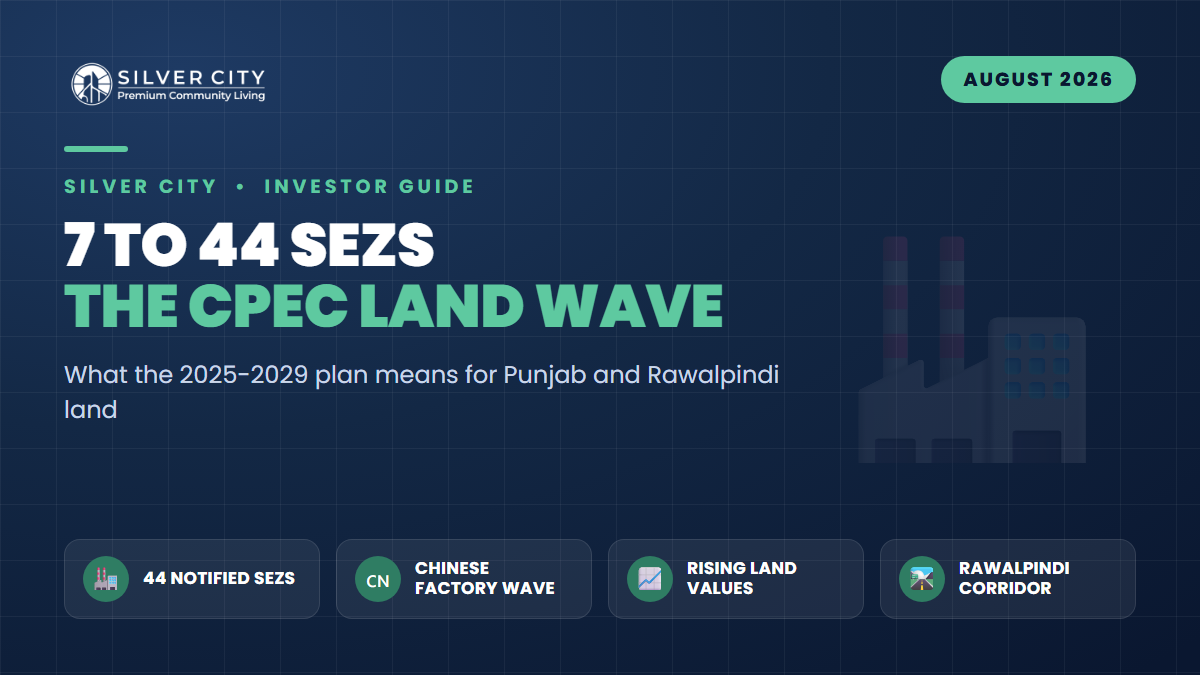
In January 2026, the Board of Investment (BOI) confirmed a figure that most property investors missed: Pakistan’s tally of Special Economic Zones (SEZs) has climbed from just seven in 2019 to 44 notified zones — thirty-seven new zones brought into the framework under CPEC’s second phase. The update was shared during a briefing with the Federal Minister for Investment at the Project Management Unit of the CPEC Industrial Cooperation Development Project (PMU CPEC-ICDP).
For a decade, CPEC meant roads, ports and power plants. That era is closing. The new chapter is about factories — and factories need serviced land near motorways, labour and power. That is exactly why this shift matters to anyone holding, or considering, plots along the Punjab and Rawalpindi-region industrial corridor.
The 2025-2029 plan: from infrastructure to industry
On 2 November 2025, Pakistan and China launched the Industrial Cooperation Action Plan (2025-2029). Its stated purpose is to move CPEC’s centre of gravity from infrastructure to industrial growth, and to align with China’s 15th Five-Year Plan (2026-2030), which openly emphasises relocating parts of its manufacturing base to Belt and Road economies as domestic costs rise.
The plan targets manufacturing, technology, mining, and emerging sectors such as clean energy, media and transport robotics. China has pledged preferential support for enterprises investing in Pakistan’s SEZs — Karachi and Islamabad were named specifically — and the framework encourages third-party (non-Chinese) participation too. A parallel driver is minerals: Pakistan’s copper, lithium and rare-earth reserves feed China’s electronics and green-energy supply chains, and SEZ-based joint ventures give Chinese firms a gateway to South Asian, Central Asian and Middle Eastern markets.
Translation for investors: this is a deliberate, government-to-government effort to fill those 44 zones with real production lines, not just to announce them.
The zones that anchor the Punjab and Pindi corridor
Not every SEZ sits near Rawalpindi, but the industrial spine running from Faisalabad up the motorway network toward Islamabad-Rawalpindi and on to the M-1 is where much of the action concentrates.
| SEZ | Location | Scale / Note |
|---|---|---|
| Allama Iqbal Industrial City (AIIC) | Sahianwala interchange, M-4, Faisalabad | ~3,217 acres — the largest CPEC SEZ; ~2,276 saleable acres, roughly a third already booked by dozens of investors |
| Rashakai SEZ | M-1, Nowshera (KP) | On the Islamabad-Peshawar motorway; a flagship prioritised zone feeding the northern corridor |
| Islamabad Model SEZ (ICT) | Near Rawat / I-15, Islamabad Capital Territory | The capital-region zone named in the 2025-29 plan for enterprise support |
| Rawat Industrial Estate | Rawalpindi, near Ring Road & GT Road | Established estate; industrial land recently listed around PKR 27.5-29 million for a 2-kanal parcel |
The Rawalpindi region’s advantage is connectivity: it links the M-1, M-2, the Rawalpindi Ring Road, GT Road and the new Islamabad airport into a single logistics grid. When Chinese and third-party manufacturers scout for sites, this junction of power, labour and motorway access is naturally on the shortlist.
How SEZ activity feeds land values
Industrial zones rarely lift only the fenced-off zone itself. The value spillover follows a predictable pattern:
- Worker housing demand. A functioning SEZ employing thousands of engineers, managers and skilled workers creates immediate demand for nearby residential plots and rentals — the single biggest driver of value for approved housing schemes on the corridor.
- Supplier and logistics clustering. Warehousing, packaging, transport yards and vendor units seek affordable land just outside the zone, pushing up peripheral commercial and industrial rates.
- Infrastructure follow-through. Road widening, gas, grid upgrades and interchanges built for the SEZ improve every parcel they pass — a benefit early landholders capture without paying for it.
A realistic, investor’s-eye timeline
| Phase | Window | What to watch |
|---|---|---|
| Notification & planning | 2024-2026 | Zones notified; land-lease policies approved (e.g. Bin Qasim). Announcement-driven sentiment. |
| Relocation onboarding | 2026-2027 | First Chinese/third-party firms sign up; utility and road works accelerate near active zones. |
| Production & employment | 2027-2029 | Factories operate; genuine housing and services demand appears around live zones. |
The key discipline: value tends to rise fastest around zones that are actually being built out and occupied, not merely notified on paper. Forty-four notifications is a headline; how many convert to operating plants over 2026-2029 is the real number to track.
How to invest sensibly, not speculatively
- Buy legality first. Insist on schemes approved by the relevant authority (RDA in the Rawalpindi region, CDA in ICT). An unapproved plot near a booming zone is still a legal risk.
- Prioritise connectivity. Proximity to a motorway interchange, Ring Road or GT Road matters more than proximity to any single zone’s fence.
- Verify the zone is live. Check BOI/PMU updates for signed investors and construction progress before pricing in an SEZ premium.
- Hold with patience. This is a 2025-2029 story. The strongest gains historically accrue to those who enter during planning and hold through occupancy.
Frequently Asked Questions
Is the jump from 7 to 44 SEZs officially confirmed?
Yes. The Board of Investment confirmed in January 2026 that notified SEZs rose from seven in 2019 to 44 under CPEC’s second phase, with 37 new zones added. It was reported by Dawn and other national outlets following a ministerial briefing at the PMU CPEC-ICDP.
Will Chinese factories actually relocate to Pakistan?
The 2025-2029 Industrial Cooperation Action Plan and China’s 15th Five-Year Plan both formally back relocating production to partner economies, and China has pledged preferential support for firms entering Pakistani SEZs. That said, actual relocation depends on security, power reliability and ease of doing business, so investors should track firm-level commitments, not just policy announcements.
Which areas near Rawalpindi benefit most?
Corridors linking the M-1, M-2, Rawalpindi Ring Road and GT Road — including the Rawat belt and the Islamabad Capital Territory zone near Rawat — are best positioned because of their logistics access and existing industrial base.
What are current industrial land prices around Rawat?
Recent listings placed industrial land in Rawat Industrial Estate at roughly PKR 27.5-29 million for a 2-kanal parcel, with broader commercial plots starting around Rs 1.3 crore. Prices move quickly, so verify current rates before committing.
The takeaway
The leap to 44 SEZs plus a five-year industrial plan built around Chinese relocation is the clearest signal yet that Pakistan’s next property cycle will be driven by factories, jobs and logistics — and the Rawalpindi-Punjab corridor sits at its heart. For investors who value both upside and security, an RDA-approved development along this corridor such as Silver City is worth serious consideration: it pairs legal clarity with a location on the very GT Road-Ring Road grid that CPEC 2.0 is set to energise. Do your own verification of approvals and current prices, and let the corridor’s momentum work in your favour.