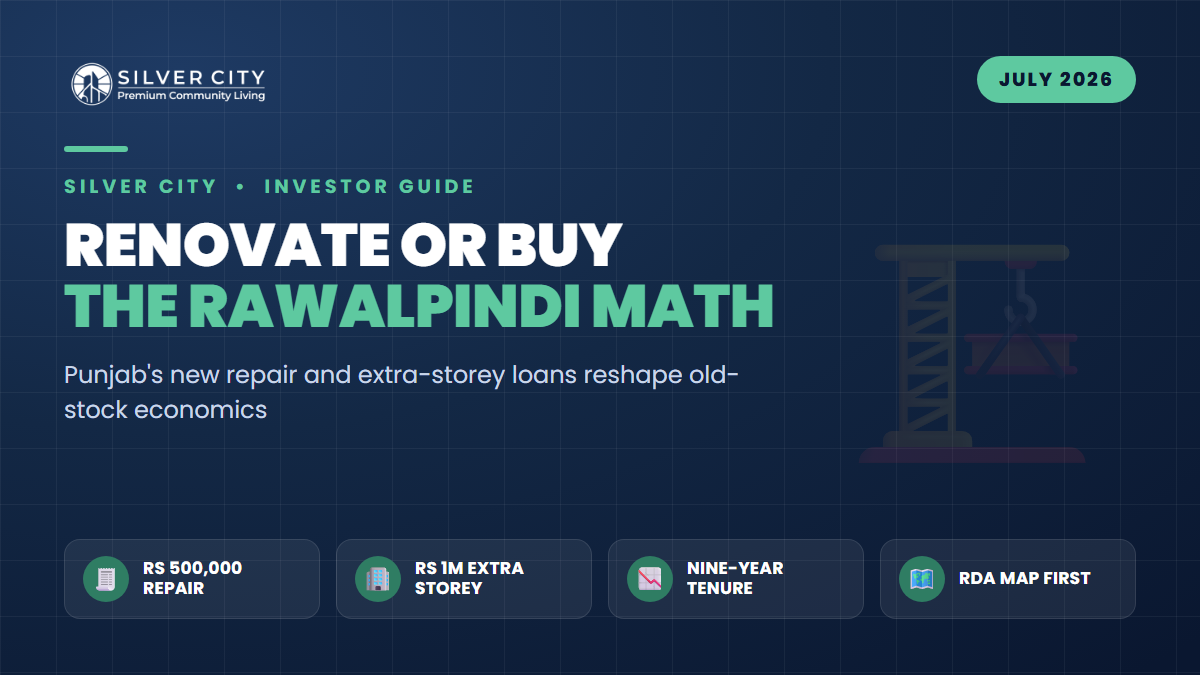
What actually changed on 5 July 2026
On 5 July 2026, Punjab’s Housing and Urban Development Minister Bilal Yasin chaired a review that formally widened the scope of the Apni Chhat Apna Ghar (ACAG) programme. Until then, ACAG was a build-your-own-home scheme: an interest-free loan of up to Rs 1.5 million for families who owned a small plot but could not fund construction. The 5 July decision extended eligible use to repair, rehabilitation, roof construction and extension of houses that already exist, with financing of Rs 500,000 to Rs 1 million routed through the programme’s e-portal.
Four days later, on 9 July 2026, Chief Minister Maryam Nawaz launched the sub-programme that operationalises it — “Apna Ghar, Mehfooz Ghar” — after a fatal building collapse in Kahna sharpened the political case for structural safety. The framing matters: this is a safety intervention that happens to have property-market consequences, not a stimulus for the property market.
The two new loan categories at a glance
| Feature | Repair & reinforcement | Additional storey |
|---|---|---|
| Loan amount | Rs 500,000 | Rs 1,000,000 |
| Monthly instalment | Rs 4,700 | Rs 9,300 |
| Tenure | 9 years | 9 years |
| Mark-up | Interest-free | Interest-free |
| Covers | Weak roofs, deteriorated structure, rehabilitation | Construction of one extra floor, released in tranches |
| Apply | acag.punjab.gov.pk, or in person at DC/AC offices and PHATA | |
For context on scale: the province reports more than 1.278 million applications received, over 180,000 loans approved, roughly 170,000 families paid, 134,343 houses completed and Rs 217.8 billion disbursed to date under the housing programme, with an intention to reach another 100,000 families in the coming fiscal year. The renovation categories are being layered onto that existing rail rather than built from scratch — which is why disbursement should move faster than a brand-new scheme would.
Why you probably cannot borrow this money — and why it still matters
Be clear-eyed here, because a lot of commentary is not. ACAG is means-tested. The core criteria include permanent Punjab residence, being the family head per NADRA records, no loan default or criminal record, ownership of 1–5 marla in urban areas (1–10 marla rural), registration in the National Socio-Economic Registry, and a Poverty Means Test score of 60 or below. A PMT cut-off of 60 is a poverty filter. If you are reading this as a property investor, you almost certainly do not qualify, and no amount of structuring will make a second-home purchase eligible.
The investor-relevant effects are second-order, and there are three worth pricing in:
- The distressed-seller floor rises. A meaningful share of old, structurally tired houses in areas like Satellite Town come to market because the owner cannot fund a Rs 4–6 lakh roof job. A Rs 500,000 interest-free loan at Rs 4,700 a month removes that trigger for qualifying households. Expect slightly thinner supply of genuinely cheap “as-is” stock over the next 12–24 months.
- Vertical extension is now official policy. The Rs 1 million extra-storey loan is the province explicitly endorsing densification of small urban plots. That is a directional signal for how approving authorities will treat added floors on 3–5 marla plots.
- The economics are legible to everyone now. Once tens of thousands of households run the “add a floor versus move” comparison, the market re-rates single-storey stock that has spare structural capacity.
The real arbitrage: cost to add versus cost to buy
The genuine opportunity for an investor is not the subsidy — it is the underlying spread between construction cost and market price in mature Rawalpindi localities. Verified 2026 Rawalpindi rates put grey structure at roughly Rs 3,000–4,500 per sq ft, standard finishing in the Rawalpindi–Islamabad belt at around Rs 4,500–5,500 per sq ft, and complete turnkey construction between Rs 4,800 and Rs 9,500 per sq ft depending on specification.
| Scenario (5 marla, Gulraiz) | Indicative outlay | What you get |
|---|---|---|
| Buy an existing built 5 marla house | Rs 1.35–1.50 crore | Finished home, no execution risk, no uplift |
| Add an ~850 sq ft first floor at Rs 4,800/sq ft (basic turnkey) | ≈ Rs 41 lakh | Second independent portion, separate entrance |
| Same floor at Rs 5,500/sq ft (better finish) | ≈ Rs 47 lakh | Lettable to a family rather than bachelors |
| Grey structure only, finish later | ≈ Rs 26–38 lakh | Phased spend; slab and columns secured first |
Read that table honestly. Adding roughly 850 sq ft for Rs 41–47 lakh against a Rs 1.35–1.50 crore entry price for a whole finished house is the arbitrage — provided the existing foundation and columns can carry the load, and provided you can let or sell the added portion. In Gulraiz, proximity to the Bahria Town corridor, PWD and the Grand Trunk Road employment belt supports upper-portion rental demand. In Satellite Town, where 3 marla houses transact in the Rs 50–80 lakh band, the same logic applies at a smaller absolute scale but a tighter margin, because plot ratios and lane widths constrain what you can add.
Where this play breaks
- Structural capacity. Much of Satellite Town’s stock dates to the 1950s–70s. Many of those roofs are RCC slabs on load-bearing brick walls, not framed columns. They frequently cannot take a second storey without underpinning that destroys the economics. Pay a structural engineer for a load assessment before you pay for the house.
- Approvals. RDA’s building and zoning regulations were last comprehensively revised in 2007, with selective adoption of LDA’s 2019 provisions since. Confirm the approving authority for your specific block and get the revised building plan sanctioned before a single brick moves. Unapproved floors are a resale liability, not an asset.
- Title and inheritance. Older family-held houses in Satellite Town routinely carry unresolved inheritance shares. Verify the fard, mutation and any pending succession before advancing token money.
- Exit liquidity. A two-portion house in an old locality has a narrower buyer pool than a plot in an approved scheme. Rental yield may be strong; capital exit may be slow.
A practical checklist before you commit
- Get a written structural load report on the existing slab and foundation.
- Price the extension from at least three contractors, per sq ft, with grey and finishing separated.
- Confirm setback, height and parking rules with the relevant authority in writing.
- Verify utility capacity — a separate electricity meter for an upper portion is not automatic.
- Compare the all-in number against a clean plot in an approved scheme before deciding.
Frequently Asked Questions
Can I use the Rs 1 million extra-storey loan on an investment property?
No. Eligibility is tied to NSER registration and a PMT score of 60 or below, plus ownership of the house as the NADRA-recorded family head. It is designed for low-income owner-occupiers, not for landlords or second-property buyers.
Does Rs 1 million actually cover an additional storey?
Not fully in Rawalpindi. At 2026 rates, Rs 1 million buys roughly 220–330 sq ft of grey structure. For an eligible household it is a meaningful contribution toward a modest room-plus-roof addition, or a substantial part of a small extension — not a complete second floor. Plan for own contribution.
Is renovating old stock better than buying a plot in a new scheme?
They solve different problems. Renovation converts cash into rental income quickly on land you already control, but carries structural, approval and title risk. A plot in an approved scheme carries lower execution risk and cleaner documentation, with returns driven by development progress rather than construction skill. Many investors run both.
How do I apply if I do qualify?
Register at acag.punjab.gov.pk, or submit in person at your Deputy Commissioner or Assistant Commissioner office, or at a Punjab Housing and Town Planning Agency office. Loans are released in tranches against verified construction progress.
The bottom line
Punjab’s 5 July 2026 expansion is real, funded and already live — but it is a social-safety measure, and the investor gain from it is indirect: a firmer floor under old stock and official endorsement of vertical growth on small plots. The renovation arbitrage in Satellite Town and Gulraiz stands or falls on structural capacity and approvals, not on the subsidy. If that execution risk is more than you want to carry, a documented plot in an RDA-approved scheme remains the lower-friction alternative — Silver City on Girja Road near the Thalian Interchange is one such option worth evaluating alongside any renovation play, with 4 marla to 1 kanal plots on instalment plans and RDA approval already in hand.