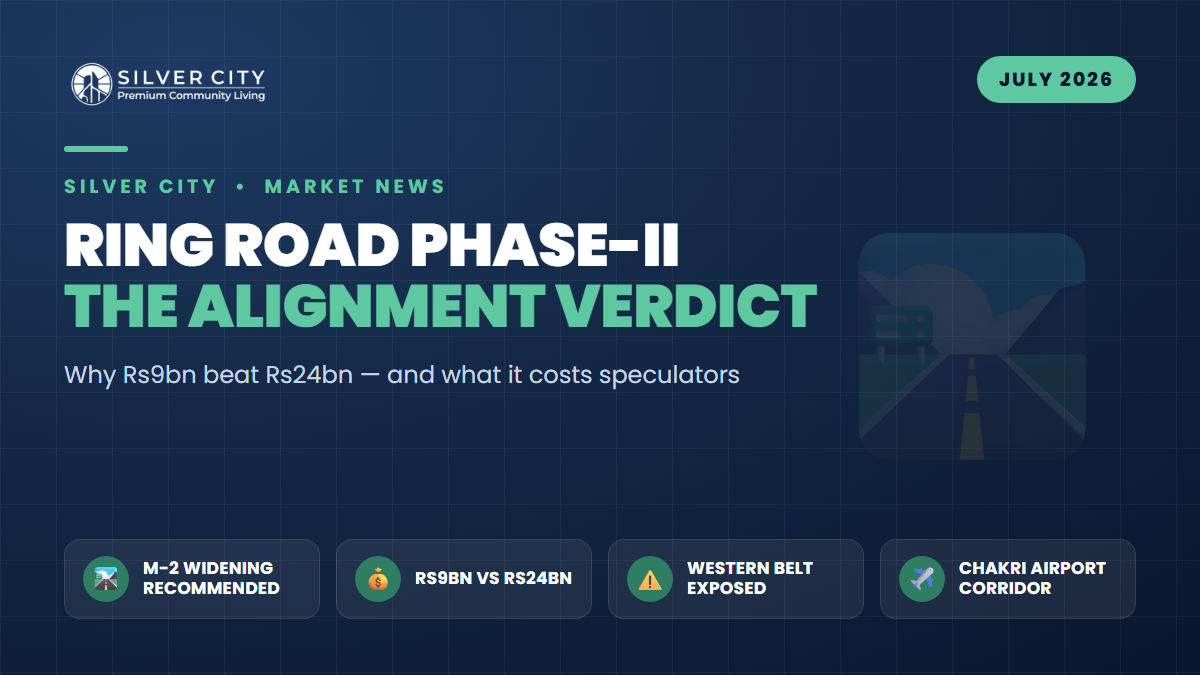
On 20 July 2026, NESPAK’s preliminary feasibility for Rawalpindi Ring Road Phase-II — the Thalian-to-Hakla link that plugs the ring into the CPEC western route — went to the Punjab cabinet with three alignment options and one clear recommendation. For anyone holding land in Rawalpindi’s outer belt on the strength of a “Phase-II is coming here” pitch, this is the single most consequential document of the year.
What NESPAK Actually Put on the Table
Three options were studied for connecting Thalian Interchange on the M-2 to the Hakla Interchange, the gateway to the M-14 Hakla–D.I. Khan Motorway (roughly 285 km, part of CPEC’s western alignment). The numbers are not close.
| Option | Description | Length | Estimated Cost | NESPAK Assessment |
|---|---|---|---|---|
| 1 — M-2 widening | Expand existing motorway from 3 to 5 lanes each side | 15.3 km | ~Rs9 billion | Recommended — most suitable, economical and practical |
| 2 — Eastern corridor | New highway east of the M-2 | 19.5 km | ~Rs18 billion | Viable but roughly double the cost |
| 3 — Western corridor | New corridor west of the M-2 | 26.5 km | ~Rs24 billion | Longest, costliest, heaviest land acquisition; benefits do not justify cost |
NESPAK’s reasoning is straightforward engineering economics: widening an existing carriageway cuts construction cost by an estimated 50–60% versus a greenfield route, requires far less land acquisition, reuses built infrastructure, and delivers years faster. The trade-offs flagged in the report are traffic management during construction, right-of-way constraints and interchange redesign — real problems, but cheaper ones than buying 26.5 km of new corridor.
Why the Western-Alignment Buyer Is Now Holding the Weakest Hand
Over the past two years a great deal of raw land west of the motorway changed hands on a single premise: that Phase-II would carve a new corridor through it, converting agricultural khasras into future road frontage. That premise has just been ranked third out of three by the government’s own consultant. Four things make the position hard to defend.
1. The fiscal signal is unambiguous
Punjab has already absorbed a large cost escalation on Phase-I — the 38-odd kilometre Baanth-to-Thalian section, now reported at around Rs50 billion. The province was unwilling to fund the roughly Rs5 billion Thalian Interchange in time for opening, deferring it and connecting the ring to the motorway through a temporary two-way arrangement instead. A government that defers a Rs5 billion interchange on a 90%-complete flagship road is not a government that selects a Rs24 billion option over a Rs9 billion one recommended by its own consultant.
2. Even if a new corridor were built, motorway-class roads do not create frontage
This is the part retail buyers consistently get wrong. Value in Pakistani peri-urban land is created by access, not proximity. A controlled-access corridor has no shops, no plot-facing entrances and no service road along its length — the uplift lands at interchange nodes and nowhere else. Owning land 800 metres from a sealed corridor with no interchange is functionally the same as owning land 8 kilometres away. The M-2 widening option makes this literal: the work happens largely inside the existing right of way, so no new access points get created for anyone.
3. The exit is thin
Speculative parcels on an unapproved alignment typically carry no RDA layout approval, no NOC, no development works and often unresolved intiqal or shared-khata title. The only buyer for that asset is the next speculator, and the news flow that fed that pipeline has now reversed. Illiquidity in this segment does not show up as falling quoted rates — sellers hold their asking price and simply stop transacting.
4. Acquisition compensation is not an exit either
Some buyers comfort themselves with the idea that if the road does come, the government will pay them out. Compensation rates reported on earlier Ring Road phases ranged from roughly Rs69,000 to Rs350,000 per kanal depending on location — a formula anchored to DC rates and agricultural use, not to the price a speculator paid on a market rumour. Land acquisition on a road project is a risk to a speculative position, not a payout.
Why the Chakri–Airport Corridor Is the Safer Side of the Trade
The M-2 widening recommendation does not weaken the Thalian–Chakri belt; it strengthens it. If Phase-II runs along the existing motorway spine rather than swinging west, the ring’s western nodes stay exactly where they are — and every kilometre of CPEC traffic moving between Hakla and the ring passes through them. Consider what is already physically built here versus promised elsewhere:
| Milestone | Status as of July 2026 |
|---|---|
| Phase-I carriageway (Baanth → Thalian, ~38 km) | Reported ~90% complete; opening targeted mid-2026 |
| Chakri, Adiala, Chak Beli Khan, Baanth interchanges | Complete or near-complete |
| Thalian Interchange (~Rs5bn) | Deferred; temporary M-2 connection, land acquisition underway for a broader design |
| Phase-II alignment (Thalian → Hakla) | Preliminary feasibility with Punjab cabinet, 20 July 2026 — no approval yet |
| M-14 Hakla–D.I. Khan (CPEC western route) | Operational |
The Chakri corridor sits roughly a quarter-hour from New Islamabad International Airport, connects to a completed interchange, and now anchors the junction between a finished ring road and the CPEC western route. That is three independent demand drivers — airport, ring road, national freight corridor — versus one unbuilt hypothetical on the western side.
How to Reposition Without Panicking
- Separate approved from unapproved holdings. Land inside an RDA-approved scheme with an LOP and NOC is a different asset class from raw khasra on a rumoured route. Do not average their performance in your head.
- Stop underwriting to the road; underwrite to the node. Ask how many minutes to a built interchange, not how many metres to a proposed line.
- Verify the alignment claim in writing. Any marketing that shows Phase-II passing through a specific site today is showing you an option the cabinet has not approved. Ask for the notification number; there isn’t one yet.
- Watch two triggers. The cabinet’s decision on the alignment, and the PC-I approval with an allocation in the provincial ADP. Until a scheme is funded, it is a study.
- Prefer possession and development over pure land banking in this cycle. Developed plots in approved societies generate rent or build-out optionality; raw speculative land generates only carrying cost.
Frequently Asked Questions
Has the Punjab cabinet approved the M-2 widening option yet?
No. As of 20 July 2026 the preliminary feasibility and NESPAK’s recommendation were submitted to the cabinet for consideration. Approval, detailed design and a funded PC-I are separate subsequent steps. Treat any “final alignment” claim before a government notification as marketing.
If Phase-II is only M-2 widening, does it still benefit property along the ring?
Yes, and arguably more predictably. Widening completes the Thalian–Hakla link at roughly a third of the cost of a new corridor, meaning it is far likelier to actually get built. A finished CPEC connection concentrates freight and commuter traffic through Thalian and the ring’s existing interchanges — including Chakri — rather than dispersing it onto a new road further west.
I already bought on the western alignment. What now?
Assess it as land on its own merits, ignoring the road entirely: title quality, access to a real road today, water and electricity availability, and who the realistic end-buyer is. If it only works as a story-driven flip, accept that the story has changed and price the exit accordingly rather than waiting for a corridor NESPAK has ranked last.
What documentation should I demand before buying anywhere in this belt?
RDA approval status and the LOP/NOC letter number, the approved layout plan with your plot marked, fard and intiqal in the seller’s name, a no-demand certificate for developer dues, and confirmation that the plot is not in a land-acquisition or litigation zone. Verify approval directly with the Rawalpindi Development Authority — never from a brochure.
The Bottom Line
The Phase-II verdict does not end the Rawalpindi growth story; it just moves the money from speculation back to fundamentals. Corridors that already exist — a completed ring road, a built Chakri interchange, an operating international airport, a live CPEC western route — are now worth more relative to corridors that were only ever drawn on a marketing map. For investors who want exposure to this belt with regulatory cover rather than rumour risk, an RDA-approved society such as Silver City, positioned on Girja Road near the Thalian Interchange with 3.5, 5 and 10 marla and 1 kanal options on instalment plans, is the kind of approved, access-anchored holding worth putting on the shortlist — after you have verified its current approval status and payment terms directly.