A quiet law is about to change how Pakistanis buy property
Tucked inside the Finance Act 2025 is Section 114C of the Income Tax Ordinance, 2001 — a provision that, once activated, will stop an “ineligible person” from registering high-value assets, including immovable property above a fair-market value of Rs100 million. The law has already been passed by Parliament. What it is waiting for is a single notification from the Federal Government in the official Gazette to switch it on.
For property investors in Rawalpindi and Islamabad, this is not a reason to panic. It is a reason to prepare. The investors who move early — by getting onto the Active Taxpayer List (ATL) and parking capital in an affordable, titled plot that sits comfortably below the threshold — stand to benefit twice: they sidestep the coming restriction, and they immediately slash their buyer withholding tax to a flat 1.25%.
What Section 114C actually says
Section 114C creates the concept of an “eligible person.” In simple terms, you are eligible for a major transaction if you have filed your income tax return for the tax year immediately preceding the transaction and have declared enough resources in your wealth statement to justify the purchase. Anyone who fails that test is treated as an “ineligible person” and is blocked from the listed high-value dealings.
The restrictions the law contemplates for ineligible persons include:
- Buying or transferring immovable property with a fair-market value above Rs100 million.
- Purchasing a motor vehicle above Rs7 million.
- Investing more than Rs50 million in securities.
- Withdrawing more than Rs100 million in cash across all bank accounts.
Crucially, the section states that its provisions “shall come into force from such date as may be notified by the Federal Government.” As of today, that notification has not been issued. The Finance Ministry had floated 1 July 2026 as an activation date, but the Federal Cabinet turned that proposal down in July 2026. So the regime is passed but dormant — a sword hanging, not yet fallen.
Status at a glance
| Item | Position (as of October 2026) |
|---|---|
| Legal basis | Section 114C, inserted via Finance Act 2025 |
| Property threshold | Fair-market value above Rs100 million |
| Who is barred | “Ineligible persons” (broadly, non-filers / under-declared filers) |
| In force? | No — awaiting Federal Government notification in the Gazette |
| Proposed activation | 1 July 2026 was proposed, then rejected by the Cabinet |
Why “file now” is the obvious move
The temptation is to wait until the notification lands. That is the wrong instinct. ATL status is not instant — you must file a return, and if you file late you land on the ATL as a “late filer,” which carries higher tax rates than an on-time active filer. Becoming a clean, on-time filer well before any activation date protects you from both the 114C bar and the punitive non-filer withholding rates.
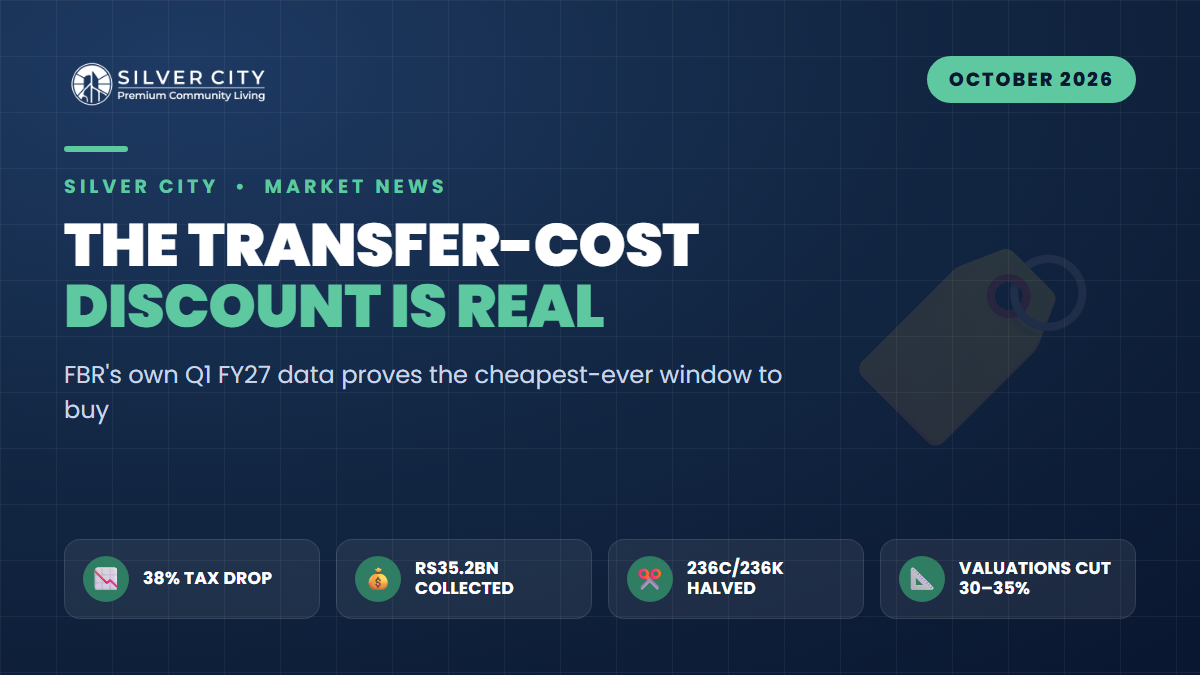
And those rates matter enormously. Under the Budget 2026-27 reforms, the government simplified Section 236K (advance tax paid by the buyer) into a single flat rate for active filers, replacing the old tiered slab system. Active filers now pay just 1.25% of the FBR-assessed value, while non-filers continue to pay multiples of that. On the sell side, Section 236C for filers was cut to a flat 2.75%.
Buyer tax: filer vs non-filer on a 5-marla plot
Assume an FBR-assessed value of Rs4,000,000 (a realistic figure for a titled 5-marla plot in a Rawalpindi housing society). Note: these rates apply to the FBR notified value, not necessarily the open-market price.
| Status | 236K buyer rate | Tax on Rs4,000,000 |
|---|---|---|
| Active filer (on-time) | 1.25% | Rs50,000 |
| Late filer | Higher (penalty tier) | roughly Rs140,000 |
| Non-filer | Several times the filer rate | Rs300,000+ |
The gap is the whole point: the same plot costs a non-filer six times more in buyer tax than a disciplined filer — before you even reach the Section 114C question.
The 5-marla strategy: stay far under the threshold
Here is where the two ideas click together. Section 114C targets big-ticket, “undocumented wealth” transactions — property above Rs100 million. A titled 5-marla residential plot in an RDA-approved Rawalpindi society transacts for a tiny fraction of that — typically in the range of Rs20 lakh to Rs55 lakh depending on location, phase and development stage. That is 2–5% of the Rs100 million ceiling.
In other words, a 5-marla plot is structurally safe from the 114C bar. An investor can buy, hold, and later sell such a plot without ever tripping the ineligible-person restriction — provided they are a filer, which also gives them the 1.25% rate. It is the classic “small, clean, documented, liquid” asset that fits a tightening tax environment.
Why 5-marla specifically works
- Affordability: Entry cost suits salaried and first-time investors, often with installment plans.
- Liquidity: 5-marla is the most traded residential size in the twin cities, so resale demand is deep.
- Below every red line: Well under the Rs100 million property threshold and far below cash-withdrawal triggers.
- Documented from day one: A titled, RDA-approved plot leaves a clean paper trail that supports your wealth statement.
Your positioning checklist
- File your income tax return for the relevant year — on time — to secure active-filer status on the ATL.
- Build or update your wealth statement so your declared resources justify the purchase.
- Choose an RDA-approved society with clean title and a transparent transfer process.
- Buy a 5-marla (or similar small) titled plot whose value sits far below Rs100 million.
- Pay the 1.25% filer buyer tax, keep every receipt, and document the source of funds.
Frequently Asked Questions
Is Section 114C in force right now?
No. The section was enacted through the Finance Act 2025 but will only take effect from a date notified by the Federal Government in the official Gazette. A proposed 1 July 2026 start was rejected by the Cabinet, and no activation notification has been issued as of October 2026. Treat it as a near-certain future rule, not a present one.
Will Section 114C stop me from buying a 5-marla plot?
No. The property restriction targets transactions with a fair-market value above Rs100 million. A titled 5-marla plot transacts for a few lakh to a few tens of lakhs of rupees — nowhere near the ceiling — so it falls completely outside the bar even after the law is switched on.
How does becoming a filer save me money immediately?
Filing gets you onto the Active Taxpayer List, which under the Budget 2026-27 rules means you pay a flat 1.25% advance buyer tax under Section 236K instead of the much higher non-filer rate. On a Rs40-lakh plot that is roughly Rs50,000 versus several times that amount — an instant, documented saving, plus a cut to 2.75% on the seller side under Section 236C.
Should I wait for the notification before filing?
No. ATL status takes time, and filing late lands you in a higher “late filer” tax tier. Filing on time now protects you from both the 114C restriction and punitive non-filer rates, and it strengthens the wealth statement you will need to prove eligibility for any future purchase.
The bottom line
Section 114C is a signal of where Pakistan’s tax system is heading: documented wealth gets freedom of movement, undocumented wealth gets fenced in. The investors who read that signal early will file their returns, join the ATL, and channel capital into affordable, titled, below-threshold assets that the new regime leaves untouched. A 5-marla RDA-approved plot is one of the cleanest ways to do exactly that. If you are weighing where to place that first documented, future-proof investment, Silver City — an RDA-approved housing society in Rawalpindi — is well worth shortlisting for titled, small-denomination plots that keep you comfortably on the right side of both the tax rate and the threshold.