First, an honest status check
Let’s start with the thing most marketing posts will not tell you: as of mid-July 2026, the Rawalpindi Ring Road is finished, not ceremonially opened. Officials have put completion at around 98 percent, with the toll plaza installation and finishing works the last items on the list. The project was handed toward the Punjab government in early July, but the formal inauguration at the GT Road Banth Interchange has slipped repeatedly, and reporting now points to 14 August as the latest target — with a fresh controversy over an NOC for a service area along the route adding uncertainty.
For an investor, that distinction matters enormously. Construction completion is what changes travel time. Inauguration is what changes headlines. The market has been trading on headlines for four years. It is about to start trading on travel time, and those are not the same asset.
What the corridor actually is
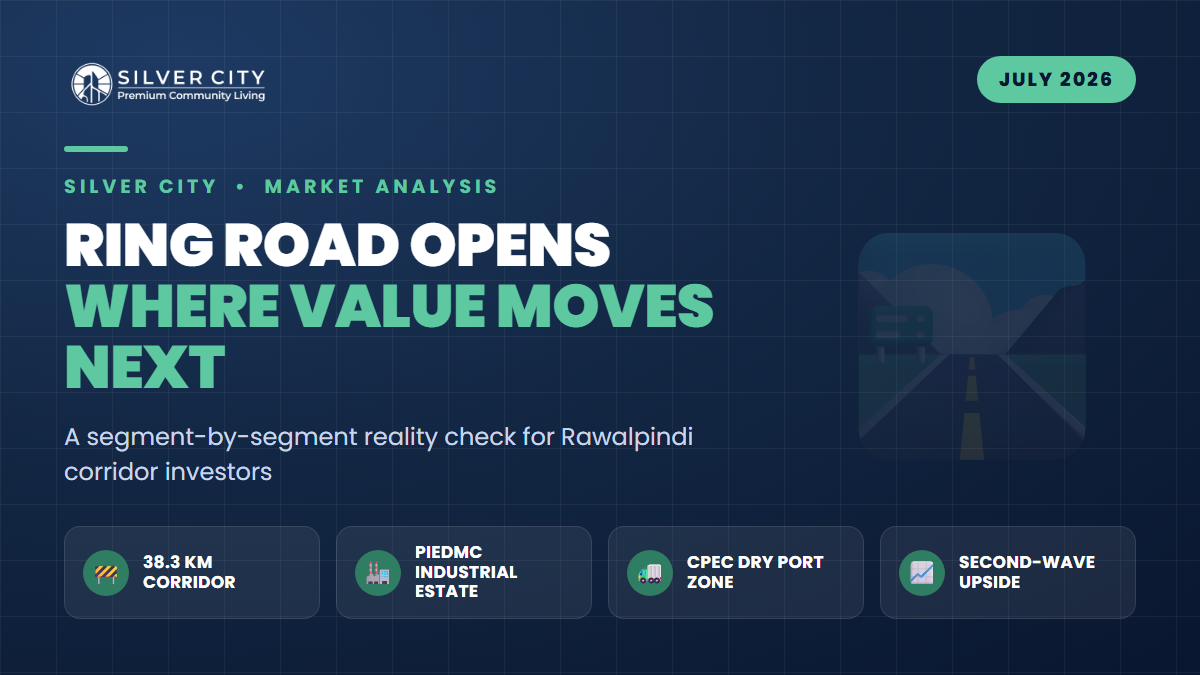
The RRR is a 38.3-kilometre (some official documents say 38.6 km), six-lane, access-controlled expressway running from Banth on GT Road to Thalian near the M-2 Motorway. The revised PC-I sits around Rs 46.64 billion, with total project cost reported between Rs 47 billion and Rs 51 billion depending on which revision you count. The design speed limit is 120 km/h. The Punjab Ring Road Authority will install and operate tolling on a model similar to Lahore Ring Road.
Four interchanges are complete: Banth, Chak Beli Khan, Adiala and Chakri. The fifth — Thalian — was deferred. The Punjab government opted to open with a temporary two-way carriageway connection to the motorway and to build the roughly Rs 5 billion Thalian interchange as a separate later phase. Traffic projections are for 30,000+ vehicles daily, absorbing an estimated 25–30 percent of general traffic between GT Road and Motorway Chowk and around 70 percent of goods transport.
Segment by segment: what is already in the price
| Segment / Node | Infrastructure status | How much is priced in | Investor read |
|---|---|---|---|
| Banth (GT Road end) | Interchange complete; inauguration point | High | Largely repriced 2024–2026. Buy for yield, not for re-rating. |
| Adiala Road interchange | Complete | Very high | Most crowded trade on the corridor. Heavy society density; check approvals hard. |
| Chak Beli Khan | Complete | Moderate | Thinner society supply, weaker retail demand — slower but less crowded. |
| Chakri Road interchange | Complete | High at the node, moderate 3–5 km out | Node premium is set; the setback belt is where arbitrage remains. |
| Thalian / M-2 end | Interchange deferred; temporary connection | Discounted for the deferral | The clearest identifiable second-wave trigger on the route. |
| Hakla–D.I. Khan (M-14) CPEC zone | Planned: Industrial Estate II, Logistics Hub II, dry port, warehouses, truck terminal | Low — mostly unbuilt | Long-dated. Real, but not a 12-month trade. |
| PIEDMC industrial estate | Board-approved May 2026; legislation and land acquisition pending | Very low | Highest optionality, highest execution risk. |
Why interchange hype and industrial value are different animals
Interchange proximity is a connectivity story. It compresses drive time, so it reprices residential land quickly, visibly and — critically — once. Anyone who bought within two kilometres of Adiala or Chakri interchange before 2024 has already collected most of that repricing. Buying that same node today means paying for a gain someone else captured.
Industrial and logistics infrastructure is an employment and freight story. It does not reprice land in a single jump. It creates a payroll, then a labour catchment, then rental demand, then genuine end-user buying — a three-to-seven-year sequence. The Hakla–D.I. Khan interchange CPEC zone (Industrial Estate II, Logistics Hub II, a dry port, warehousing and a truck terminal) is exactly this shape: freight-driven, slow-building, and far more durable than an interchange bump once it lands.
The PIEDMC pivot investors are misreading
In May 2026, PIEDMC approved an industrial estate along the Ring Road — replacing the earlier Special Economic Zone proposal. Many marketing posts framed this as a downgrade. It is more accurately a legal workaround: under Pakistan’s IMF programme, the tax exemptions and incentive packages that legally define an SEZ cannot be extended. The industrial estate model needs no such exemptions, which is why it cleared the board when the SEZ could not.
Here is the discipline required. As things stand, Punjab Assembly enabling legislation has not passed, land acquisition has not begun, and no plots are open for application. The Rawalpindi Chamber of Commerce and Industry’s own framing was conditional — industrialists will come if land is priced reasonably. Meanwhile, the Punjab government has earmarked a 500-metre strip on both sides of the corridor for broader development.
Translation: this is a legitimate, well-motivated plan at a genuinely early stage. Treat it as optionality you get for free if you are buying the corridor for other reasons. Do not pay a premium for it today.
Where the second wave actually sits
- The Thalian deferral gap. The market discounted the M-2 end because the interchange was postponed. That interchange is a funded, announced, separate phase — not a cancellation. Land on the Thalian/Girja side currently carries a discount for a delay, not for a defect.
- The 3–8 km setback belt. Directly adjacent to a working interchange, the premium is set. Three to eight kilometres back, along feeder roads, pricing still reflects pre-opening travel times that no longer apply.
- Post-toll behaviour, once observable. Nobody yet knows real usage. Once toll rates are notified and actual daily volumes are visible, some segments will be revealed as through-routes and others as genuine destinations. Destinations get retail and rental demand; through-routes get noise.
- Approval-clean stock in disputed belts. Several schemes in the Chakri and Adiala belts carry disputed or incomplete approval status. As freight traffic makes the corridor real, the spread between RDA-approved and unapproved land tends to widen, not narrow.
Frequently Asked Questions
Has the Rawalpindi Ring Road officially opened yet?
Construction is essentially complete — around 98 percent, with toll infrastructure the main outstanding item — and it is being opened via the GT Road Banth Interchange. The formal inauguration has been repeatedly rescheduled, with 14 August 2026 cited as the current target. Verify the current position with the Punjab Ring Road Authority before making a purchase decision that depends on a specific date.
Is it too late to buy near an interchange?
Near Adiala and Chakri interchanges, most of the connectivity premium is already in the price. That does not make it a bad asset — it makes it a fully-valued one. If you want re-rating rather than steady appreciation, look at the Thalian end or at setback land along feeder roads.
Will the industrial estate and dry port raise nearby plot prices soon?
Not immediately. The PIEDMC estate still needs Punjab Assembly legislation and land acquisition before any plots exist. The Hakla-linked CPEC zone components — dry port, truck terminal, warehousing — build value through jobs and freight over several years, not through an announcement spike. Budget a realistic holding period.
What is the single biggest risk on this corridor right now?
Approval status. Infrastructure gains flow to legal, developed land. A plot in an unapproved or disputed scheme does not capture corridor upside reliably, however close the interchange is. Confirm the NOC directly with RDA rather than relying on a brochure map.
The wrap-up
The RRR was never going to be one event. It is three: a road that is now essentially built, an industrial programme that is approved but not yet legislated, and a freight ecosystem that will take years to mature. The first is priced. The second and third are not. Investors who understand that sequencing will buy patience rather than proximity.
If you are positioning for the Thalian-end second wave, approval status should be your first filter, not your last. Silver City, an RDA-approved society on Girja Road near the Thalian interchange with direct access toward the M-2 and the Ring Road corridor, is one of the options worth evaluating on those terms — legal clarity first, location second, hype last.