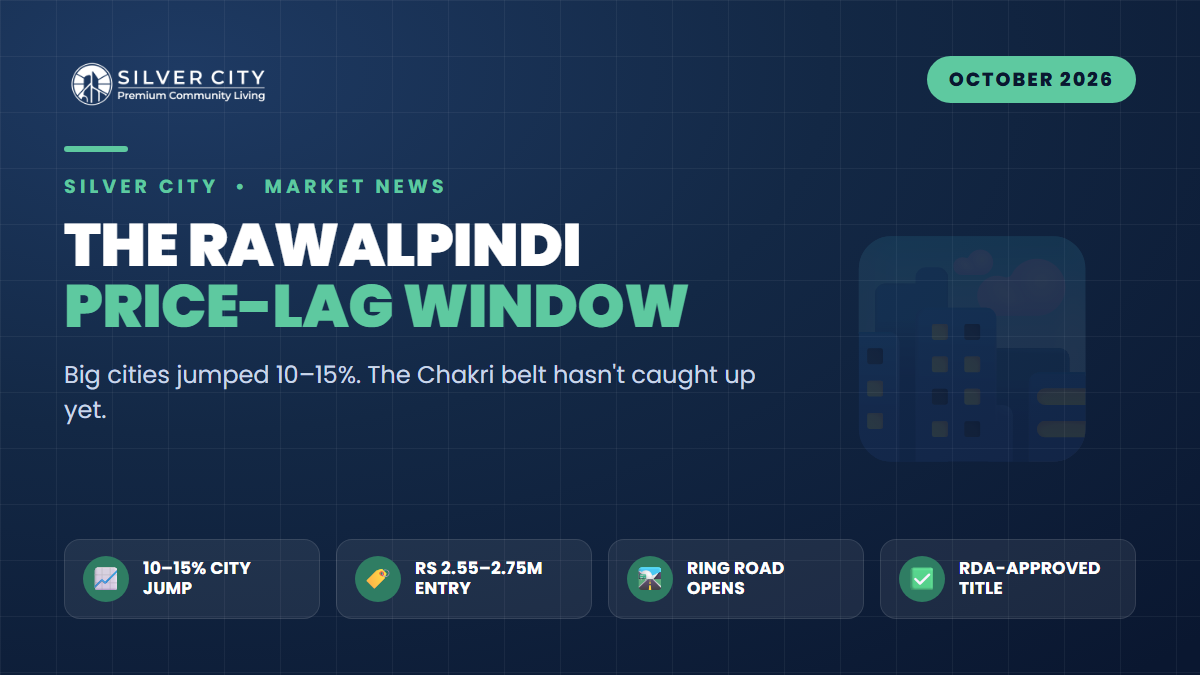
Something shifted in Pakistan’s property market over the last few weeks. According to a late-October 2026 Business Recorder report, residential prices across Karachi, Lahore and Islamabad have climbed an estimated 10–15% in a matter of weeks — not over a year, but weeks — as local and overseas buyers moved back into bricks and mortar. Yet travel 25 kilometres southwest of Islamabad to the Rawalpindi–Chakri belt, and prices there have barely moved. That gap is the whole story, and for a 5-marla buyer it is an opportunity with a visible expiry date.
What Actually Happened to Prices
The surge was driven by a cluster of forces arriving together. Ibrahim Amin, Chairman of valuation firm TriStar International, told Business Recorder that Middle East geopolitical tension has pushed investors to diversify into Pakistani real estate, while the government’s reductions to property transaction taxes (the withholding rates under sections 236C for sellers and 236K for buyers) lowered the friction of buying. Overseas Pakistanis, watching the rupee and chasing tangible assets, added demand on top. In high-end localities such as DHA, limited supply met this rush and prices jumped fast.
The key word is localities. This was a demand shock concentrated in the most liquid, most visible addresses of the three biggest cities — the places where overseas money and speculative capital land first. A mid-tier 5-marla plot in an established Islamabad society that might have traded near Rs90 lakh a couple of months ago is now being quoted closer to Rs1.06 crore by sellers who have seen the headlines. Premium CDA sectors run far higher still, with comparable plots stretching toward Rs2–3 crore.
Why the Rawalpindi–Chakri Belt Lags
Price information does not travel at the same speed everywhere. Peripheral, instalment-driven markets like the Chakri belt reprice on a lag for structural reasons:
- Different buyer base. The Chakri belt sells mostly to end-users and salaried savers on 3–4 year instalment plans — not to the overseas and speculative capital that chases DHA and CDA sectors. That buyer is slower to bid prices up.
- Instalment pricing is sticky. When a society publishes a payment plan, that figure holds until the developer formally revises it. Open-market resale in Islamabad moves daily; a booked RDA file at a fixed plan does not.
- Sentiment arrives last at the edge. Catch-up demand flows outward from the core. Rawalpindi’s affordable belt typically re-rates after the core cities, as priced-out buyers widen their search radius.
History in the twin cities is consistent on this: when the centre runs, the affordable periphery follows with a delay measured in months. The lag is not evidence that the belt is cheap for a bad reason — it is simply late.
The Numbers Side by Side
| Location (5-marla) | Approx. price | Recent move | Typical buyer |
|---|---|---|---|
| Islamabad — mid-tier society | ~Rs1.06 crore | Up 10–15% in weeks | Investor / overseas |
| Islamabad — premium CDA sector | Rs2–3 crore | Up, supply-constrained | High-end / speculative |
| Lahore / Karachi — prime societies | Varies, repriced up | Up 10–15% in weeks | Investor / end-user |
| Rawalpindi RDA belt (e.g. Silver City) | ~Rs2.55–2.75 million | Flat — not yet repriced | End-user / saver |
The arithmetic is blunt. A single mid-tier Islamabad 5-marla at roughly Rs1.06 crore costs about what four RDA-approved 5-marla plots in the Rawalpindi belt cost today. For a first-time investor, that is the difference between one stretched purchase and a diversified, title-clean foothold.
Two Catalysts That Could Close the Gap
Lags do not last forever, and two dated events sit directly on this belt:
- The Rawalpindi Ring Road. The 38.3-km RRR, with an interchange at Chakri, was slated for inauguration around 28 October 2026 at the Banth Interchange. Crucially, it was opening before its electronic tolling was switched on — meaning an early, effectively toll-free window for traffic across the Chakri–Adiala corridor. Improved access is the classic trigger for a peripheral belt to re-rate.
- The tax cuts are already live. The same 236C/236K reductions fuelling the city surge apply to Rawalpindi too. Lower transaction cost plus flat plot prices is an unusually buyer-friendly combination that rarely holds for long once demand notices.
How to Act Without Getting Burned
A value window only pays off if the plot is real. In a belt with both titled RDA schemes and unapproved “files,” discipline matters:
- Insist on RDA approval. Buy into a scheme with a genuine RDA No-Objection Certificate and an approved layout — not a marketing file promising future approval.
- Verify the exact plot. Confirm the block, plot number and dimensions on the approved map, and check dues are clear before any payment.
- Read the payment plan in writing. A typical RDA 5-marla runs a 3–4 year plan: roughly 20–25% down (around Rs315,000+) and monthly instalments near Rs30,000. Get it documented.
- Don’t overpay for the “ring-road premium” blindly. Proximity helps, but pay for approved, developed land — not speculative hype about an interchange.
Frequently Asked Questions
Is the Rawalpindi price lag guaranteed to close?
No forecast is guaranteed. But the structural logic is sound: the core cities have repriced on real demand and tax relief, and affordable peripheries have historically followed in the twin cities. The Ring Road adds a concrete access catalyst. The window exists precisely because the catch-up hasn’t happened yet.
Why buy in Rawalpindi instead of chasing the Islamabad jump?
After a 10–15% run-up, you’d be buying the Islamabad move after it happened. In the Rawalpindi belt you’re buying before a potential re-rate, at roughly a quarter of the ticket size, on an instalment plan a salaried buyer can actually service.
What’s the single biggest risk?
Title. The belt carries both RDA-approved plots and unapproved files sold at a discount. An unapproved file can be cheaper today and worthless later. Paying slightly more for a titled, RDA-approved 5-marla is the cheapest insurance you’ll buy.
How much do I need to get started?
On a typical RDA 5-marla priced around Rs2.55–2.75 million, expect a down payment near Rs315,000–Rs400,000 (about 20–25%), then monthly instalments around Rs30,000 over three to four years. Always confirm the current plan directly with the developer.
The Takeaway
The big cities have already moved; the Rawalpindi–Chakri belt has not. That timing gap — flat prices, cheaper transaction taxes, and a Ring Road opening onto the corridor — is the entry window, and windows like this tend to close quietly once demand catches up. Among RDA-approved options on this belt, Silver City is a titled, RDA-sanctioned society with 5-marla plots still in the Rs2.55–2.75 million range on multi-year instalments — worth shortlisting and verifying for yourself while the lag lasts. Confirm approval, confirm the plot, and decide before the catch-up does it for you.
@@HTML@@