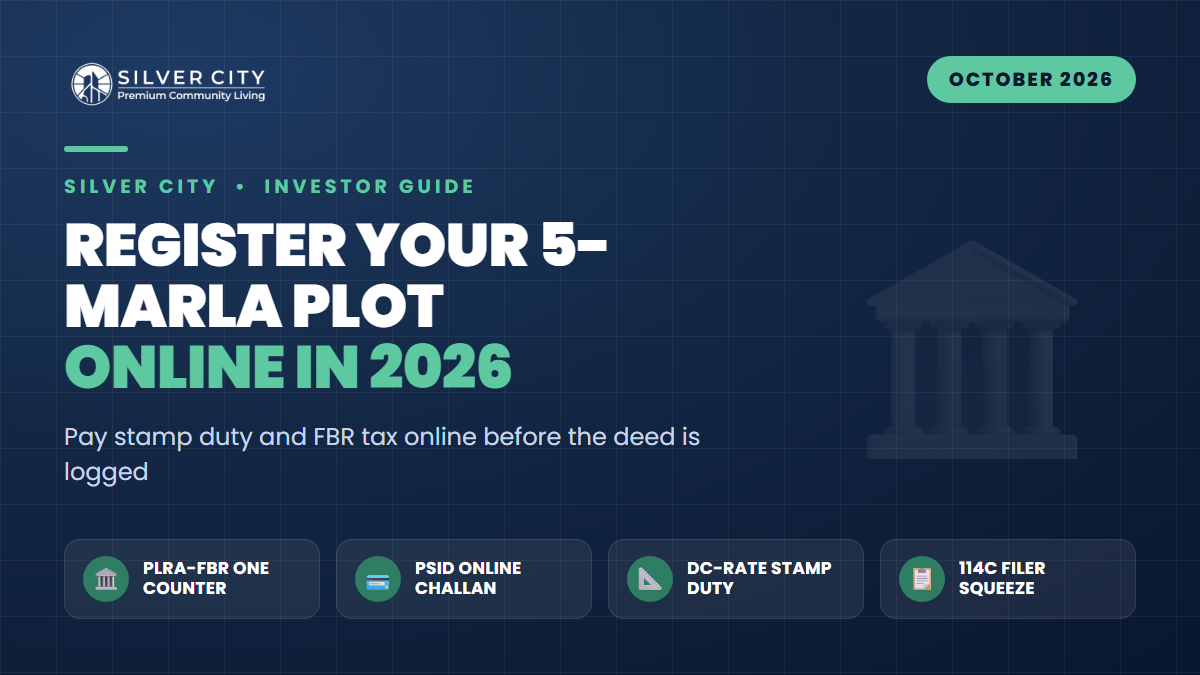
Since the Punjab Land Records Authority (PLRA) and the Federal Board of Revenue (FBR) switched on their integrated one-counter property registration system on 21 August 2026, the way a titled plot changes hands in Rawalpindi has fundamentally changed. You no longer buy physical stamp paper, queue twice, or manually generate FBR challans on a separate website. Instead, stamp duty and federal withholding tax are now calculated, paid online, and verified before your sale deed is ever logged with the Sub-Registrar.
For investors buying or selling a 5-marla plot in an RDA-approved society, this is good news: fewer touchpoints, a clearer audit trail, and less room for a tout to inflate costs. But it also means the paperwork is unforgiving — a mismatched valuation or a lapsed filer status will stall your case. Here is exactly how the digital transfer works in 2026.
What the PLRA–FBR Integration Actually Changed
Property registration in Punjab runs through PLRA’s e-Registration portal (eregistration.punjab-zameen.gov.pk). Under the old flow, you dealt with the e-stamp system, FBR’s IRIS portal, and the registry office as three separate silos. Now they are stitched together end to end:
- The operator pulls the seller’s ownership record and the property’s valuation automatically.
- The system calculates stamp duty, registration fee, and FBR advance tax in one pass.
- A single PSID (Payment Slip ID) challan is generated, which you pay through any bank’s mobile app.
- Once payment is confirmed, the case auto-routes to the Sub-Registrar — no manual hand-carrying of challans.
Crucially, only the process changed. The tax rates themselves stayed the same; what moved online is the sequencing. Payment now comes first, digital signing second.
Step-by-Step: Transferring a Titled RDA 5-Marla Plot
- Confirm the title and society no-dues. For a society plot, obtain a no-demand certificate and transfer-permission letter from the developer, plus the allotment/transfer chain. The plot must be in the seller’s clear name.
- Check filer (ATL) status first. Verify both buyer and seller on FBR’s Active Taxpayer List before generating any challan. Non-filer rates are punishing (see below), and a mid-process status change forces a redo.
- Enter the transaction on the e-Registration portal. Buyer, seller, and two witnesses’ CNICs, the exact property description, and the agreed price are keyed in.
- System generates the combined challan. The portal itself calls FBR and auto-generates the tax challans against the correct notified valuation — you do not create them on FBR’s site anymore.
- Pay the PSID online. Stamp duty, registration fee, and FBR advance tax are settled via mobile banking against the single PSID.
- Appear in person once for biometric signing. Buyer, seller, and witnesses attend the Sub-Registrar with original CNICs for biometric verification and digital execution of the deed.
- Collect the registered deed and apply for mutation (intiqal). The registered instrument then feeds the land record for mutation.
Verifying DC-Rate Stamp Duty in 2026
Every levy is charged on the higher of three values: the FBR-notified valuation, the DC (District Collector) valuation table for that locality, and your declared sale price. The DC rate is the provincial floor for stamp duty, so you must check it before you agree a price — if the DC table is higher than your declared figure, your stamp duty is computed on the DC table, not the bargain.
You can confirm the applicable DC rate for your sector or scheme through the district revenue office or PLRA’s valuation tables for Rawalpindi. Following the Stamp (Amendment) Ordinance 2026 and the notification dated 10 April 2026, Punjab reduced stamp duty on immovable property to a uniform 1%, removing the earlier urban/rural split. The registration fee is charged per the fee schedule (commonly around 1%, subject to applicable caps), plus minor local cess and mutation fees.
Illustrative Cost: Rs 5,000,000 5-Marla Plot (Filer Buyer)
| Head | Rate (Filer) | Amount (Rs) |
|---|---|---|
| Stamp duty | 1% | 50,000 |
| Registration fee | ~1% (per schedule) | 50,000 |
| FBR advance tax — buyer (Sec 236K) | 1.25% | 62,500 |
| Local cess / mutation fee | Nominal | Varies |
| Approx. buyer-side total | — | ~162,500+ |
The seller separately pays advance tax under Section 236C at 2.75% (filer). Figures are illustrative; your actual cost depends on whichever valuation is highest and current notifications, so always recalculate against the live DC table.
Filer vs Non-Filer: Buyer Advance Tax (Sec 236K)
| Transaction value | Filer (ATL) | Non-Filer |
|---|---|---|
| Up to Rs 50 million | 1.25% | 10.5% |
| Rs 50m – Rs 100m | 1.25% | 14.5% |
| Above Rs 100m | 1.25% | 18.5% |
How This Ties Into the 114C Documentation Squeeze
The digital registry is one half of a broader push to formalise land records; Section 114C of the Income Tax Ordinance is the other. Introduced via the Finance Act 2025, it would bar “ineligible persons” — broadly, those who have not declared enough liquid resources in their returns — from buying property above Rs 100 million. As of this writing, those restrictions remain on the books but are not yet in force: no enabling gazette notification has been issued, and the federal cabinet declined to activate them from 1 July. A modest 5-marla plot sits well under the threshold regardless.
The practical takeaway is not panic but preparation. With payment, valuation, and identity all captured digitally at the counter, every transaction now leaves a clean, government-visible trail. Being on the Active Taxpayer List turns a potential 10.5%+ non-filer hit into a 1.25% filer rate and keeps you clear of future eligibility rules. File your return first, buy second.
Frequently Asked Questions
Do I still need to visit the registry office at all?
Yes — once. Payment and challan generation are online, but buyer, seller, and witnesses must appear in person at the Sub-Registrar with original CNICs for biometric verification and digital signing of the deed.
What happens if my declared price is below the DC rate?
Stamp duty and taxes are calculated on the highest of the FBR-notified value, the DC valuation table, and your declared price. If the DC rate is higher, you pay on the DC rate — so verify it before agreeing a figure.
Is Section 114C stopping me from buying a 5-marla plot in 2026?
No. The Section 114C restrictions target purchases above Rs 100 million and have not been notified into force as of October 2026. A 5-marla plot is far below that value. Still, maintaining filer status is strongly advised to secure the lower tax rates and future-proof your file.
Can I generate the FBR challan on the FBR website myself?
For registries after the integration date, the FBR tax challan must be auto-generated through the PLRA e-Registration portal, not FBR’s own site. The portal talks to FBR directly and produces the combined PSID.
The Bottom Line
Digital registration rewards the prepared buyer: verify your DC rate, confirm ATL status, and let the one-counter system do the arithmetic. If you are shopping for a transparently titled 5-marla plot that slots cleanly into this new regime, an RDA-approved society such as Silver City in Rawalpindi is worth considering — approved status, documented title, and society no-dues letters make the e-registration path far smoother than an unregulated alternative. Always confirm the latest rates and notifications with PLRA and FBR before you transact.