On 10 April 2026, the Punjab government issued a notification under the Stamp (Amendment) Ordinance 2026 that quietly rewrites the maths for every property buyer in Rawalpindi. The headline is simple: stamp duty on immovable property is now a uniform 1% across the province — the old 3% rural rate is gone, and rural now equals urban. Paired with a second reform that strips patwaris of everything except inheritance transfers and pushes all sales, gifts and partitions onto the fully-digital Punjab Land Records Authority (PLRA) rail, this is the biggest change to how Rawalpindi property changes hands in years.
But a lower stamp duty does not mean a low transfer bill. Stamp duty was never the largest line item. To know what you will actually pay, you have to add up every provincial and federal charge stacked on a transaction. Below is the honest, recomputed all-in cost for a Rawalpindi transfer in 2026 — and a clear picture of what the PLRA-only route means in practice.
What actually changed on 10 April 2026
- Uniform 1% stamp duty. Previously Punjab charged roughly 1% in notified urban (rating-area) localities and 3% in rural areas. The ordinance fixes it at 1% everywhere, calculated on the higher of the DC valuation table or the declared price.
- Patwaris limited to inheritance (wirasti intiqal). Patwaris can now only process hereditary mutations. Every sale, gift (hiba) and partition must go through the standardised PLRA digital workflow.
- Section 7E gone. The Budget 2026-27 abolished the 1% “deemed income” tax under Section 7E, so buyers and sellers no longer chase a 7E compliance certificate to complete a transfer.
The stamp-duty change matters most for the peri-urban and rural belt where much of Rawalpindi’s new-society development sits — around the Chakri and Adiala corridors and the Rawalpindi Ring Road interchanges. Those areas carried the old 3% rate; they now drop to 1%. Buyers inside long-notified urban limits were already at ~1%, so for them the reform is neutral on stamp duty.
The recomputed all-in transfer bill
Assume a residential plot with a tax-base value (higher of DC rate / FBR value) of Rs 10,000,000, both parties tax filers. Here is who pays what in 2026:
| Charge | Who pays | Rate (filer) | On Rs 10m |
|---|---|---|---|
| Stamp duty (now uniform) | Buyer | 1% | Rs 100,000 |
| Municipal / TIP transfer tax (TMA) | Buyer | ~1%* | Rs 100,000 |
| Registration fee | Buyer | Fixed nominal | ~Rs 500–1,000 |
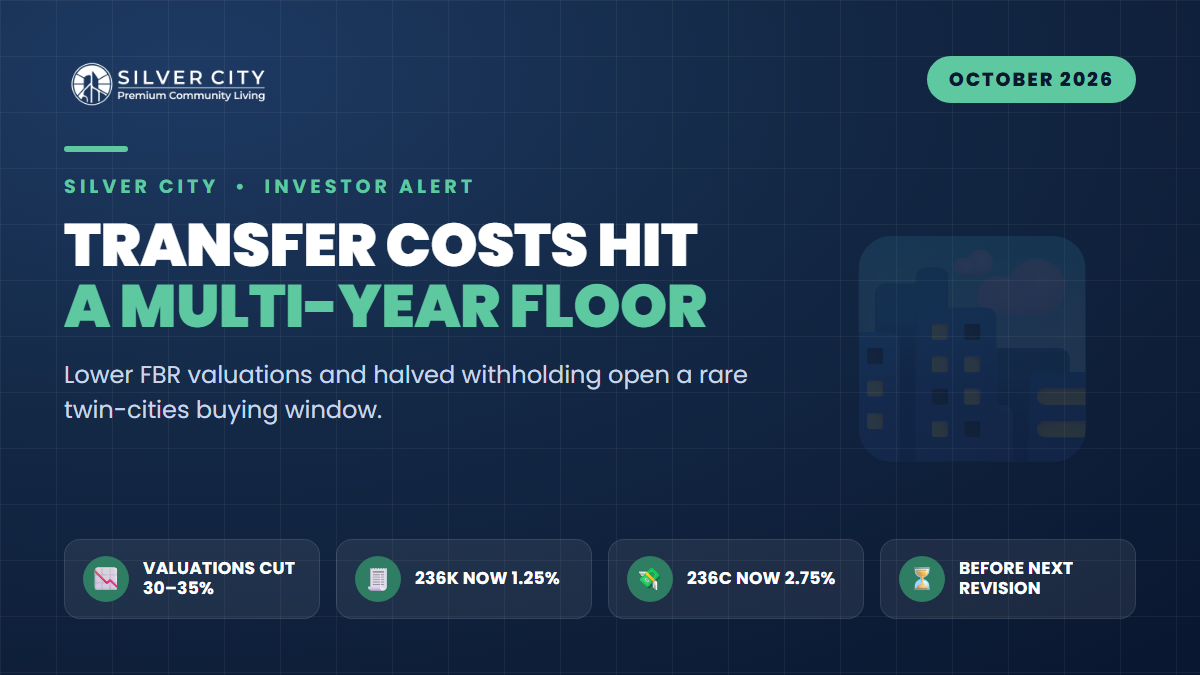
| Advance tax — Section 236K | Buyer | 3%** | Rs 300,000 |
| Advance tax — Section 236C | Seller | 3%** | Rs 300,000 |
| Provincial CVT (residential) | — | 0% | Rs 0 |
*Municipal Transfer of Immovable Property tax varies by municipality (commonly 1–3%); confirm the exact slab for your tehsil. **236K/236C filer rates rise on higher-value slabs and are roughly tripled for non-filers/late-filers; commercial CVT is 2%.
Buyer’s all-in ≈ Rs 500,500 (about 5% of value). Seller’s all-in ≈ Rs 300,000 (about 3%). Combined transaction friction lands near 8% — split across the two parties — with the federal advance taxes, not stamp duty, doing most of the damage.
Before vs after: where the saving is real
| Location type | Old stamp duty | New stamp duty | Buyer saving on Rs 10m |
|---|---|---|---|
| Notified urban (already ~1%) | ~1% | 1% | Rs 0 |
| Rural / peri-urban belt | 3% | 1% | Rs 200,000 |
The message for investors: the reform is a genuine 2% discount on rural-notified land — exactly the belt where affordable RDA-approved societies are launching — but it does nothing to shrink the 236K/236C withholding block. Keeping your filer status is worth far more than the stamp-duty cut, because non-filer advance tax alone can add double-digit percentages to the same deal.
What the fully-digital PLRA route means for you
With patwaris confined to inheritance, a normal Rawalpindi sale now runs on PLRA’s electronic system through an Arazi Record Centre (ARC) or the plra.punjab.gov.pk portal. In practice the flow looks like this:
- Verify online first. Pull the digital Fard (record of rights) by CNIC or khasra number to confirm the seller’s title and check for any lien or “roken” (freeze) before you pay a rupee.
- Deed drafting and stamp payment. Pay the 1% stamp duty and fees via e-stamp; the deed is registered with the Sub-Registrar.
- Biometric mutation at the ARC. Both parties appear for thumb-verification; the mutation (intiqal) is entered and approved digitally — no manual patwari register.
- Updated digital Fard issued reflecting the new owner, usually far faster and with a clean audit trail.
The upside is real: biometric verification and a tamper-resistant electronic record cut out the classic frauds — double sales, back-dated mutations and “ghost” entries — that plagued the patwari system. The trade-off is that everything is now on record, so undocumented or under-declared deals are harder, and your paperwork must be clean. For a serious investor, that is a feature, not a bug: a title that is verifiable online is a title you can resell or mortgage without friction.
Practical takeaways for Rawalpindi buyers
- Budget for roughly 5% buyer-side costs, not just the 1% stamp duty headline.
- Stay on the Active Taxpayer List before you transact — filer status is the single biggest lever on your bill.
- Always pull the digital Fard yourself and confirm the land is in a PLRA-computerised estate.
- For rural-notified plots, the new 1% rate is a genuine saving — factor it into your negotiation.
Frequently Asked Questions
Is stamp duty in Rawalpindi really just 1% now?
Yes — under the 10 April 2026 notification, stamp duty is a uniform 1% on immovable property in both urban and rural Punjab, charged on the higher of the DC valuation table or the declared sale price. It replaces the old 3% rural rate.
So is my total transfer cost only 1%?
No. Stamp duty is one line item. A filer buyer typically pays around 5% all-in once you add the municipal transfer (TIP) tax, the nominal registration fee and the 3% federal advance tax under Section 236K. The seller separately pays about 3% under Section 236C. Non-filers pay substantially more.
Can I still get my sale done through a patwari?
Not for a sale. Patwaris are now restricted to inheritance (wirasti) transfers only. Sales, gifts and partitions must go through the PLRA digital process at an Arazi Record Centre, with biometric verification and an electronic mutation.
How do I check a property’s record before buying?
Use the PLRA portal (plra.punjab.gov.pk) or visit an Arazi Record Centre to obtain the digital Fard by CNIC or khasra number. Confirm ownership, check for any freeze or dispute, and ensure the estate is computerised before making any payment.
The bottom line
Punjab’s 1% stamp duty and the PLRA-only transfer rail together lower cost and raise transparency — especially in the rural-notified belt where Rawalpindi’s growth is happening. When you pair a cleaner, digitally verifiable title with a genuine stamp-duty saving, RDA-approved projects in that corridor become more attractive on paper and in practice. Silver City, an RDA-approved housing society on the Rawalpindi side, is one such option worth considering for buyers who want documented, transfer-ready plots that sit comfortably inside this new, fully-digital framework — but as always, verify the current Fard and your own tax status before you commit.