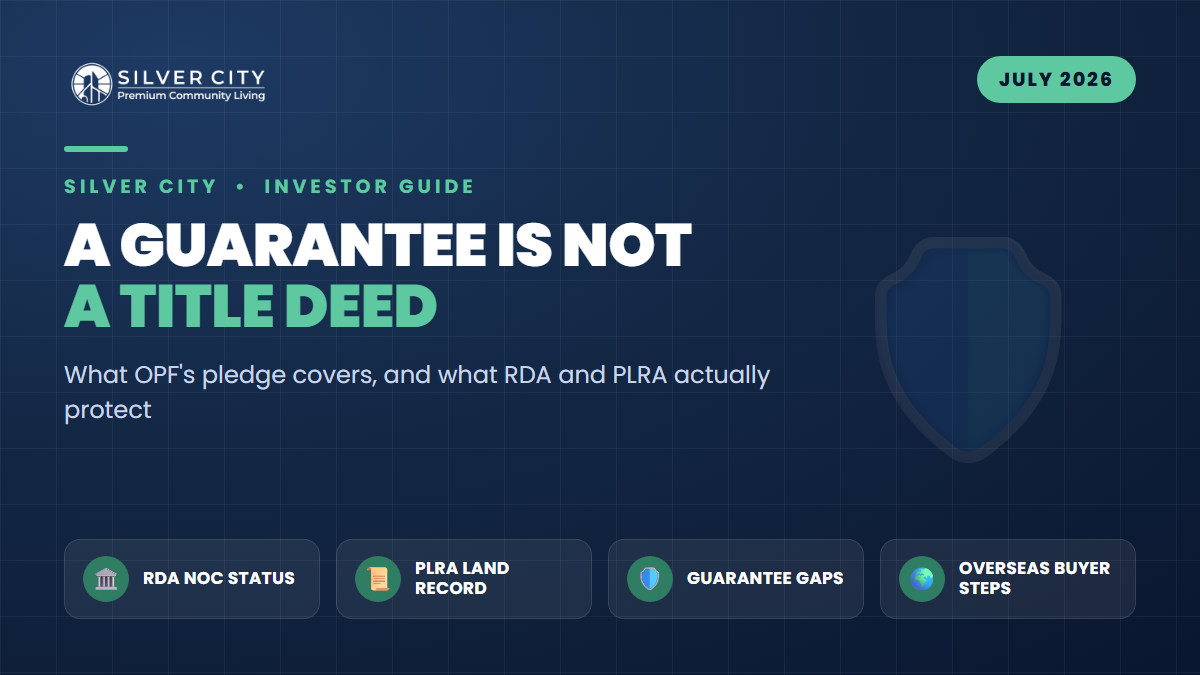
Two announcements have given overseas Pakistani buyers a reason to feel safer this year. The Overseas Pakistanis Foundation (OPF) says it is willing to stand behind the delivery of property investments it recommends. And on 28 July 2026, British-Pakistani businessman Shafiq Akbar announced from Manchester that a private property verification service for overseas Pakistanis will launch in August 2026, allowing buyers abroad to check a property’s legal and ownership status remotely before paying.
Both are genuinely useful developments. Neither is a substitute for the two things that actually decide whether a diaspora buyer in Rawalpindi keeps their money: whether the scheme holds a valid Rawalpindi Development Authority (RDA) approval for the exact block being sold, and whether the land underneath it shows up cleanly in the Punjab Land Records Authority (PLRA) record.
What Was Actually Announced — And What Wasn’t
The OPF Position
OPF Chairman Syed Qamar Raza said the Foundation is conducting due diligence on housing societies that hold NOCs and possess sufficient land, and will then recommend them: “We will engage with them and recommend them to overseas Pakistanis, assuring that if they invest in these property projects, OPF will take responsibility for the investment and delivery.”
Read that carefully. It is a stated intention, not a notified scheme. As of now there is no published claims procedure, no compensation ceiling, no escrow account, no premium, and no statutory instrument creating an enforceable liability on OPF. It also sits alongside other OPF proposals — mandatory membership at roughly Rs 10,000 for five years, 30% diagnostic-centre discounts, up to 40% hotel discounts, and a dedicated OPF bank — which signals a facilitation body expanding its services, not an insurer issuing policies.
The August Verification Service
The private service launching in August 2026 addresses a real problem — Akbar noted that fear of fraudulent transactions has kept some overseas Pakistanis out of the market entirely. But a verification report is a professional opinion on records as they stood on the day of the search. It does not create title, cannot bind RDA or the revenue department, and its liability is limited to whatever its own service contract says. Pricing and regulatory oversight have not been disclosed.
Coverage Matrix: What Each Layer Really Does
| Protection layer | Protects against | Does NOT cover | Status (July 2026) |
|---|---|---|---|
| OPF delivery guarantee | Reputational risk of picking an unvetted developer; a shortlist of NOC-holding schemes | Price falls, possession delays, sub-standard development, disputes on your individual file, resale losses | Under consideration; no notified rules or claim process |
| Private verification service | Forged files, double-sold plots, seller who is not the recorded owner, litigation flags on record | Fraud committed after the report date; unrecorded oral claims; developer insolvency; enforcement | Launching August 2026; terms undisclosed |
| RDA approval + approved layout | Buying a plot in an unapproved or partially approved block; demolition and de-listing risk; unsellable files | Individual seller fraud; overpricing; delivery timeline | Live, checkable free on the RDA portal |
| PLRA record / registered deed | Ownership disputes, defective chain of title, encumbrances, mortgages on the mother land | Development quality, society solvency, market value | Live via PLRA’s online record system |
Why RDA Status Still Carries the Real Risk
RDA’s own scheme census tells the story: roughly 66 legally approved private schemes in its jurisdiction, around 59 under process for legal status, and about 261 declared illegal, with advertising by unlawful societies prohibited. That ratio is the single most important number an overseas buyer in Rawalpindi should know. No guarantee, public or private, can rescue money placed in a scheme that sits in the 261.
Check it yourself and free: go to the RDA website, open Private Housing Societies, then Know Status of Housing Society, and search the scheme by name. Then push further — ask for the approval letter number, the date, and the specific sectors or blocks covered by the sanctioned layout plan. A society can be genuinely approved while an extension block being marketed to you is not yet sanctioned. That gap is where most diaspora losses in Rawalpindi actually occur, and it is invisible to anyone checking only “is the society approved?”
The PLRA Record — And The Gap Nobody Warns You About
PLRA’s online services let you pull a fard (record of rights), registered deeds, and related records without flying home. Use it to confirm that the khasra numbers under your block are recorded in the developer’s name, and that no mortgage or attachment sits against them.
Here is the nuance most articles skip. In most private Rawalpindi schemes, what you buy is an allotment or transfer letter from the society — a contractual interest, not a PLRA-recorded title in your name. Your name enters the revenue and registration record only after sub-division approval and a registered sale deed. Until that day, your protection is the society’s own recorded ownership plus its RDA sanction, which is exactly why those two checks outrank any guarantee. Ask, in writing, when registry will be available for your block, and prefer schemes already executing registries.
Transaction Costs You Should Budget
| Head | Indicative position (2025–26) | Note for overseas buyers |
|---|---|---|
| Stamp duty (Punjab) | 1% of value | Punjab has moved to a uniform 1% rate; confirm the notified rate on registry day |
| Registration fee | 1% of consideration/valuation | Payable at deed registration, not at file purchase |
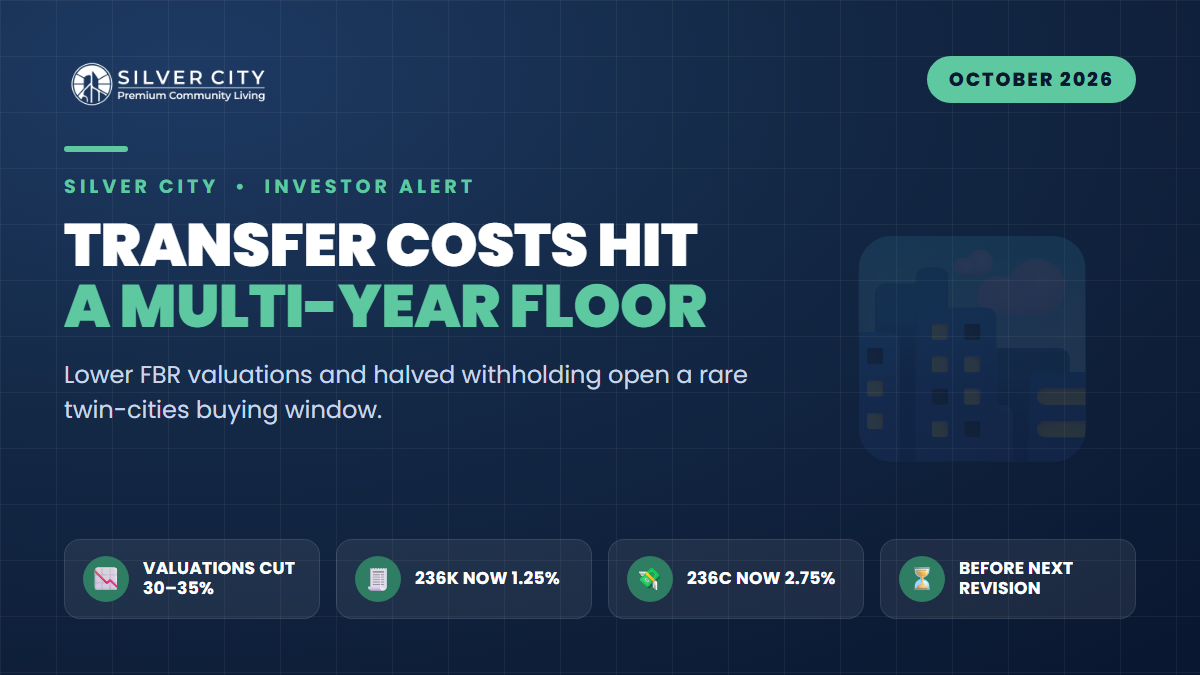
| Advance tax on purchase (236K) | From 1.5% at filer rate on the lowest slab | Non-filer rates rise steeply by slab |
| Advance tax on sale (236C) | From 4.5% at filer rate on the lowest slab | The 2025 Act shifted burden toward sellers |
| Non-resident relief | Filer-rate treatment via Clause 111AC | NICOP/POC holders who are non-resident may claim filer rates even if not on the ATL |
A Practical Sequence Before You Transfer Money
- Confirm scheme status on the RDA portal, then obtain the approval letter and sanctioned layout for your specific block.
- Pull the fard for the underlying khasra numbers through PLRA and check for encumbrances.
- Verify the seller’s identity and that the file’s transfer history matches society records — this is where the August service can add value.
- Execute a special power of attorney attested by the Pakistan mission in your country and then by MOFA; never give a general POA over all your assets.
- Pay only into the society’s declared bank account against a receipt in your name. Never into an agent’s personal account.
- Keep NICOP/POC documentation ready to claim non-resident filer-rate treatment at transfer.
Frequently Asked Questions
If OPF recommends a society, is my money protected?
Not yet in any enforceable sense. The Chairman has stated an intention to take responsibility for investment and delivery in vetted, NOC-holding schemes, but no notified rules, claim mechanism, or compensation limit have been published. Treat an OPF recommendation as a useful shortlist filter, not as insurance.
Does the August verification service replace a lawyer?
No. It is a records-search product that reports what the register shows on a given date. You still need a lawyer to review the sale agreement, the POA, the payment schedule, and the transfer documentation, and to act if something goes wrong.
Can I get a registry in my own name while living abroad?
Yes, where the block is sub-divided and registry-ready, using a properly attested special power of attorney. If the scheme cannot yet offer registry, your file remains a contractual interest — which is why the developer’s own recorded ownership and RDA sanction matter so much.
Which check should I do first?
RDA status, always. It is free, takes minutes, and eliminates the largest single category of diaspora loss before you spend anything on verification, travel, or legal fees.
The Bottom Line
Guarantees and verification services reduce friction; approvals and land records reduce risk. Build outward from the records that already exist — RDA sanction for your exact block, a clean PLRA fard, and a credible path to registry — and treat every new guarantee as a bonus layer on top of that foundation, not a replacement for it. For overseas buyers applying that test in Rawalpindi, Silver City on Girja Road near Thalian Interchange is an RDA-approved option worth including on the shortlist — and worth verifying block by block, exactly as you would with any scheme.