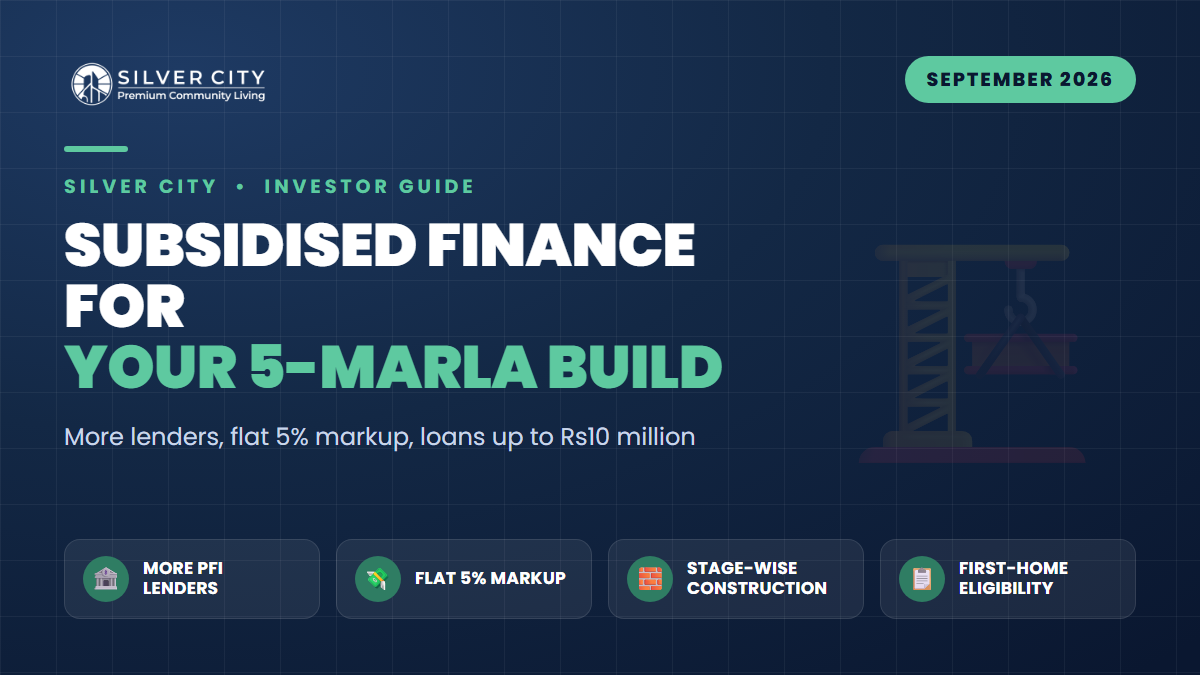
If you already hold a 5-marla plot in Silver City, the biggest hurdle to actually building has usually been the money — grey-structure and finishing costs run into millions, and commercial mortgages at 20%-plus markup make monthly payments punishing. The government’s Mera Ghar Mera Aashiana (MGMA) scheme changed that maths with a flat 5% end-user markup, and a July 2026 policy update has now widened the doors even further by letting NBFCs and microfinance companies act as Participating Financial Institutions (PFIs). For a plot owner in an RDA-approved society, that means more places to apply and a better chance of an approval that fits your income profile.
What the July 2026 Update Actually Changed
MGMA is a State Bank of Pakistan (SBP) markup-subsidy and risk-sharing programme. The government pays the difference between the market rate and the end-user rate, so you carry a subsidised cost while your lender earns a market return. After the Economic Coordination Committee (ECC) revisions earlier in 2026, the headline terms became a uniform flat 5% markup and a maximum loan of Rs10 million, with eligible units of up to 10 marla for houses (a 5-marla plot sits comfortably inside this) and roughly 1,500 sq ft for flats.
Until mid-2026, the lender list was limited to commercial banks, Islamic banks, microfinance banks (MFBs) and the House Building Finance Company Limited (HBFCL). The July 2026 update added two new categories of PFI:
- NBFCs (Non-Banking Finance Companies) — approved to lend up to Rs10 million, the full scheme ceiling.
- Microfinance companies — approved to lend up to Rs5 million, aimed at smaller, lower-ticket construction needs.
For borrowers this matters because banks often decline self-employed or informal-income applicants who cannot show clean salary slips. NBFCs and microfinance lenders are generally more comfortable underwriting cash-flow-based and small-business incomes — so a shopkeeper, freelancer or overseas-remittance household that a bank rejected now has genuine alternatives at the same subsidised 5% cost.
Why This Fits a Silver City 5-Marla Owner Perfectly
MGMA finances three things: buying a ready home, constructing on land you already own, or buying land plus construction together. A Silver City plot holder falls squarely into the middle case — you own the land, you just need build finance. Construction loans are typically released in stages (foundation, structure, finishing), so you draw and pay markup only as work progresses rather than servicing the full Rs10m from day one.
Because Silver City is an RDA-approved scheme with an approved layout and title chain, lenders can verify your plot and mortgage it far more easily than in an unapproved or disputed society — approval friction that trips up many MGMA applications elsewhere simply does not arise here.
Indicative 5-Marla Construction Budget (Illustrative)
| Stage | Typical scope | Rough cost band |
|---|---|---|
| Grey structure | Foundation, columns, slabs, brickwork, plaster | Rs3.5m – Rs5.5m |
| Finishing | Flooring, wood/kitchen, sanitary, paint, electrical | Rs3.0m – Rs5.0m |
| Fixtures & extras | Grills, boundary finish, fittings, contingency | Rs0.8m – Rs1.5m |
| Approx. total (double-storey) | Turnkey 5-marla home | Rs7m – Rs11m |
These are indicative market ranges that move with material prices; get a current BOQ from your builder. The point is that the Rs10m ceiling (or Rs5m via a microfinance company for a modest single-storey build) can cover most or all of a 5-marla construction at a fraction of normal financing cost.
Snapshot of Core Terms
| Feature | Detail |
|---|---|
| End-user markup | Flat 5% (subsidised for the first 10 years) |
| Maximum loan | Rs10m (NBFC/bank); up to Rs5m (microfinance company) |
| Tenure | Up to 20 years |
| Borrower equity | Around 10% of project cost |
| Eligible unit | House up to 10 marla / flat up to ~1,500 sq ft |
| Who qualifies | First-time home owner, valid CNIC, adult within lender age limits |
How to Pick the Right PFI
The 5% end-user rate is fixed by the scheme, so lenders don’t compete on that. They compete on approval speed, income flexibility, processing fees, insurance charges and how construction tranches are released. Use this checklist:
- Match the lender to your income type. Salaried with a clean bank statement? A commercial or Islamic bank is fastest. Self-employed or informal income? An NBFC or microfinance company will likely understand your file better.
- Match the loan size to the lender. Need close to Rs10m? Use a bank, HBFCL or NBFC. A modest single-storey build under Rs5m fits a microfinance company.
- Conventional vs Islamic. Islamic PFIs structure this as diminishing-musharakah rather than interest; the 5% cost is comparable, so choose on preference and paperwork comfort.
- Ask about all-in cost, not just markup. Compare processing fees, legal/valuation charges, mandatory life and property takaful/insurance, and any early-settlement terms.
- Check the construction-draw schedule. Confirm how many tranches, what site inspection each needs, and how quickly funds release — delays here stall your builder.
- Confirm they accept Silver City documentation. Since the society is RDA-approved, ask the lender’s panel whether the layout and transfer letter are pre-cleared, which shortens verification.
Documents You’ll Typically Need
- CNIC and recent passport-size photos
- Proof of income — salary slips and bank statements, or business/tax records for the self-employed
- Plot ownership documents: allotment/transfer letter and society NOC
- Approved building plan and a builder’s cost estimate (BOQ)
- An undertaking that you do not already own a residential unit
Frequently Asked Questions
Can I use MGMA if I already own my Silver City plot but no house?
Yes. Construction-on-owned-land is one of the three uses the scheme explicitly covers. Your plot becomes both the site and the collateral, and funds are released in stages as construction progresses.
Is the 5% markup really fixed, or can lenders charge more?
The 5% end-user rate is set by the scheme and subsidised by the government for the first 10 years, so no PFI can charge you more than that on the markup. What varies between lenders is fees, insurance and processing — which is why you should compare the all-in cost.
What’s the difference between borrowing from an NBFC versus a microfinance company?
Both are new PFI categories added in July 2026. NBFCs can lend up to the full Rs10m ceiling, while microfinance companies are capped at Rs5m. Microfinance lenders are usually more flexible on smaller, informal-income cases; NBFCs suit larger construction tickets.
Do I still need to put in my own money?
Yes — expect to contribute roughly 10% equity toward the project cost, plus processing and insurance charges. Budget for these upfront so a construction tranche isn’t held up.
The Takeaway
The July 2026 addition of NBFCs and microfinance companies as PFIs means a Silver City 5-marla owner is no longer dependent on a single bank’s appetite — you can now shop across banks, HBFCL, NBFCs and microfinance lenders for the same flat 5% markup and loans up to Rs10 million. Pair that widened access with an RDA-approved society whose title and layout make lender verification straightforward, and Silver City stands out as a practical, financing-ready base for building your first home. Confirm the latest terms with your chosen PFI and the SBP before you commit, then let the subsidised construction finance do the heavy lifting.
@@HTML@@