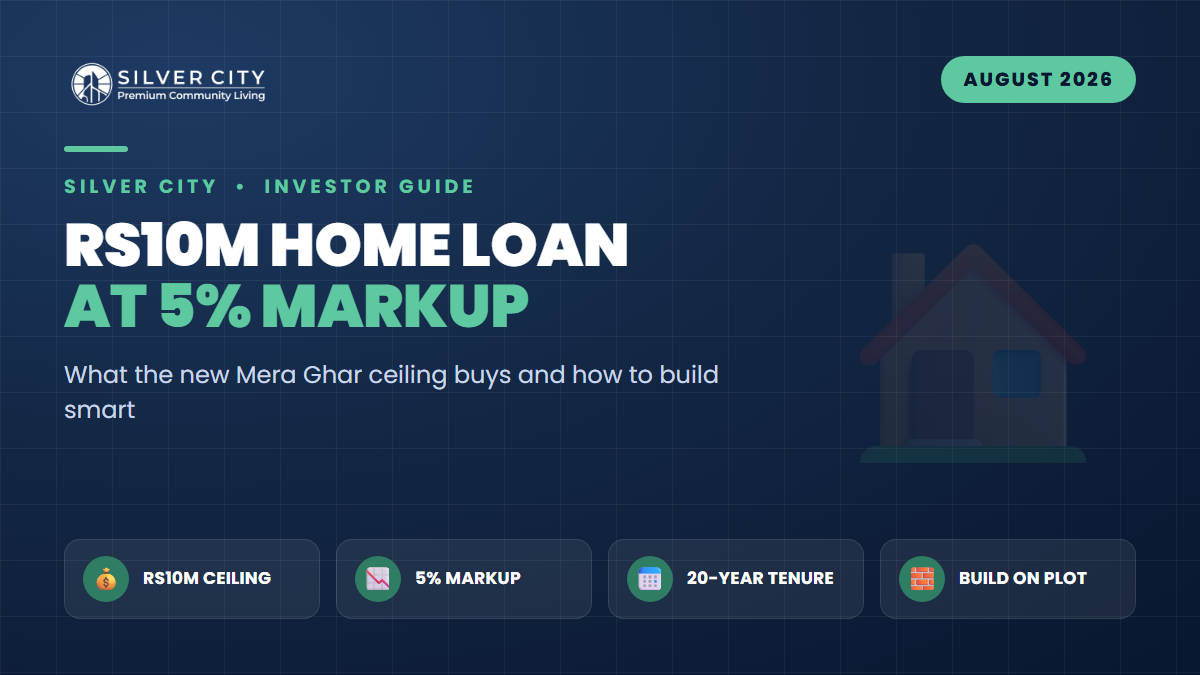
For years, Pakistan’s flagship low-cost housing loan struggled with one fatal flaw: the numbers were too small to matter. A Rs2m–Rs3.5m cap could not build a real house in an inflation-hit market. That has now changed. In its decision of 28 February 2026, the Economic Coordination Committee (ECC) raised the ceiling under Mera Ghar Mera Aashiana to Rs10 million and cut the markup to a uniform 5%, with repayment tenures stretching up to 20 years. For plot owners in RDA-approved societies like Silver City, this reshapes the arithmetic of turning an empty plot into a finished home.
What Actually Changed
The revamped scheme is a government markup-subsidy and risk-sharing programme routed through commercial and microfinance banks under the State Bank of Pakistan. The headline changes are worth memorising before you talk to any bank:
- Loan ceiling: raised from a tiered Rs2m–Rs3.5m to up to Rs10 million.
- Markup: a single subsidised rate of 5% per annum, replacing the old 5%/8% split.
- Tenure: repayment up to 20 years.
- Down payment / equity: as low as 10% of property value.
- Eligible units: houses up to 10 marla or flats up to 1,500 sq ft.
- Eligibility: a Pakistani CNIC holder who is a first-time homeowner (you must not already own a housing unit anywhere in Pakistan), typically aged 21–65 at loan maturity, with verifiable income.
- Scale: the revised scheme targets financing for roughly 500,000 units over four years.
One important caveat to confirm with your bank: several reports indicate the subsidised 5% applies to an initial period and may reset to market-based pricing after year 10. Ask your lender in writing whether the 5% is locked for the full tenure or repriced — it changes your later instalments materially.
What Does a Rs10m Mortgage Cost Per Month?
At 5% over 20 years, a Rs10m loan works out to roughly Rs66,000 per month. Compare that to a normal bank home loan at ~20%+, where the same amount would cost well over Rs160,000 a month — the subsidy is doing heavy lifting. Here is how different loan sizes look:
| Loan amount | Rate | Tenure | Approx. monthly instalment | Approx. total repaid |
|---|---|---|---|---|
| Rs2,000,000 | 5% | 20 yrs | ~Rs13,200 | ~Rs3.2m |
| Rs3,500,000 | 5% | 20 yrs | ~Rs23,100 | ~Rs5.5m |
| Rs5,000,000 | 5% | 20 yrs | ~Rs33,000 | ~Rs7.9m |
| Rs10,000,000 | 5% | 20 yrs | ~Rs66,000 | ~Rs15.8m |
Banks generally cap your instalment at around 35%–50% of net monthly income. To service the full Rs66,000, you will typically need documented household income in the region of Rs140,000–Rs180,000 a month. Figures are indicative; each bank runs its own affordability model.
Buy-and-Build vs. Build-Only: Why Plot Owners Win
The scheme finances buying, building, or renovating. If you already own a plot in an approved society, you skip the biggest single cost — land — and point the entire Rs10m at construction. That is a structural advantage. A ready 5-marla house in a good Rawalpindi society can run Rs2.5–4 crore; owning the plot and borrowing to build lets you reach a finished home for a fraction of the cash outlay.
Here is a realistic 2026 construction budget for Rawalpindi/Islamabad, useful for sizing your loan against what you want to build:
| Build scope | Approx. cost / sq ft | 5-marla double storey (~2,250 sq ft covered) |
|---|---|---|
| Grey structure only | ~Rs4,500–6,000 | ~Rs10m–13.5m |
| Turnkey (standard finish) | ~Rs8,500–11,000 | ~Rs19m–25m |
| Turnkey (premium finish) | Rs12,000+ | Rs27m+ |
The takeaway: Rs10m broadly covers the grey structure of a 5-marla double storey, or a full turnkey finish of a compact single-storey/3-marla home. Many plot owners use the loan for grey structure and finishing, then complete cosmetic work (paint, wardrobes, landscaping) from savings — keeping the borrowed amount, and the instalment, disciplined.
How Construction Financing Is Released
Unlike a purchase loan paid in one shot, a build loan is disbursed in stages (tranches) tied to construction milestones — foundation, grey structure, roof, finishing. The bank sends a valuer to verify each stage before releasing the next tranche, and mark-up usually accrues only on the amount disbursed so far. Practical implications:
- Keep an approved building plan and BOQ (bill of quantities) ready — banks want a costed schedule.
- Ensure your society membership, allotment, and possession documents are clean and transferable — an RDA-approved layout makes this far smoother.
- Budget for the 10% equity plus incidental costs (map fee, valuation, legal, insurance).
- Build with a buffer — construction inflation on cement, steel and labour can move mid-project.
How to Apply
There is no single government portal — you apply directly through a participating bank. The path is: choose a scheme-participating bank, submit the Loan Application Form with CNIC, income proof, bank statements and plot/allotment documents; the bank verifies eligibility (including first-time-owner status) and property; approval typically takes a few weeks; construction funds then release in tranches. Always get the markup terms, reset clause, and total cost of financing in writing before signing.
Frequently Asked Questions
Is the 5% markup fixed for the whole 20 years?
The scheme advertises a subsidised 5%, but reporting suggests it may apply for an initial period (commonly cited as 10 years) before repricing to market rates for the remaining tenure. This is the single most important thing to confirm in writing with your lender, because it changes your later instalments significantly.
Can I use the loan to build on a plot I already own?
Yes. The scheme covers construction and renovation, not just purchase. Owning your plot means the full financing goes toward building, which is exactly why plot owners in approved societies are well positioned. Funds are released in stages against verified construction milestones.
Do I qualify if I already own property?
Generally no. Mera Ghar Mera Aashiana is aimed at first-time homeowners — you should not already own a housing unit anywhere in Pakistan. You will also need a valid CNIC, verifiable income, and to fall within the bank’s age and affordability limits.
What size house can I build within the eligible limits?
Eligible units are houses up to 10 marla or flats up to 1,500 sq ft. A Rs10m loan realistically funds the grey structure of a 5-marla double storey or a turnkey finish of a smaller home — pair it with modest savings to complete.
The Bottom Line for Silver City Plot Owners
The jump from Rs3.5m to Rs10m at a subsidised 5% finally makes government housing finance capable of building a real house rather than a token structure. If you already hold a plot in an RDA-approved society such as Silver City on Girja Road, Rawalpindi, you are positioned to convert land into a finished home with a manageable monthly commitment and a clean, bankable title — the kind of documentation that keeps staged construction disbursements moving. As always, verify the current markup terms, reset clause and total cost of financing directly with your chosen bank before committing. For first-time buyers weighing where to plant that plot, an RDA-approved layout like Silver City is worth shortlisting precisely because approved, transferable documentation is what makes schemes like this work in practice.
@@END@@
Sources: [Profit by Pakistan Today](https://profit.pakistantoday.com.pk/2026/02/28/govt-raises-loan-limit-to-rs10-million-for-low-cost-housing-cuts-mark-up-to-5/), [Geo News](https://www.geo.tv/latest/653340-ecc-extends-loan-limit-to-rs10m-for-mera-ghar-mera-aashiana-applicants), [Business Recorder](https://www.brecorder.com/news/40412130/mera-ghar-mera-ashiana-housing-scheme-loan-size-enhanced-up-to-rs10m), [Mettis Global](https://mettisglobal.news/Mera-Ghar-Mera-Ashiana-Govt-cuts-housing-loan-rate-to-5-59106), [Daily Ausaf](https://dailyausaf.com/en/news/mera-ghar-mera-aashiana-loan-limit-raised-to-rs10-million-by-ecc/)