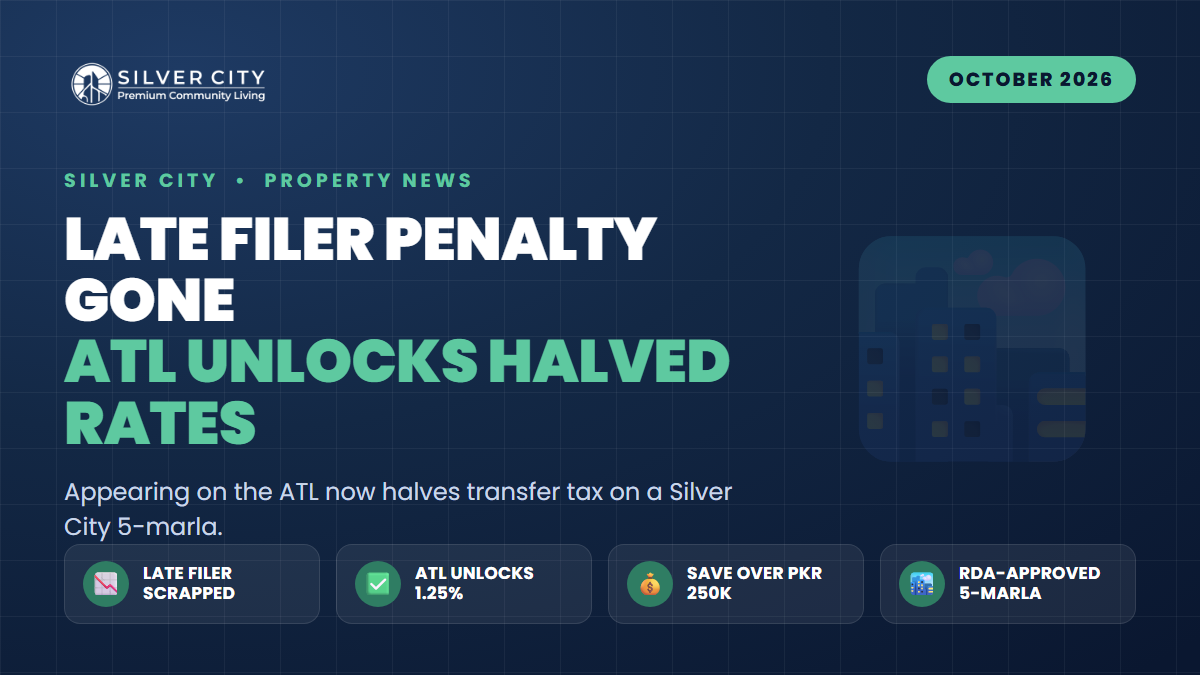
For three years, Pakistan’s property buyers lived with a confusing middle tier called the “late filer” — a status that punished you for filing late even after you had complied. The Finance Act 2026 has quietly removed it. With the extended income tax return deadline of 15 October 2026 now behind us, the rules are simpler than they have been in years: you are either on the Active Taxpayer List (ATL) or you are not. And for anyone buying or selling a 5-marla plot in an RDA-approved society like Silver City, that single line of status is worth hundreds of thousands of rupees.
What Actually Changed in the Finance Act 2026
The Tenth Schedule of the Income Tax Ordinance, 2001 previously carried a rule (1A) that created a three-way split: on-time filer, late filer, and non-filer. Late filers paid an intermediate withholding rate on property — better than a non-filer, worse than a punctual filer. The Finance Act 2026 omitted that rule entirely. Pakistan is now back to a clean binary test: your name appears on the ATL, or it doesn’t.
This matters because the two advance-tax sections that bite every property transaction — Section 236K (collected from the buyer on purchase) and Section 236C (collected from the seller on sale) — key entirely off ATL status. The Act also converted these into clean flat rates for filers, ending years of slab-by-slab confusion. If you are on the ATL at the moment the transfer is registered, you pay the low rate. If you are not, you pay the punitive non-filer rate — there is no longer a softer “late filer” cushion in between.
The Numbers: Filer vs Non-Filer in 2026-27
Here are the current advance-tax rates for immovable property under the Finance Act 2026. These are withholding taxes, adjustable against your annual tax liability when you file.
| Transaction | Section | On ATL (Filer) | Not on ATL (Non-Filer) |
|---|---|---|---|
| Buying property | 236K | 1.25% (flat) | 10.5% up to Rs 50m; 14.5% Rs 50–100m; 18.5% above Rs 100m |
| Selling property | 236C | 2.75% (flat) | ~11.5% |
The gap is no longer a nuisance; it is a wall. On a purchase, the non-filer pays roughly eight times what an ATL buyer pays. The “late filer” rate that used to sit politely between them is gone — miss the ATL and you fall all the way to the non-filer column.
A Worked Example on a Silver City 5-Marla
Silver City’s 5-marla residential plots currently trade in roughly the Rs 2.55–2.75 million range, with installment files sitting around Rs 2.75 million. Advance tax is calculated on the higher of the FBR valuation or the declared consideration. Using Rs 2.75 million for illustration:
| Scenario (Rs 2.75m plot) | On ATL | Not on ATL | Difference |
|---|---|---|---|
| Buyer — 236K | Rs 34,375 (1.25%) | Rs 288,750 (10.5%) | Rs 254,375 |
| Seller — 236C | Rs 75,625 (2.75%) | Rs 316,250 (11.5%) | Rs 240,625 |
A buyer who is simply on the ATL saves over Rs 2.5 lakh on a single 5-marla purchase. To put it bluntly: the cost of being a non-filer now exceeds the entire down payment on some installment plans.
You Missed Oct 15 — Can You Still Get on the ATL?
Yes. This is the most important practical point. The deadline for Tax Year 2026 returns was extended from 30 September to 15 October 2026 through FBR Circular No. 3 of 2026-27. If you filed by then, you will appear on the ATL in the normal course. If you missed it, you are not locked out — but it now costs more to get back in.
Under Section 182A, a person who files after the due date must pay an ATL surcharge before their name is restored to the list. The Finance Act 2026 sharply increased these amounts, effective 1 July 2026:
- Individual: Rs 25,000 (up from Rs 1,000)
- Association of Persons (AOP): Rs 50,000
- Company: Rs 100,000
For an individual investor, the arithmetic is still overwhelmingly in your favour. Pay the Rs 25,000 surcharge, get on the ATL, and you unlock a saving of roughly Rs 2.5 lakh on a single 5-marla transfer. The surcharge is a rounding error against the rate difference.
How Quickly Does the Name Appear?
The ATL is refreshed on a rolling weekly basis. Once your return is filed and any surcharge is paid through the correct payment head, your name typically reflects on the next weekly update. The lesson: do not wait until the day you sit down to sign the transfer. File first, confirm your ATL status online or via SMS to 9966, and only then book the registration date.
Timeline: Getting ATL-Ready for a Transfer
- File your TY2026 return — ideally this was done by 15 October; if not, file now.
- Pay the Section 182A surcharge (Rs 25,000 for individuals) if you filed late.
- Wait for the next weekly ATL update and verify your status by CNIC.
- Book the transfer at the Silver City office once you are confirmed on the list.
- Pay 236K/236C at the ATL rate — and keep the challan for your next return, since the tax is adjustable.
Why This Favours Disciplined Investors
The removal of the late filer tier rewards the organised and penalises the casual. There is no longer a halfway house. For a long-horizon buyer in a corridor like Girja Road — where the newly carpeted Rawalpindi Ring Road and the Thalian Interchange have lifted connectivity — the tax saving compounds: lower entry cost on 236K, lower exit cost on 236C, and a clean paper trail that makes resale to other filers far smoother. In a market where a 5-marla file is already an affordable entry point, shaving Rs 2.5 lakh off the transfer is effectively a free upgrade to your holding.
Frequently Asked Questions
Is the “late filer” rate completely abolished?
Yes. The Finance Act 2026 omitted Rule 1A of the Tenth Schedule, which created the late filer category. There are now only two statuses for property transfers — on the ATL (filer rates of 1.25% on purchase and 2.75% on sale) or off it (non-filer rates). There is no intermediate band anymore.
I filed after 15 October. Will I still get the 1.25% rate?
You can, but only after you appear on the ATL. File your return, pay the Rs 25,000 Section 182A surcharge (for an individual), and wait for the next weekly ATL update. Once your name is active on the list at the time of registration, the collecting authority applies the 1.25%/2.75% filer rates.
How much does a non-filer actually lose on a 5-marla Silver City plot?
On a Rs 2.75 million plot, a non-filer buyer pays about Rs 288,750 in 236K versus Rs 34,375 for a filer — a difference of roughly Rs 2.54 lakh. A non-filer seller pays a comparable premium under 236C. The surcharge to join the ATL is a fraction of either figure.
Is the property advance tax refundable?
Sections 236K and 236C are advance, adjustable taxes — not final. When you file your annual return, the amount is credited against your overall tax liability, and any excess can be claimed. Being on the ATL also protects that adjustability, which non-filers often struggle to realise in practice.
The Bottom Line
The Finance Act 2026 has made tax status the single biggest lever in your property cost — bigger than negotiating a few percent off the plot price. With the late filer tier gone, simply appearing on the ATL unlocks the 1.25% and 2.75% transfer rates, and even a late filer can get there for a Rs 25,000 surcharge. If you are weighing an affordable, documented entry into the Rawalpindi market, an RDA-approved society like Silver City on Girja Road — with 5-marla files still in the Rs 2.55–2.75 million band and the Ring Road corridor now live — is a credible option worth considering, provided you sort out your ATL status before you sign.