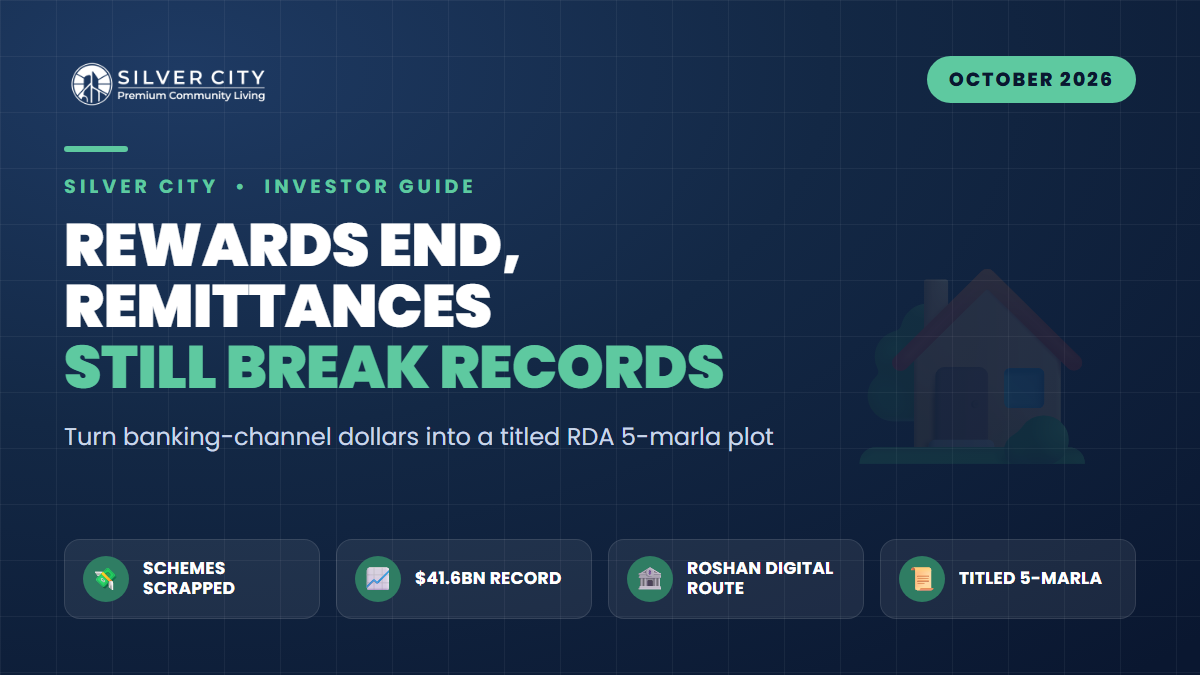
For years, the biggest fear for an overseas Pakistani buying property back home was not the price — it was the risk. Handing over savings to a developer, then waiting years with no legal guarantee of delivery, refund, or clean title. Pakistan’s new IMF-linked framework is designed to fix exactly that. Built alongside the International Monetary Fund under the $7 billion Extended Fund Facility, it pairs tax relief with a mandatory escrow structure for primary (developer-to-buyer) transactions and a clearer route to repatriate funds in dollars.
This guide breaks down what has actually changed, what is still a proposal awaiting the Finance Bill, and why RDA-approved schemes like Silver City are well positioned for this new environment. Always confirm the latest rates with FBR or a tax adviser before you transact — several figures below are proposed, not yet notified law.
What the IMF-Linked Framework Actually Does
The reform package has three moving parts working together: lower transaction taxes, a mandatory escrow layer, and formalised dollar inflows for non-residents. The goal, as stated by the government, is to make real estate “safe, transparent and tax-exempt” for overseas Pakistanis while broadening the domestic tax base — a balance the IMF has insisted on.
1. Lower and Simpler Transaction Taxes
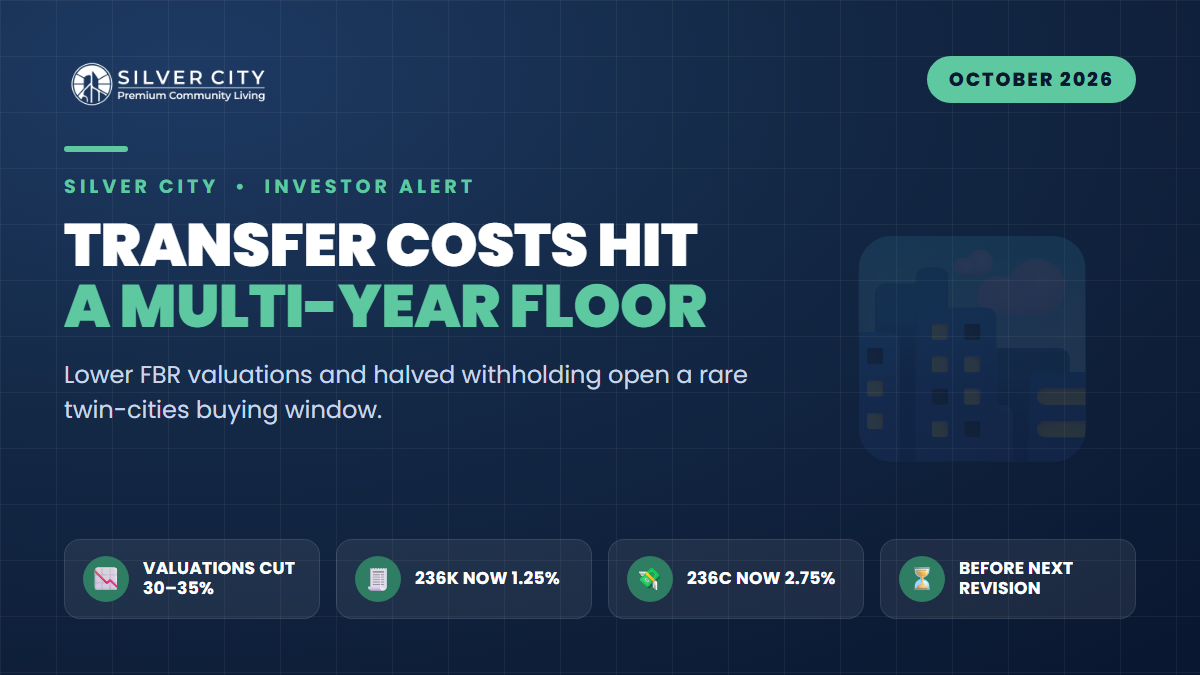
The Finance Act 2025 already abolished the unpopular 7% Federal Excise Duty (FED) on the transfer of plots, houses and commercial property. For the 2026-27 budget cycle, the government has proposed deep cuts to advance withholding taxes on filers:
- Buyer’s advance tax under Section 236K proposed to fall sharply for active filers (reported as low as 0.25% from prior 1.5–3% slabs).
- Seller’s advance tax under Section 236C proposed to be reduced for filers.
- Capital Value Tax on foreign assets abolished — a direct win for overseas Pakistanis who hold wealth abroad.
Critically for the diaspora: FBR allows overseas Pakistanis holding NICOP or POC who qualify as non-residents to pay advance tax at the lower filer rates under 236K/236C, even if they are not on the Active Taxpayers List — provided they complete the correct FBR verification.
2. Mandatory Escrow for Primary Transactions
This is the structural heart of the reform. Instead of paying a developer directly, buyer funds in eligible primary transactions are routed into a bank-managed escrow account. Money is released to the developer only when an independently verified construction or development milestone is reached. If the project misses agreed timelines, the escrow structure provides a defined pathway for the buyer to be reimbursed.
In plain terms: your capital is no longer sitting in a developer’s operating account against a verbal promise. It is held by a neutral bank and released against proof of progress.
3. A Dollar-Repatriable Path
The framework is explicitly designed to attract capital in dollars and to give overseas investors a documented, banking-channel record of their inflow. When funds enter through formal channels tied to the escrow and FBR-registered process, the investor establishes the paper trail needed to eventually repatriate sale proceeds abroad — a long-standing pain point that informal cash purchases could never solve.
Old Way vs. New Escrow-Backed Way
| Factor | Traditional Purchase | Escrow-Backed (New Framework) |
|---|---|---|
| Where your money sits | Developer’s own account | Neutral bank-managed escrow |
| Release of funds | Upfront / on faith | Only on verified milestone |
| If project stalls | Hard to recover | Defined reimbursement pathway |
| Dollar repatriation | Difficult, informal | Documented banking-channel trail |
| FED on transfer | 7% (pre-2025) | Abolished |
| Overseas tax rate | Often non-filer slab | Filer rate via NICOP/POC route |
Indicative Transaction Tax Snapshot
Rates below mix enacted and proposed figures and are for orientation only — verify current slabs with FBR before signing.
| Levy | Applies to | Status |
|---|---|---|
| 7% FED on transfer | Buyer/seller | Abolished (Finance Act 2025) |
| 236K advance tax | Buyer | Filer rate proposed as low as 0.25% |
| 236C advance tax | Seller | Filer reduction proposed |
| Capital Value Tax on foreign assets | Overseas holders | Abolished |
| Non-filer surcharge | Non-filers | Remains high — file to avoid |
A Practical Timeline for an Overseas Buyer
- Register with FBR using your NICOP/POC to secure non-resident filer-rate treatment on 236K/236C.
- Shortlist an RDA-approved scheme — approval status is your first line of defence against fraud.
- Route funds through the formal banking channel into the designated escrow account, not to a private account.
- Track milestone-based releases and retain every bank remittance advice for future repatriation.
- Complete transfer once title and possession conditions are verified.
Why RDA Approval Still Matters Most
Escrow and tax relief only protect you inside a legitimate, approved project. The Rawalpindi Development Authority (RDA) approval — like the No Objection Certificate process for housing schemes in its jurisdiction — remains the single most important due-diligence check. An escrow account attached to an unapproved or litigated scheme does not fix a defective title. Approval status, layout sanction, and NOC should be confirmed directly with the RDA before any payment.
Frequently Asked Questions
Is the entire property market now tax-free?
No. “Tax-free” refers to a targeted incentive framework for eligible primary transactions and specific reliefs (like the abolished FED and Capital Value Tax on foreign assets), not a blanket removal of all property taxes. Advance taxes under 236K and 236C still apply, though at reduced proposed rates for filers. Treat headlines as directional and confirm specifics with FBR.
How does the escrow account actually protect me?
Your payment sits in a bank-controlled escrow account rather than the developer’s account. The bank releases funds only when an independently verified milestone is met, and if the project fails its timelines, the structure gives you a defined route to reclaim your money. It converts a trust-based purchase into a verification-based one.
Can I get filer tax rates without living in Pakistan?
Yes. Overseas Pakistanis holding NICOP or POC who qualify as non-residents can access filer rates under Sections 236K and 236C even without being on the Active Taxpayers List, provided they complete FBR’s verification process. This can materially lower your buying and selling cost versus non-filer slabs.
Are these tax cuts final law yet?
Some are enacted (the 7% FED abolition, Capital Value Tax on foreign assets), while several of the deeper 236K/236C reductions were proposed for the 2026-27 budget and only become binding once passed in the Finance Bill and notified by FBR. Always confirm the current notified rate before you transact.
The Bottom Line
Pakistan’s IMF-linked framework meaningfully de-risks buying property from overseas: escrow protection on primary transactions, lower transaction taxes for filers, and a documented, dollar-repatriable inflow trail. For diaspora investors weighing a Rawalpindi plot, an RDA-approved society such as Silver City is an option worth considering — approval status, transparent processes, and alignment with this safer new structure are exactly the boxes a cautious overseas buyer should be ticking. Pair the framework’s protections with your own due diligence, and confirm all current rates with FBR or a qualified adviser before committing.