The era of falling official property values in the federal capital is over. After the Federal Board of Revenue (FBR) spent 2024–2025 cutting notified valuations — including a widely reported ~30% reduction to revive a stalled Islamabad market — the pendulum has swung hard the other way in 2026. Two fresh notifications have reset the tax base for the twin cities, and the arithmetic now quietly favours RDA-approved Rawalpindi societies for anyone hunting a first 5-marla plot.
What actually changed: two SROs, not one
There is some confusion online because two separate orders landed months apart. Getting them straight matters, because they hit different postcodes:
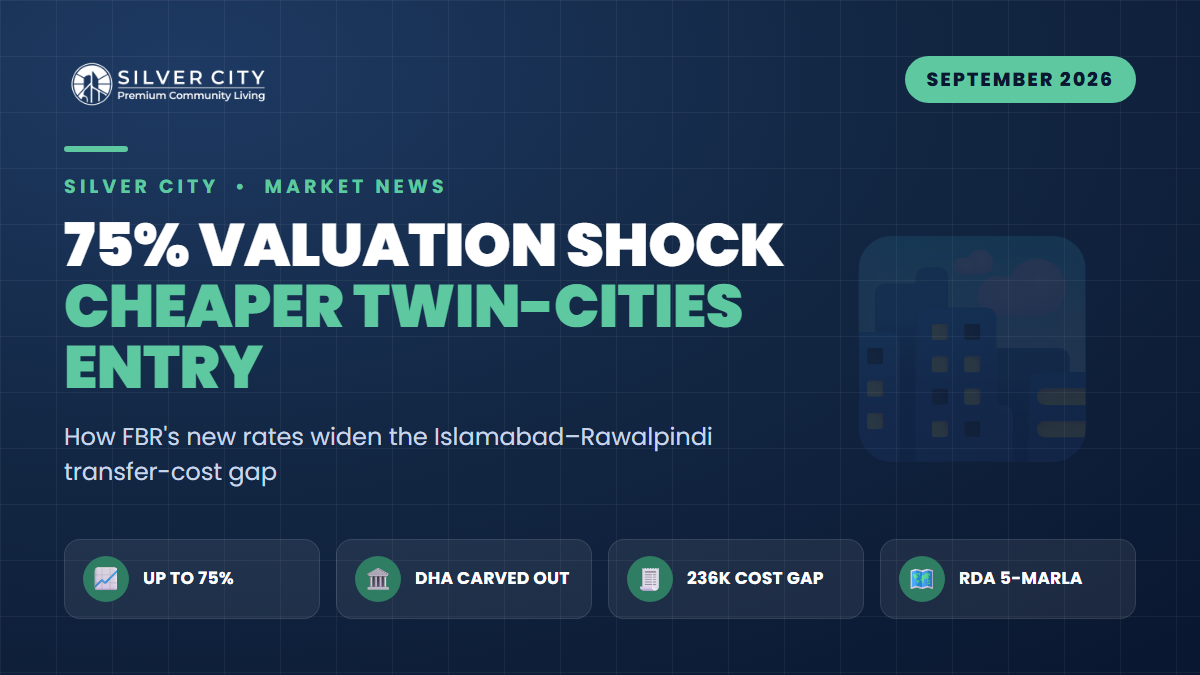
- SRO 163(I)/2026 — issued in early February 2026 for the Islamabad Capital Territory (ICT). It raised assessed residential and commercial values by an average of 15% to 75%, superseding the suspended SRO 2392(I)/2025. Crucially, it excludes Defence Housing Authority (Defence Housing Society) areas, which continue on their older, lower notified rates.
- SRO 877(I)/2026 — issued 19 May 2026, revising valuations for Rawalpindi (alongside a parallel exercise covering DHA Lahore and DHA Rawalpindi). This brought Rawalpindi’s tax base up, but from a much lower starting point than ICT.
A follow-up order, SRO 644(I)/2026, later trimmed the superstructure (construction) rates in Islamabad from Rs 3,000 to Rs 2,500 per sq ft for buildings up to five years old, and from Rs 1,500 to Rs 1,200 for older structures — a small softening, but the land-value hikes remain.
Why an FBR “value” decides your real cost
The notified FBR valuation is not just paperwork. It is the base on which federal transaction taxes are calculated at the moment of transfer or registration:
- Section 236K — advance tax paid by the buyer. Filer rate is 1.25%; non-filers pay a steep multiple (roughly 10.5%–18.5% depending on value slab).
- Section 236C — advance tax paid by the seller. For the current tax year this was simplified to a flat 2.75% for filers, with non-filers around 11%.
- Section 7E, capital gains, gift and inheritance assessments also key off the notified value.
The percentage rate is national. What changes city to city is the value the percentage is applied to. Push Islamabad’s assessed value up 75% and, even at an unchanged 1.25% filer rate, the rupees a buyer hands over at transfer rise by the same 75%. That is the mechanism now widening the twin-cities gap.
The gap in rupees: an illustration
The table below is an illustrative 236K (buyer, filer) comparison to show the direction and scale of the gap — not a quote for any specific plot. Always confirm the current notified value for the exact sector or society before you transact.
| Scenario (5-marla, filer buyer) | Assumed FBR value | 236K @ 1.25% | Non-filer 236K (illustrative) |
|---|---|---|---|
| Islamabad sector — post-hike | Rs 12,000,000 | Rs 150,000 | ~Rs 1,260,000+ |
| Islamabad DHA — carved out (old rate) | Rs 9,500,000 | Rs 118,750 | ~Rs 997,500+ |
| RDA Rawalpindi society (lower base) | Rs 4,500,000 | Rs 56,250 | ~Rs 472,500+ |
The pattern is the point: the entry friction — the cash you burn on tax and transfer before you own anything — is materially lower on a lower-valued Rawalpindi plot. Multiply that across buyer and seller sides, and across a non-filer penalty, and the gap becomes decisive for a budget-conscious first buyer.
The DHA anomaly — and why it’s temporary comfort
The DHA carve-out means DHA Islamabad addresses keep their older, lower valuations for now, softening their transfer cost relative to freshly hiked CDA sectors. But this is an administrative pause, not a policy — DHA Rawalpindi was itself pulled into the May revision. Betting on a carve-out surviving the next budget cycle is speculation, not strategy.
Where RDA Rawalpindi societies fit
This is the structural case for approved Rawalpindi society plots. They sit on a lower notified base, so transfer-day tax is lighter; they are priced for end-users rather than capital-gains speculators; and the corridor’s fundamentals have improved sharply with the 38.6 km Rawalpindi Ring Road now carpeted and live in mid-2026.
Silver City, on Girja Road near the Thalian interchange, is one such RDA-approved option. Approval matters here: it means the layout, land use and development plan have been sanctioned by the Rawalpindi Development Authority — the regulatory risk that sinks so many unapproved “files” is resolved. Current indicative pricing puts 5-marla residential plots in roughly the Rs 2.75 million band with 1-kanal around Rs 10.35 million, typically on four-year (48-month) installment plans. For context, a 5-marla plot in Islamabad’s cheapest CDA sector (I-16) has been cited near Rs 5.8 million before transfer taxes even enter the picture.
Quick comparison
| Factor | Islamabad CDA sector | RDA Rawalpindi society (e.g. Silver City) |
|---|---|---|
| FBR valuation trend (2026) | Up 15%–75% (SRO 163) | Revised up from a lower base (SRO 877) |
| Indicative 5-marla ticket | ~Rs 5.8m+ | ~Rs 2.75m |
| Transfer-day tax friction | Higher (bigger base) | Lower (smaller base) |
| Payment structure | Mostly lump-sum / resale | 4-year installments |
What this means for your next move
If you file your returns, stay a filer — the 236K/236C gap between filer and non-filer now dwarfs almost every other cost lever. Verify the exact notified value for your target sector or society on the FBR portal before signing, because the number, not the rate, drives your bill. And weigh entry friction, not just sticker price: a lower-valued, approved installment plot lets you avod front-loading tax while averaging cost against an inflating rupee.
Frequently Asked Questions
Did SRO 877(I)/2026 raise Islamabad valuations by 75%?
Not directly. The up-to-75% Islamabad hike came through SRO 163(I)/2026 in February 2026, which also carved out DHA. SRO 877(I)/2026 (May 2026) revised Rawalpindi valuations. The two are often merged in reporting, but they cover different jurisdictions.
Are DHA Islamabad plots exempt from the new rates forever?
No. DHA areas were excluded from SRO 163 and continue on older valuations for now, but that is an administrative pause. DHA Rawalpindi was already folded into the May revision, so the carve-out should be treated as temporary.
Why does a lower FBR value make Rawalpindi cheaper to enter?
Because advance taxes under 236K (buyer) and 236C (seller) are charged as a percentage of the notified value. The rate is the same nationwide, but a lower assessed value means fewer rupees paid at transfer — so an RDA Rawalpindi plot costs less in both price and transaction tax.
Is Silver City safe from regulatory problems?
Silver City is an RDA-approved society, meaning its layout and land use are sanctioned by the Rawalpindi Development Authority. Approval removes the core legal risk associated with unapproved files. Still, always verify the latest approval status and installment terms directly before booking.
Wrap-up
FBR’s reversal from valuation cuts to sharp hikes has re-priced the cost of entering the twin-cities market, and the burden falls heaviest on the highest-valued Islamabad postcodes. For first-time and end-user buyers who want approved land, installments and lighter transfer friction, an RDA-approved society such as Silver City on the Ring Road corridor is a genuinely worth-considering way to secure a 5-marla footprint — provided you verify current values, terms and filer status before you commit.