In January 2026, the Board of Investment (BoI) confirmed a number that should matter to every property investor watching the twin cities: the count of approved Special Economic Zones (SEZs) in Pakistan has climbed from just 7 to 44 under CPEC Phase 2.0 — including the notification of 37 new zones. It is one of the clearest signals yet that CPEC has shifted from a road-and-power story into an industrial, export-manufacturing story. And industry, unlike a highway, needs workers who need homes.
This article breaks down what actually changed, why the Rawalpindi–Islamabad region sits at the centre of it, and — most importantly — how a factory buildout converts into concrete, end-user demand for affordable plots across the Potohar belt.
From 7 to 44 SEZs: What Actually Changed
Federal Minister for the Board of Investment, Qaiser Ahmed Sheikh, reviewed the progress at the CPEC Industrial Cooperation Development Project’s Project Management Unit in Islamabad. The headline was the jump in approved zones, but the substance sits in the operational fixes that make zones actually buildable:
- Approval of the Land Lease Policy for Bin Qasim Industrial Park (BQIP) — described as removing a long-standing structural bottleneck for investors.
- Progress on the Karachi Industrial Park (KIP) and a dedicated Gilgit-Baltistan SEZ.
- Alignment with the government’s “Uraan Pakistan” 5Es Framework, which puts exports and competitiveness at the centre of policy.
The strategic message is that CPEC 2.0 is “industry-led”: export-oriented manufacturing, technology transfer, and value addition, with SEZs as the anchor platforms. For the north of the country, that anchor increasingly points at Rawalpindi.
Why the Twin Cities Sit at the Centre
Two federally backed zones put the Rawalpindi–Islamabad region directly in the industrial map:
- Islamabad Model / ICT Model Industrial Economic Zone (near Rawat): spread over 1,000+ acres at the junction of the N-5 National Highway and the Islamabad Expressway, with anticipated investment cited around USD 2.5 billion. It is the first zone of its kind in the federal capital region and is designed for low-carbon-footprint industries.
- The New Islamabad International Airport corridor: the Fateh Jang / Chakri side of the airport has long been earmarked for industrial and logistics activity, and it is exactly where affordable Potohar land meets national road links (M-1, M-2 motorways, and the airport itself).
Location is the whole point. Workers, supervisors, and support-service staff do not commute from Karachi to a Rawat or Chakri factory — they live nearby. That is the mechanism that turns industrial policy into local housing demand.
The Ring Road Just Became Part of the Story (September 2026)
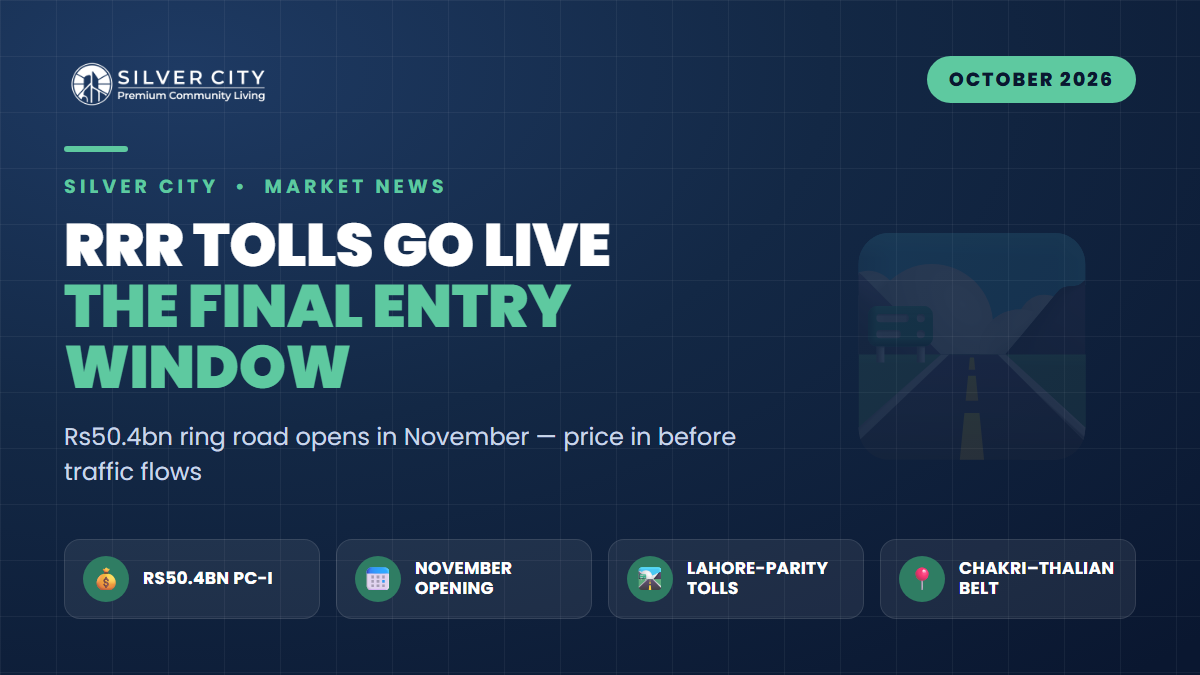
The most recent development ties it together. In September 2026, officials moved to develop the 38-kilometre Rawalpindi Ring Road as a Special Economic Zone — pitched as the “economic gateway of northern Punjab.” The land-use plan, briefed by the Rawalpindi Commissioner and chaired at the housing-secretary level, includes:
- Dedicated light and heavy industrial zones;
- A tax-free zone along the route;
- Zones for IT, education, sports, health, and food sectors, plus green buffers and bus terminals.
A summary for approval of the land-use plan was being sent to the cabinet. The Ring Road already loops through the Potohar affordable belt and connects Adiala Road, Chakri, GT Road, and the airport corridor — so SEZ status layered on top of it directly upgrades the investment case for plots along those interchanges.
Key Zones at a Glance
| Zone | Location | Size / Scale | Status (2026) |
|---|---|---|---|
| Islamabad Model / ICT Industrial Zone | Rawat (N-5 × Islamabad Expressway) | 1,000+ acres, ~USD 2.5bn | Development underway |
| Rawalpindi Ring Road SEZ | 38 km loop around Pindi/airport | Corridor-wide, tax-free zone | Land-use plan to cabinet |
| Bin Qasim Industrial Park | Karachi | Anchor coastal zone | Land Lease Policy approved |
| National SEZ count | Pakistan-wide | 44 approved (37 new) | Notified under CPEC 2.0 |
From Factory Floor to Front Door: The Demand Chain
Here is how an SEZ realistically converts into plot demand — and why the affordable end benefits most:
- Construction phase: land development, boundary works, utilities, and civil contractors bring in labour and site staff who rent nearby.
- Operational phase: factories hire line workers, technicians, supervisors, drivers, and admin staff — the bulk of them middle-income earners.
- Support economy: transport, catering, security, warehousing, and retail spin up around any industrial cluster.
- Housing search: most of these earners cannot afford Bahria or DHA pricing, so demand flows to 3, 5, and 7-marla plots in RDA-approved schemes within a 15–25 minute commute.
This is why analysts frame industrialisation as a multi-year tailwind, not an overnight windfall. Plots bought near a genuine employment node tend to appreciate as the zone fills up — not on announcement day.
Where the Affordable Demand Lands: The Potohar Belt
The Potohar affordable corridor — Adiala Road, Chakri Road, the Chakri interchange, and the GT Road / Rawat side — is the natural catchment. Indicative ranges below are for orientation only; always verify live rates and development stage on the ground before committing.
| Belt / Corridor | Typical plot sizes | Indicative price band (per marla) | Why it benefits |
|---|---|---|---|
| Adiala Road | 5–10 marla | Rs 1.5–3.0 lakh | Established, near Ring Road interchange |
| Chakri Road / interchange | 3.5–7 marla | Rs 1.0–2.5 lakh | Motorway + airport access |
| Rawat / GT Road side | 5–10 marla | Rs 2.0–4.0 lakh | Closest to Rawat industrial zone |
| Airport / Fateh Jang corridor | 5–10 marla | Rs 1.5–3.5 lakh | Logistics + zone spillover |
For context, a completed 5-marla house in greater Rawalpindi commonly ranges from roughly Rs 50 lakh upward, while grey-structure construction runs around Rs 3,000–4,500 per square foot in 2026 — useful when you compare buying a plot-and-build versus a ready unit.
How Investors Should Play It
- Buy only in RDA-approved schemes and confirm the No-Objection Certificate and approved layout in writing.
- Anchor to a real employment node (Rawat zone, Ring Road interchange, airport corridor) — not just a marketing map.
- Prefer developed or fast-developing phases where possession and utilities are visible, so you capture end-user, not just speculative, demand.
- Avoid over-leverage. Treat SEZ momentum as a 3–5 year story and size instalments to what you can comfortably carry.
Frequently Asked Questions
Does a higher SEZ count guarantee my plot’s value will rise?
No. Approval and notification are policy milestones, not delivery. Value follows actual construction, jobs, and utilities near your plot. Buy close to a zone that is genuinely being built (like the Rawat zone or a funded Ring Road interchange), and give it a multi-year horizon.
Which areas near the twin cities are best positioned?
The affordable Potohar belt — Adiala Road, Chakri Road and interchange, the Rawat/GT Road side, and the New Islamabad Airport corridor — because these sit within commuting distance of the region’s industrial zones and along the Ring Road route.
Is the Rawalpindi Ring Road SEZ confirmed?
As of September 2026, officials had prepared the land-use plan (including a tax-free industrial zone) and were sending a summary to the cabinet for approval. It is a strong, advanced signal — but confirm the final notification before you pay a premium purely on this basis.
Should I buy a plot or a ready house for worker-driven demand?
Plots in developing affordable phases usually offer more upside per rupee and match the rental/end-user profile of factory earners. A ready house suits you only if you want immediate rental yield rather than capital appreciation.
The Bottom Line
CPEC 2.0’s leap from 7 to 44 approved SEZs — reinforced by the Rawat industrial zone, the airport corridor, and the emerging Ring Road SEZ — is a credible, multi-year demand engine for affordable housing across the Rawalpindi–Potohar belt. The winners will be disciplined investors who buy verified, RDA-approved land near real employment nodes and hold through the buildout. Among the options worth shortlisting in this corridor is Silver City, an RDA-approved housing society positioned in the Potohar growth path — a sensible starting point for anyone looking to align with this industrial tailwind rather than chase it after the fact.