For two years Pakistani savers were rewarded for doing nothing. Policy rates above 20% meant a term deposit or a T-bill fund could hand you a double-digit nominal return while you waited for the storm to pass. That trade is now quietly expiring. As of September 2026 the macro picture has flipped from crisis-management to a genuine stabilisation cycle — and the arithmetic that made idle cash attractive has stopped working. This article lays out what changed, why near-zero-real-return deposits are now a slow leak, and why an RDA-approved 5-marla plot in the Rawalpindi–Islamabad belt deserves a place in the conversation.
The stabilisation cycle is now on the record — not a forecast
Three independent, hard-to-fake signals landed in the space of a few weeks, and together they mark a regime change rather than a headline:
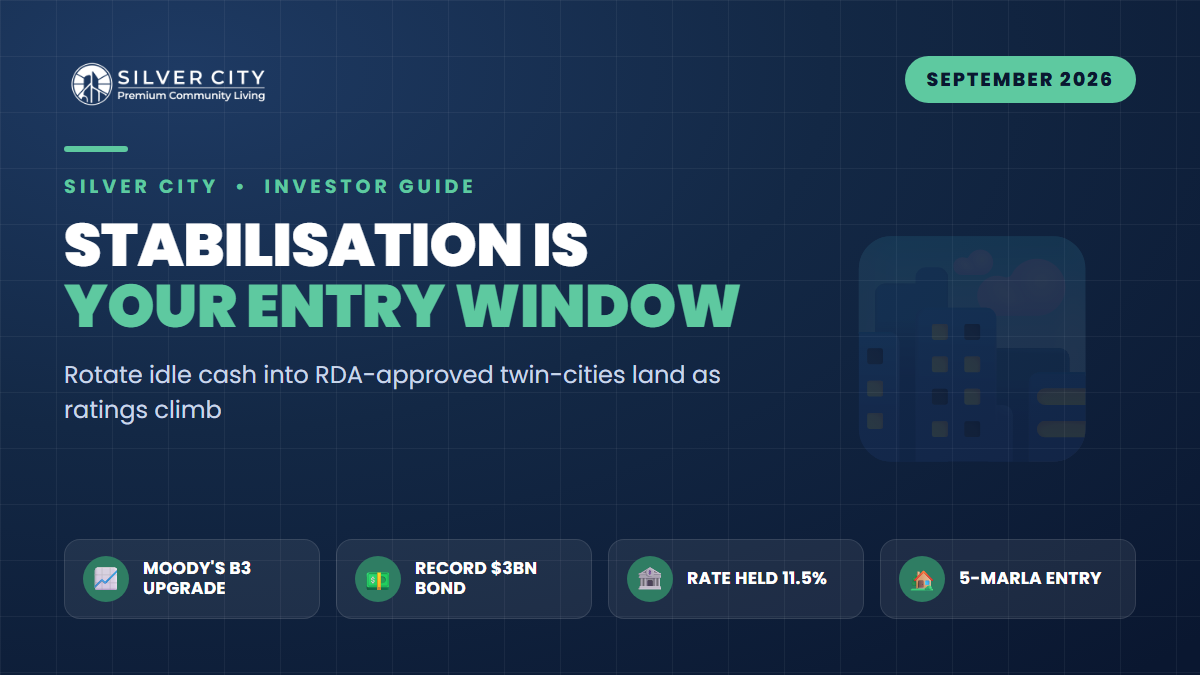
- Moody’s upgraded Pakistan to B3 from Caa1 on 24 August 2026 with a stable outlook, citing an easing of external-vulnerability risk and improved debt affordability. It also lifted the local and foreign-currency country ceilings to B1 and B3.
- S&P Global raised Pakistan to ‘B’ from ‘B-‘ in July 2026 — the first time the sovereign has carried a straight ‘B’ in roughly nine years — on the back of IMF-anchored reform and fiscal consolidation.
- A record $3 billion dual-tranche Eurobond priced in early September 2026: $1.75bn at 7.5% (5.5-year) and $1.25bn at 7.9% (10-year), drawing nearly $6bn in orders — almost twice the amount on offer. It was Pakistan’s single largest international bond transaction and the first issue under a renewed Global Medium Term Note programme following the country’s debut Panda Bond.
Underneath these, the plumbing improved too. SBP-held reserves jumped roughly $3bn on the week to about $21.4bn after the Eurobond settled, and total liquid reserves climbed past the $25bn mark to around $26.8bn by mid-September 2026 — a multi-year high and enough for a far more comfortable import-cover cushion than the near-default levels of early 2023.
The rate hold at 11.5% is the tell
On 14 September 2026 the SBP’s Monetary Policy Committee held the policy rate at 11.5% for a second consecutive meeting. That number matters less than what it implies. With headline inflation running near 11% after an oil-driven bump, and the medium-term target sitting at 5–7%, the era of 20%+ nominal deposit yields is over. Banks now price term deposits well below the highs of 2023–24, and once you subtract withholding tax and actual inflation, the real return on parked rupees is hovering around zero — and negative for many savers.
| Indicator | Crisis low (early 2023) | September 2026 |
|---|---|---|
| Moody’s rating | Caa3 (deep speculative) | B3, stable outlook |
| S&P rating | CCC+ | B, stable outlook |
| SBP policy rate | ~17–22% (peaked 22%) | 11.5% (held) |
| Total liquid reserves | ~$3–4bn | ~$26.8bn |
| International bond access | Effectively shut | $3bn issue, 2x oversubscribed |
Why idle cash is now the risky position
Investors instinctively treat cash as “safe.” In a stabilisation cycle with easing rates, that instinct inverts. Here is the trap in plain terms:
- Yields are falling toward inflation. A deposit that pays roughly the same as prices rise preserves nothing in real terms after tax.
- The rupee is steadier, so the old hedge motive weakens. With reserves rebuilt and external risk easing, the panic-driven case for holding dollars or gold cools — and hard assets denominated in rupees start to look more attractive on a relative basis.
- Land re-rates when rates fall. Lower financing costs historically pull buyers back into plot files; the developed-property and plot markets in the twin cities tend to firm as the cost of holding cash rises relative to the cost of holding land.
The window that rewards a rotation is precisely the early part of a stabilisation cycle — after the sovereign risk has visibly receded (ratings, reserves, bond access) but before the asset re-rating has fully played out. That is where September 2026 sits.
Why a twin-cities 5-marla — and why RDA-approved specifically
Not all land captures a recovery equally. The case for a 5-marla plot in the Rawalpindi–Islamabad corridor rests on three pillars: ticket size, regulatory safety, and location optionality.
A 5-marla file is the most liquid residential category in Pakistan — small enough for salaried professionals and overseas Pakistanis to enter on instalments, and the easiest to resell because the buyer pool is deepest. In an RDA-approved, NOC-cleared scheme, the single biggest risk in Rawalpindi’s plot market — approval and litigation risk — is already resolved before you sign.
Silver City, on Girja Road near the Thalian interchange, illustrates the profile. An RDA-approved standard 5-marla plot currently sits in roughly the Rs 2.55–2.75 million band, typically on instalment plans of around four years, with Rawalpindi Ring Road–adjacent positioning that stands to benefit as the western interchange belt is developed.
| Parameter | Indicative detail (Sept 2026) |
|---|---|
| Plot size | 5 marla (approx. 125 sq yd) |
| Approval status | RDA-approved, NOC-cleared |
| Indicative price band | ~Rs 2.55m–2.75m |
| Typical instalment tenor | ~48 months (down payment + monthly) |
| Location anchor | Girja Road, near Thalian interchange / Ring Road belt |
A disciplined way to rotate idle cash
- Size the rotation, don’t dump. Move the portion of savings you genuinely won’t need for 3–5 years — land is illiquid over short horizons.
- Verify the approval yourself. Confirm the scheme’s RDA/NOC status and the specific plot’s documentation directly, not just from a brochure.
- Use the instalment structure to your advantage. A four-year plan lets you deploy in tranches while keeping some liquidity, effectively rupee-cost-averaging into land.
- Prioritise developed or fast-developing blocks where possession and access reduce the “dead capital” period.
- Keep an emergency buffer in cash. Rotation is about the excess idle balance, not your entire safety net.
The risks — stated plainly
Stabilisation is not the same as a boom, and a B3/B rating is still firmly speculative-grade. External buffers remain thin by global standards, the geopolitical backdrop is volatile (oil-price shocks have already nudged inflation up), and IMF-programme discipline must hold. On the property side, illiquidity, developer execution, and location-specific delays are real. None of this erases the core point: the relative attractiveness of parked cash has fallen sharply, and hard, approved land in a supply-constrained corridor is a reasonable place to redeploy a portion of it.
Frequently Asked Questions
Does a Moody’s B3 or S&P B rating mean Pakistan is a safe investment?
No — both are speculative (“highly speculative”) grades. What they signal is direction: two agencies independently confirming that default risk has receded materially from the 2023 lows. For a domestic real-asset investor, the takeaway is improving stability and cheaper sovereign borrowing, not a guarantee.
Why not just keep money in a bank deposit or T-bill fund?
With the policy rate held at 11.5% and inflation near 11%, nominal deposit yields have fallen close to the inflation rate. After withholding tax, the real return on cash is roughly zero or negative — meaning your purchasing power is barely maintained while you wait.
Why 5 marla instead of a larger plot?
A 5-marla file has the deepest buyer pool and the lowest entry ticket, making it the most liquid and instalment-friendly residential category. That liquidity matters most when you eventually want to exit.
How important is RDA approval?
Critically. Approval and litigation risk is the number-one hazard in Rawalpindi’s plot market. Buying inside an RDA-approved, NOC-cleared scheme removes that variable before you commit capital, leaving you exposed mainly to price and timing rather than legality.
The bottom line
The stabilisation cycle is now documented in ratings, reserves and a record bond — not merely hoped for. With the SBP holding at 11.5% and real returns on cash near zero, the cost of standing still has quietly risen. For investors weighing where to redeploy idle rupees, an RDA-approved, NOC-cleared scheme in the twin-cities interchange belt — Silver City on Girja Road near the Thalian interchange, with 5-marla plots in the roughly Rs 2.55–2.75m band on multi-year instalments — is one credible, liquidity-friendly option worth shortlisting while the entry window is still open. As always, verify the documentation yourself and size the rotation to your own horizon.