In October 2026, the Capital Development Authority (CDA) announced two things that, read together, tell you almost everything you need to know about risk in Pakistan’s “premium” capital sectors. First, it retrieved 1,133 kanals of state land in Sector E-12 that had sat under illegal occupation for roughly four decades. Second, it promised allottees that they would finally get possession of their plots within six months.
For the families who booked E-12 plots in the late 1980s, that is a headline wrapped around a wound. Many allottees paid in full a generation ago, watched their children grow up, and never saw a demarcated plot, let alone a boundary wall. The lesson for today’s buyer is not that CDA sectors are worthless — E-12 land is genuinely worth billions — but that a prestigious address with no possession is a frozen asset. This article unpacks the E-12 case and contrasts it with what a titled, actively developing Rawalpindi Development Authority (RDA) society can deliver right now.
What Actually Happened in E-12
Sector E-12 was carved out as a residential sector in the capital’s master plan decades ago, and plot files changed hands for years on the promise of a prime Margalla-facing location. The problem was never demand — it was delivery. Large tracts of the sector remained encroached, litigated, or physically occupied, which meant CDA could not develop roads, water, sewerage, or electricity, and therefore could not hand over possession.
The October 2026 operation, carried out on the directions of the Federal Minister for Interior Syed Mohsin Raza Naqvi and under CDA Chairman Sohail Ashraf, cleared 1,133 kanals and let development work accelerate. CDA then committed to delivering possession to allottees within six months. That is real progress — but investors should read the timeline honestly.
| Milestone | Approx. Timing | What It Meant for the Allottee |
|---|---|---|
| E-12 plots allotted / files traded | Late 1980s onward | Money paid, “owned” a capital-sector plot on paper |
| Development stalled by encroachment & litigation | ~1990s–2020s | No boundary, no utilities, no possession |
| 1,133 kanals retrieved | October 2026 | Development finally able to proceed |
| Possession promised | Within 6 months of Oct 2026 | First credible handover date in ~40 years |
Even if CDA delivers on schedule, the compounded opportunity cost is staggering. Capital locked for four decades earns nothing; the same money in a developing, deliverable project could have been built on, rented, or flipped several times over.
The Real Lesson: Possession Is the Asset
In Pakistani real estate, four things create value, roughly in this order: clear title, physical possession, utilities and access, and location. Buyers obsess over the fourth and ignore the first three. E-12 shows why that is backwards. A plot in a blue-chip sector that you cannot demarcate, build on, or sell at market rate is a liability with a prestigious name.
Before committing to any project — capital sector or private society — insist on verifiable answers:
- Is the title/allotment clean and transferable in the development authority’s own records?
- Is possession available now, or is it a promise with no date?
- Are utilities and metalled roads laid in the specific block you are buying — not just in the brochure?
- Can you physically stand on your plot and see its boundary pillars?
If the honest answer to possession is “soon,” price that uncertainty in. A six-month promise after forty years is worth respecting but not pre-paying for.
The Contrast: A Titled, Developing RDA Society
Rawalpindi’s private societies are not automatically safer than CDA sectors — the twin cities are littered with illegal and un-approved schemes. The distinction that matters is RDA approval plus visible, on-ground development. A society like Silver City, on the Girja Road corridor near the Thallian interchange and the emerging Rawalpindi Ring Road alignment, is positioned as an RDA-sanctioned scheme where developed blocks offer something E-12 allottees waited 40 years for: possession you can verify.
The investment logic is also fundamentally different. Instead of parking a large sum in a frozen capital-sector file, a buyer enters at an affordable ticket and pays as development matures:
| Feature | E-12 (CDA Capital Sector) | RDA Society (e.g., Silver City) |
|---|---|---|
| Possession history | ~40 years to first credible date | Developed blocks deliverable / under active development |
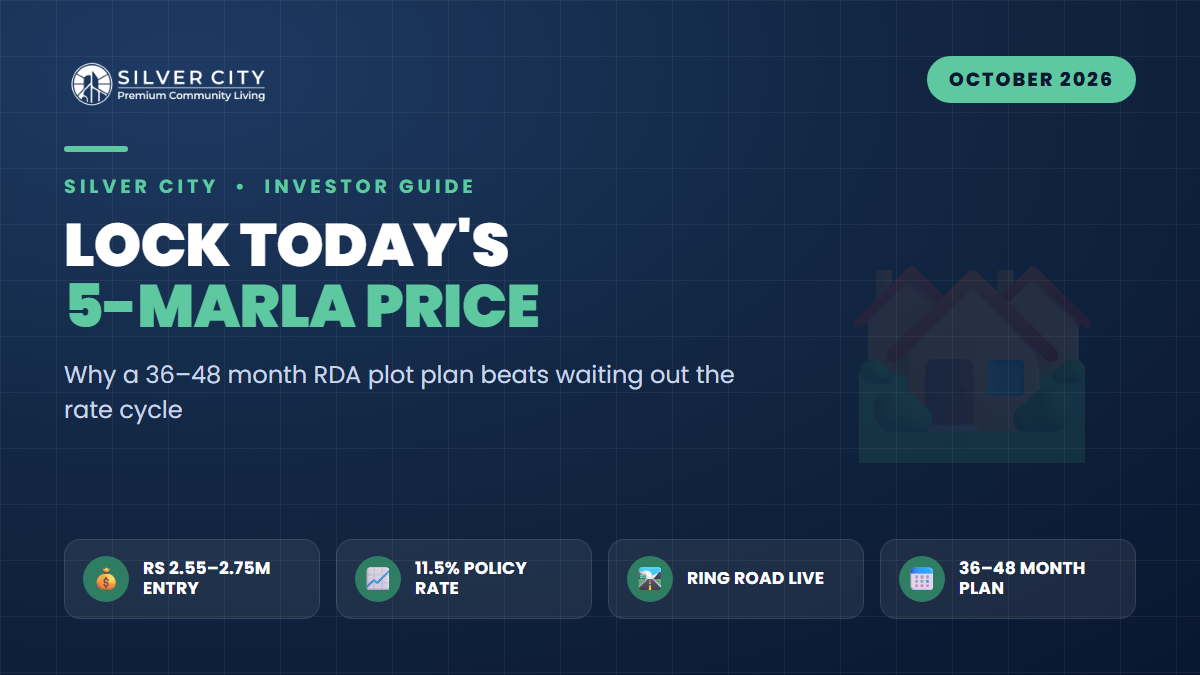
| Typical entry (5 marla) | High file value, capital locked | Approx. PKR 2.55m–2.75m |
| Payment structure | Largely paid up front, long ago | ~15% booking + 15% confirmation + ~48 monthly instalments (~PKR 30,000/month) |
| Approval body | CDA | RDA (verify NOC/LOP directly) |
| Primary risk | Delivery timing | Developer execution & location maturation |
Note the figures above are indicative of recently marketed plans and move with the market — always confirm the live payment plan and prices before booking. The point is structural: an instalment-based, possession-backed plot lets your capital stay liquid and productive while an infrastructure catalyst (here, the Ring Road and Thallian interchange works) matures over roughly the same four-year window as your payment plan.
How to Apply This as an Investor
- Verify approval at the source. For capital projects, check CDA records; for Rawalpindi societies, confirm the NOC/Layout Plan directly with RDA — never rely on a brochure or agent’s word.
- Separate “address” from “asset.” Only possession-ready, titled plots behave like real assets. Everything else is a bet on timing.
- Match your payment runway to a real catalyst. An instalment plan that ends around the same time a major road or interchange opens aligns your cash flow with value creation.
- Demand a boundary, not a promise. If you can walk the plot and see utilities in your block, your downside is limited.
Frequently Asked Questions
Is E-12 a bad investment now that land has been recovered?
Not necessarily — E-12 land is genuinely valuable and development is now accelerating. But a first-time investor should treat the six-month possession promise as a target, not a guarantee, and avoid overpaying on files until infrastructure and handover are visibly underway.
Why did E-12 possession take so long?
The sector was held up for decades by illegal occupation and litigation on large tracts of state land. Without clearing roughly 1,133 kanals, CDA could not lay infrastructure or demarcate plots — which is exactly why possession, not location, is the true measure of a plot’s value.
How do I confirm a Rawalpindi society is really RDA-approved?
Ask for the society’s NOC and approved layout plan, then verify those documents against RDA’s own records. Approval tied to visible on-ground development — laid roads, utilities, and handed-over blocks — is far stronger evidence than any marketing claim.
Is instalment buying safer than paying upfront for a capital-sector file?
For many investors, yes. Instalments keep your capital liquid, spread risk over time, and let you walk away with limited loss if execution disappoints — whereas a fully-paid, possession-less file can freeze your money for years, as E-12 history shows.
The bottom line: E-12’s forty-year wait is a reminder that in Pakistani property, verifiable possession and clean title beat a prestigious name with no delivery. If you want capital that stays productive, a titled, actively developing RDA-approved society such as Silver City is worth evaluating on its own documented merits — approval, possession, and on-ground progress you can check for yourself before you commit.