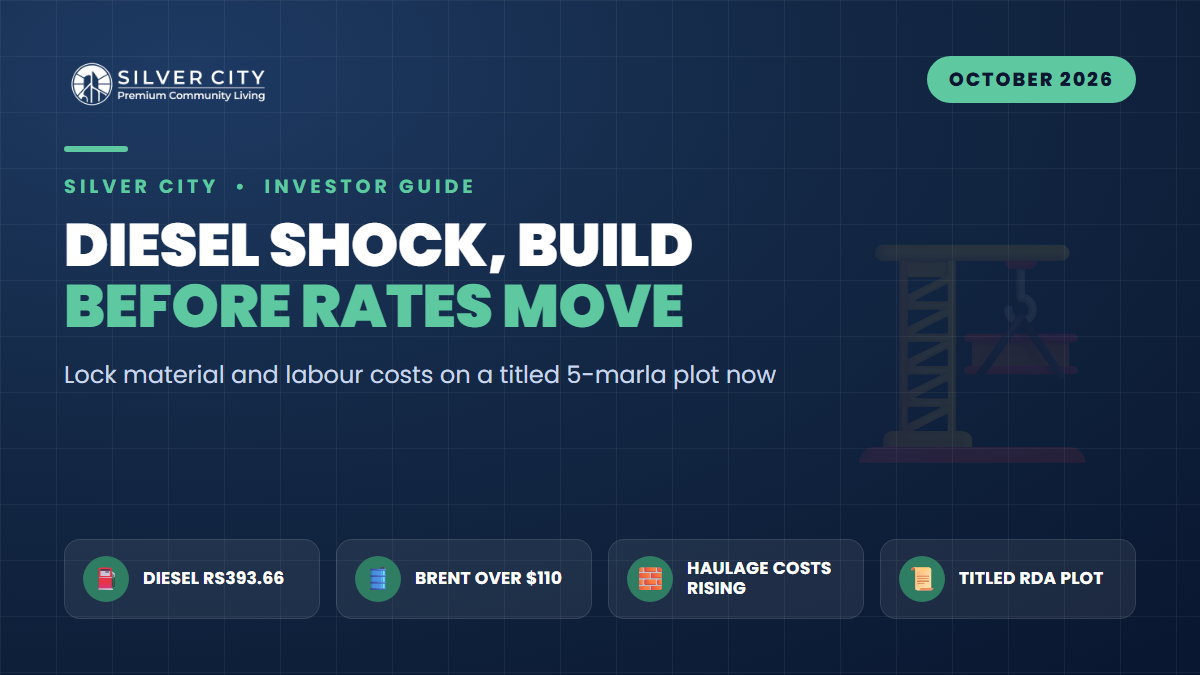
On 24 October 2026, OGRA left petrol untouched at Rs377.71/litre but pushed high-speed diesel up by Rs1.91 to Rs393.66/litre. For most households that looks like a non-event — the pump price for the family car did not move. For anyone planning to build, it is the opposite of a non-event. Diesel, not petrol, is the fuel that runs trucks, tractor-trolleys, concrete mixers, dumpers and generators. When diesel rises, the delivered cost of cement, sand, crush, bricks and steel to your Rawalpindi plot rises with it — usually within a fortnight, and usually quietly.
The backdrop makes this more than a routine tweak. Brent crude settled above $110 in late October — its highest since spring — as tanker attacks near the Strait of Hormuz and strikes on Saudi facilities kept supply risk elevated. Because OGRA now revises prices on a fortnightly cycle, the full weight of this oil shock has not yet flowed through. The next review is where haulage-heavy diesel can climb again. That gap between today’s material rates and next fortnight’s is the window a disciplined self-builder can exploit.
Why Diesel — Not Petrol — Sets Your Build Cost
A grey structure is, in weight terms, a logistics problem. A single 5-marla home pulls in roughly 1,600–2,000 bags of cement, several trolleys of sand and crush, tens of thousands of bricks or blocks, and two to three tons of steel. Almost none of that arrives by car. It arrives on diesel-powered trucks and trolleys, is lifted by diesel mixers, and on load-shedding days is cut and bent using diesel generators.
So the transmission is direct: diesel up → freight up → delivered material up → your BOQ up. Petrol holding steady does nothing to protect that chain. This is why the 24 October split — petrol flat, diesel up — is precisely the signal to act rather than relax.
The Cost Picture Right Now (Rawalpindi/Islamabad)
Current market rates for the twin-city zone, which Silver City sits inside, look roughly like this. Treat these as planning figures and confirm live quotes with your contractor and suppliers before committing.
| Item | Current indicative rate (Oct 2026) | Diesel sensitivity |
|---|---|---|
| Grey structure (Rawalpindi/Islamabad) | ~Rs3,300–3,500 / sq ft | High — freight-heavy |
| 5-marla covered area (double storey) | ~1,900–2,100 sq ft | — |
| 5-marla grey structure (shell) | ~Rs5–8 million | High |
| Cement (per bag, delivered) | Market-linked; freight embedded | Direct |
| Sand / crush (per trolley) | Mostly transport cost | Very high |
| Steel (per ton) | Global + local haulage | Moderate–high |
Notice that the items most exposed to diesel — sand, crush, delivered cement — are exactly the ones you consume earliest, at foundation and plinth stage. That is the heart of the phased-build argument: the diesel-sensitive spend is front-loaded, so starting now captures the biggest saving.
A Phased Self-Build Plan That Locks Rates
You do not need the full build budget in hand to benefit. The point of phasing is to convert today’s rates into purchased, delivered material and contracted labour before the next OGRA cycle re-prices them.
- Phase 0 — Secure a titled plot (now): You can only build on land with clean title and an approved map. An RDA-sanctioned plot avoids demolition and transfer risk later.
- Phase 1 — Foundation & plinth (0–6 weeks): Buy and haul the diesel-heavy aggregates — sand, crush, bricks for the sub-structure — at current freight. Lock your mason/labour contract in writing.
- Phase 2 — Superstructure & roof slab (2–5 months): Pre-purchase cement and steel in tranches; stagger deliveries to cap storage loss while still fixing the rate.
- Phase 3 — Brickwork, plaster, roof (4–8 months): The shell closes. Most freight-intensive work is now behind you.
- Phase 4 — Finishing (flexible): Tiles, fixtures, paint and electrical are less diesel-exposed and can track your cash flow.
Illustrative Rate-Lock Timeline
| Phase | Timing | What you lock |
|---|---|---|
| Plot + title | Immediate | Land cost, legal standing |
| Foundation | Weeks 1–6 | Sand, crush, sub-structure bricks, labour |
| Superstructure | Months 2–5 | Cement & steel tranches |
| Finishing | Months 6+ | Low diesel exposure; pace to cash flow |
The Risk of Waiting
The “wait and see” instinct assumes prices might fall. With Brent above $110 and an unresolved Middle-East supply shock, the asymmetry runs the other way: the base case is further diesel pass-through, not a cut. Each fortnightly review that nudges diesel higher lifts delivered material and, with a lag, labour rates. A six-month delay on a grey structure can quietly add six figures to a 5-marla build — not from any single dramatic jump, but from the compounding of freight into every trolley and truckload.
Frequently Asked Questions
Diesel only rose Rs1.91 — is that really enough to matter?
The single revision is small; the trend behind it is not. Rs1.91 on 24 October follows a run of increases and sits on top of Brent above $110 with the next OGRA review still pending. Freight costs respond to the direction of travel, and a 5-marla build involves dozens of diesel-powered deliveries, so the cumulative effect dwarfs any one adjustment.
Why start building now instead of just holding the plot?
Holding land protects you from land-price inflation but not from construction-cost inflation. Those are two separate clocks. Starting a phased build lets you convert today’s material and labour rates into locked, delivered inputs before the oil shock finishes feeding through the fortnightly cycle.
Is a phased build riskier than building all at once?
Not if it is contracted properly. The main risks are material storage loss and labour continuity — both managed by staggering deliveries, writing a fixed-rate labour agreement, and keeping the shell watertight between phases. Done well, phasing reduces financial risk because it spreads payments while still fixing rates early.
Does title really affect construction cost?
Indirectly but decisively. Building on an unapproved file risks stop-work notices, demolition or blocked utility connections — any of which strands the money you just spent locking material rates. A titled, RDA-approved plot gives those savings somewhere safe to land.
The Takeaway
The 24 October split — petrol frozen at Rs377.71, diesel climbing to Rs393.66 against $110 Brent — is a clear, if understated, signal for builders. Diesel is the fuel of construction logistics, and the next fortnightly review is where more of the oil shock can arrive. Starting a phased self-build now lets you lock the diesel-sensitive, front-loaded spend at current rates. For that to pay off, the land underneath it must be secure — which is why a titled, RDA-approved society such as Silver City on Girja Road, near the Thalian interchange off the M-2, is worth serious consideration for a 5-marla build you can begin today and finish in phases. Always verify current plot prices, payment plans and material quotes directly before committing.