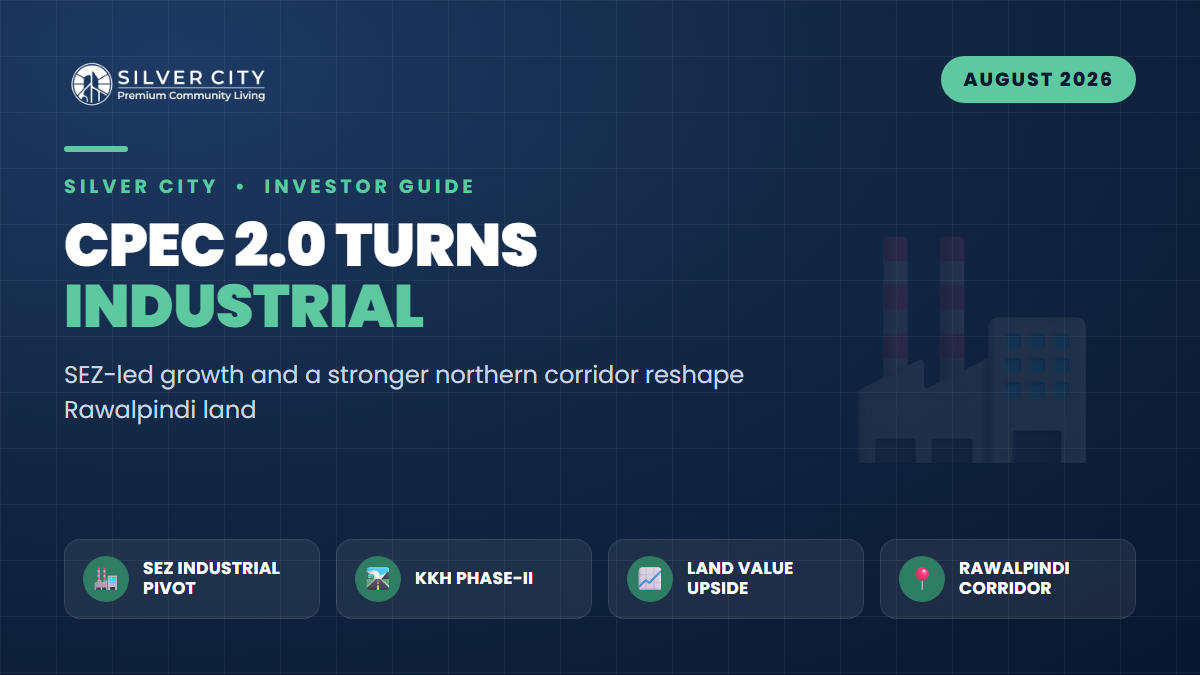
For most of its first decade, the China-Pakistan Economic Corridor (CPEC) was a story of roads, ports and power plants. In August 2026, that story is visibly changing. On 6 August, Federal Minister for Planning, Development and Special Initiatives Ahsan Iqbal chaired the 91st meeting of the CPEC Projects Review and National Steering Committee and directed every ministry to fast-track implementation of CPEC 2.0’s five “corridors” — Growth, Livelihood, Innovation, Green Development and Regional Connectivity. The unmistakable emphasis this time was on industry: Special Economic Zones (SEZs), export-led production, and the reliable energy connectivity that factories actually need to run.
Days later, attention shifted north. Pakistan gave an in-principle go-ahead to Karakoram Highway (KKH) Phase-II, with the crucial financing arrangement to be settled at a Joint Working Group meeting expected at the end of August 2026. Put these two threads together and you get a clear signal for property investors in the Rawalpindi-Islamabad region: the money and the policy focus are moving toward productivity and the northern corridor — and land that sits near industry and along that corridor is where the long-term thesis lives.
From Infrastructure Phase to Productivity Phase
CPEC’s first phase (roughly 2015-2020) was about closing Pakistan’s infrastructure gap — motorways, transmission lines and generation capacity. CPEC 2.0 reframes the goal as building things Pakistan can export. Ahsan Iqbal’s directive reaffirmed the government’s commitment to supporting industrial growth through reliable power supply to the zones and told stakeholders to resolve outstanding SEZ issues — particularly power connectivity — on a priority basis.
Why does this matter to a land buyer near Rawalpindi? Because an SEZ-anchored, export-led model rewards a specific kind of location: plots that are close to operating industrial estates, close to a motorway interchange for freight, and close to a workforce that needs housing. When factories fill up, they pull in managers, engineers, technicians and support businesses — and every one of them needs somewhere to live and somewhere to shop. Residential and commercial land in the catchment of a working SEZ tends to appreciate on the back of genuine demand, not just speculation.
The KKH Phase-II Decision: Rawalpindi Is the Southern Gateway
The KKH is the spine of Pakistan’s northern trade route to China via the Khunjerab Pass. KKH Phase-II covers the realignment and upgrade of the 241-kilometre Thakot-Raikot section, estimated at roughly Rs576 billion (about US$2 billion), with China committing around 85% of the financing. There is urgency built in: portions of the existing alignment risk submergence once the Diamer-Bhasha Dam reservoir fills, and the minister flagged a 2028 deadline, directing that if Chinese financing stalls, construction should begin using Pakistan’s own resources.
Here is the connection investors sometimes miss. Freight coming south on the KKH does not stop in the mountains — it flows down through the Hazara belt (Thakot, Abbottabad, Havelian) onto the Hazara Motorway and the GT Road/M-1, converging on the Rawalpindi-Islamabad twin cities before dispersing to the rest of the country. Rawalpindi is effectively the southern gateway and logistics staging area of the entire northern corridor. A modernised, higher-capacity KKH strengthens the trade volume that has to pass through this region, reinforcing demand for warehousing, transport services and the housing that supports them.
Key Numbers at a Glance
| Item | Detail |
|---|---|
| Fast-track directive | 6 August 2026, 91st CPEC Steering Committee (Ahsan Iqbal) |
| CPEC 2.0 corridors | Growth, Livelihood, Innovation, Green Development, Regional Connectivity |
| KKH Phase-II section | Thakot-Raikot, 241 km realignment/upgrade |
| Estimated cost | ~Rs576 billion (~US$2 billion) |
| Chinese financing commitment | ~85% (balance via self-finance if needed) |
| Financing decision | Joint Working Group, expected end-August 2026 |
| Deadline pressure | Target 2028, before Diamer-Bhasha reservoir fill |
Where Industrial-Adjacent Value Sits Near Rawalpindi
The twin-cities region already has SEZ anchors that define the “industrial-adjacent” map. The Rashakai SEZ (District Nowshera, on the M-1 Peshawar-Islamabad Motorway, ~1,000 acres, roughly 90 km from Islamabad) is the flagship CPEC zone on the western side of the corridor. Closer in, the Islamabad Model Special Economic Zone near Rawat — at the junction of the N-5 GT Road and Islamabad Expressway, over 1,000 acres — is planned to attract sizeable industrial investment.
For an investor, the practical takeaway is to think in terms of corridors and interchanges rather than isolated plots:
- M-1 / M-2 motorway interchanges — the Thalian and Chakri interchanges feed freight toward the New Islamabad International Airport and the wider industrial belt.
- N-5 GT Road spine — the traditional industrial artery through Rawat and toward Rawalpindi, now anchored by the Islamabad Model SEZ.
- Airport-and-motorway cluster — societies around the new airport and the M-2 benefit from both logistics access and the housing demand that industry generates.
Land here does not need to be inside an SEZ to benefit. In fact, zoned residential and mixed-use schemes on the fringe of industrial growth often capture the housing and commercial demand that factories create, while carrying fewer of the regulatory constraints of industrial land itself.
A Measured Word on Risk
None of this is a guarantee. The KKH financing arrangement was still to be finalised at the end-August Joint Working Group, and Pakistan explicitly retained a self-finance fallback — a reminder that timelines can slip and that CPEC 2.0’s SEZ rollout has historically moved slower than announced. Sensible investors treat these developments as a multi-year directional signal, verify society approvals and title independently, and avoid over-paying on the strength of a single news cycle. Buy on fundamentals — approval status, location, access and developer track record — and let the corridor tailwind work over time.
Frequently Asked Questions
What is different about CPEC 2.0 compared to the first phase?
CPEC’s first phase focused on infrastructure — motorways, ports and power. CPEC 2.0, as re-emphasised in Ahsan Iqbal’s 6 August 2026 directive, prioritises industrial productivity, export-led growth, Special Economic Zones and the reliable energy needed to run them, organised around five corridors of Growth, Livelihood, Innovation, Green Development and Regional Connectivity.
How does KKH Phase-II affect Rawalpindi specifically?
The KKH is the northern trade route to China. Freight moving south flows through the Hazara belt onto the GT Road and motorways, converging on Rawalpindi-Islamabad before dispersing nationally. A strengthened KKH reinforces trade volume through this gateway, supporting demand for logistics, warehousing and the housing that serves them.
Should I buy industrial land or residential land to benefit?
Most individual investors are better served by well-located, approved residential or mixed-use land near industrial and motorway corridors, rather than industrial plots that carry heavier zoning and operational constraints. The housing and commercial demand created by nearby SEZs typically flows into these schemes.
Is now the right time to buy?
The policy direction is clear, but financing decisions and SEZ timelines can move slowly. Treat CPEC 2.0 as a multi-year thesis: prioritise approval status, location and developer credibility, verify documents independently, and avoid overpaying on headlines alone.
The Bottom Line
CPEC 2.0’s pivot to industry and a re-energised northern corridor both point back to one region: the Rawalpindi-Islamabad gateway where trade, industry and housing demand meet. For investors positioning for that shift, an RDA-approved society such as Silver City (silvercity.pk) — sited within the twin cities’ motorway-and-airport growth belt — is a credible, regulation-compliant option worth considering as part of a patient, corridor-aligned strategy.