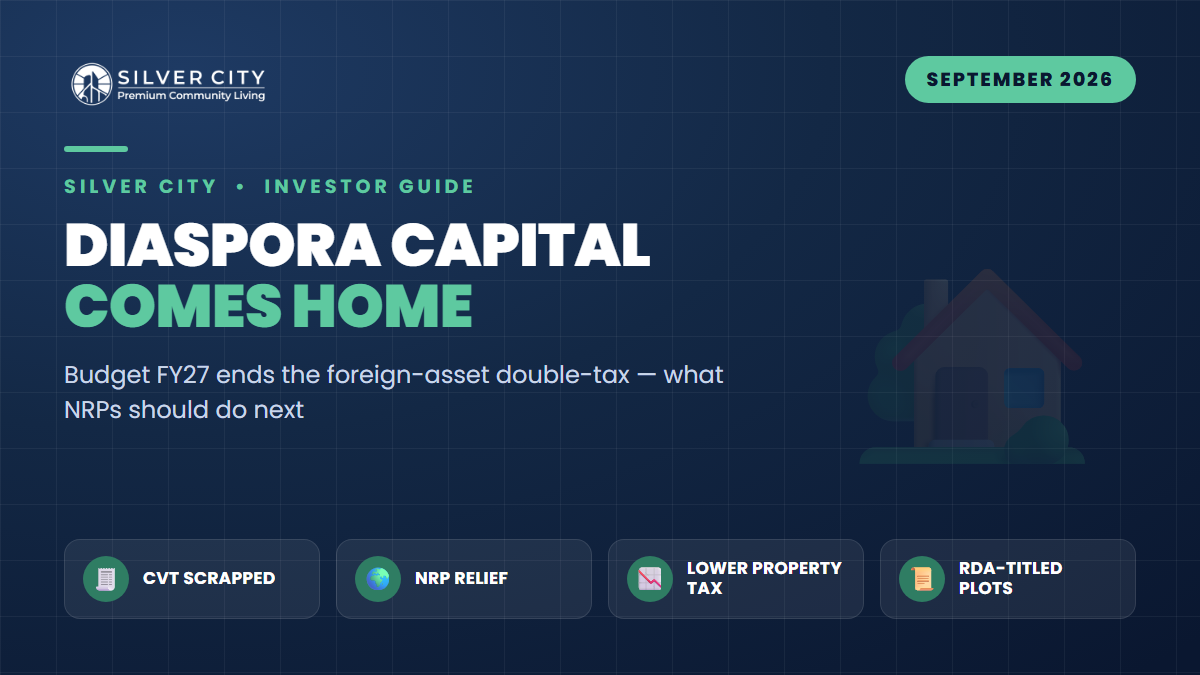
For years, the Non-Resident Pakistani (NRP) who wanted to hold or declare offshore assets faced an ugly arithmetic problem: pay tax where the asset sits abroad, then pay again at home. The Capital Value Tax (CVT) on foreign assets — introduced through the Finance Act 2022 — layered a 1% annual levy on foreign holdings above Rs100 million on top of whatever the host country already charged. The result was predictable. Instead of encouraging disclosure, it pushed capital into the shadows and gave diaspora investors one more reason to keep their wealth parked overseas.
The Budget for FY27 (2026-27) has now removed that penalty. Here is what changed, why it matters for diaspora capital, and why titled, RDA-approved plots in Rawalpindi deserve a serious look as the repatriation destination.
What Exactly Changed in Budget FY27
Finance Minister Muhammad Aurangzeb presented the federal budget for 2026-27 with a total outlay of roughly Rs18.77 trillion, targeting 4% GDP growth. Buried inside the Finance Bill 2026-27 was a quietly significant move: the abolition of the Capital Value Tax on foreign movable and immovable assets held by Pakistanis.
The government’s own budget documents admitted the levy had failed its purpose — rather than documenting overseas wealth, the CVT discouraged citizens from voluntarily declaring foreign holdings. The Senate Standing Committee on Finance and Revenue, chaired by Senator Saleem Mandviwala, approved the abolition during its review of the Finance Bill, with the Finance Minister and senior FBR officials present.
The logic is straightforward: remove the disincentive, and more Pakistanis will bring their assets into the formal, documented economy — expanding the tax base rather than shrinking it.
The “Double-Tax” Penalty, Explained
The CVT on foreign assets was a wealth-style tax, not an income tax. It applied to the capital value of the asset regardless of whether it generated any return that year. So an overseas apartment, foreign shares, or a bank balance abroad could be taxed at 1% of value every single year — even while the same asset was being taxed on rent, gains, or property rates in its host jurisdiction.
For a diaspora investor with a UK flat or a Gulf portfolio, that meant a compounding drag: foreign tax plus Pakistani CVT, year after year, on the same underlying wealth. Abolishing it removes one full layer of that stack.
The Bigger Picture: NRP-Friendly Real Estate Relief
The CVT change does not stand alone. Budget FY27 paired it with the most buyer-friendly property tax package in years — and this is where repatriation into Pakistani real estate becomes genuinely attractive rather than merely patriotic.
| Measure | Before | Budget FY27 |
|---|---|---|
| CVT on foreign assets | 1% on value above Rs100m | Abolished |
| Buyer advance tax (Sec 236K, filer) | Up to ~4% | Tiered 0.5%–1.25% by value band |
| Seller advance tax (Sec 236C, filer) | Up to ~4.5% | Flat 2.75% |
| Section 7E (deemed rental on plots) | Applied to idle plots | Abolished |
| Federal Excise Duty on property transfer | 7% | Abolished |
Two points matter for NRPs. First, these reductions apply to active filers — non-filers still face steep penal multipliers, so being on the Active Taxpayers List (ATL) is now the single highest-return administrative step a diaspora investor can take. Second, the removal of Section 7E means an undeveloped plot is no longer taxed as if it were earning phantom rent — a direct win for the classic “buy land and hold” strategy.
Why Titled, RDA-Approved Plots Beat Offshore Holds Right Now
Repatriating capital is only smart if it lands somewhere clean. In Pakistan’s property market, the difference between a legally titled, regulator-approved file and an unapproved one is the difference between an asset and a liability. Here is why the 5-marla, RDA-approved category is the sweet spot for returning diaspora money:
- Regulatory risk is already resolved. An RDA-approved (NOC-cleared) scheme has cleared the layer that traps buyers in unapproved societies — no demolition scares, no frozen transfers.
- Entry ticket suits remittance-sized capital. A 5-marla plot is affordable enough to buy outright with a modest slice of repatriated savings, or on instalments — no need to liquidate an entire offshore portfolio at once.
- Lower transaction cost on the way in. With FED gone and 236K slashed for filers, the friction of actually deploying capital into titled land has collapsed versus a year ago.
- Tangible, rupee-hedged, and title-backed. Unlike a foreign brokerage line item, a registered plot is a physical asset with a name on the file — the kind of documented holding the new regime rewards.
A Worked Example: Rawalpindi’s Ring Road Belt
Consider Silver City on Girja Road near the Thalian interchange, adjacent to the Rawalpindi Ring Road. Its 5-marla plots sit in roughly the Rs2.55m–2.75m band, with 3.5, 5 and 10 marla and 1 kanal options offered on four-year (48-month) instalment plans. For an NRP, that is a price point reachable with one or two years of disciplined remittances — and the four-year structure lets you average in rather than time the market.
| Option | Indicative price band | Typical NRP use case |
|---|---|---|
| 5-marla plot | ~Rs2.55m–2.75m | Entry hold / first repatriation |
| 10-marla plot | Scales up from 5-marla | Build-and-hold for family home |
| 1 kanal | ~Rs10.35m | Larger capital rotation from offshore |
Prices are indicative and move with the market and plot location; always confirm the current rate and payment plan directly with the developer before committing.
Practical Steps Before You Repatriate
- Get on the ATL. File your return so the FY27 filer rates apply — this alone can save several percent on entry.
- Route funds through formal channels. Use banking/remittance channels so your source of funds is documented and your purchase is clean.
- Verify the NOC. Confirm the scheme’s RDA approval and that your specific block/plot falls within the approved layout.
- Confirm title and dues. Ensure the file is transferable and free of outstanding development charges before transfer.
- Take professional tax advice. The Finance Act’s final text and rules govern; a Pakistani tax advisor can confirm how the changes apply to your specific residency status and asset mix.
Frequently Asked Questions
Does abolishing CVT on foreign assets mean my overseas assets are now completely tax-free in Pakistan?
No. CVT was a capital-value (wealth-style) levy — that specific 1% charge on foreign assets above Rs100 million is gone. Income earned on those assets, and normal disclosure obligations, are separate matters. The change removes one layer of tax, not all of them, so continue to declare holdings correctly.
I’m a Non-Resident Pakistani. How does this affect me directly?
The immediate benefit is that the disincentive to declare and repatriate foreign wealth is gone, and it arrives alongside sharply lower property transaction taxes for filers. Together they make bringing capital home into documented, titled real estate materially cheaper than it was in FY26.
Why 5-marla specifically, and not a larger plot?
Five marla is the most liquid, remittance-sized entry point: affordable to buy outright or on instalments, easy to resell, and low-friction under the new filer tax rates. It lets you deploy capital in stages rather than liquidating an entire offshore position at once.
Are these tax changes permanent?
They are enacted through the Finance Bill 2026-27 and were approved at committee stage before passage. As with any budget measure, future finance acts can revise rates, so treat the current window as the prevailing regime and confirm the latest position before transacting.
The Bottom Line
Budget FY27 has done something rare in Pakistani fiscal policy: it lowered the cost of doing the right thing. Scrapping CVT on foreign assets removes the double-tax penalty on diaspora capital, and the parallel cuts to property transaction taxes give that capital a clean, cheaper runway into titled land. For NRPs weighing where to land repatriated funds, an RDA-approved, Ring Road–adjacent option like Silver City’s 5-marla plots is well worth considering — a documented, title-backed asset that fits the exact behaviour this budget is trying to reward. As always, verify current pricing, NOC status and your own tax position before you commit.