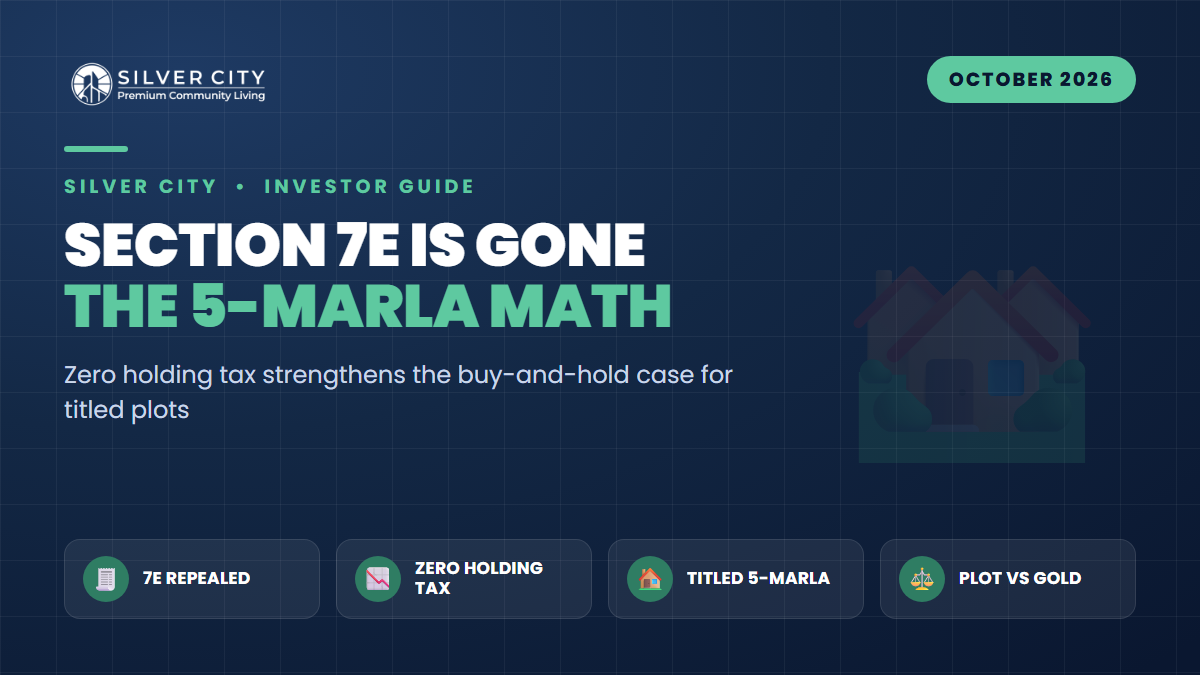
For three years, Pakistani property investors carried a quiet, recurring cost on any second or idle plot: the Section 7E “deemed income” tax. The Finance Act 2026 has now removed it. For anyone weighing a titled, RDA-approved 5-marla plot against parking money in a savings account or buying gold, this changes the arithmetic of holding — and it changes it in favour of real estate.
What Section 7E Was — and Why It Stung
Introduced through the Finance Act 2022, Section 7E of the Income Tax Ordinance, 2001 treated certain immovable property as if it produced income, whether or not it actually did. The mechanism was simple and painful: the law assumed a notional income equal to 5% of the property’s fair market value, then taxed that notional income at 20%. The net effect was an annual charge of roughly 1% of the property’s value, payable every year the asset sat on your books.
The tax broadly applied to resident taxpayers whose capital assets exceeded the exemption threshold (aggregate fair market value above Rs 25 million), with carve-outs such as one self-owned property, business premises and agricultural land. Crucially, 7E also created friction at the point of sale: sellers were routinely asked to produce a 7E clearance certificate proving the tax did not apply or had been paid before a transfer could be registered smoothly.
What Changed in the 2026–27 Budget
In May 2026, the Federal Constitutional Court of Pakistan held Section 7E to be ultra vires. The Finance Act 2026 — the legislation that enacts the FY2026–27 budget — gave that ruling statutory effect by omitting Section 7E entirely, with effect from 1 July 2026. Because the section no longer exists, the associated 7E certificate requirement at the time of sale is also gone, removing a recurring source of delay and disputes at the sub-registrar.
In plain terms: the roughly 1%-per-year holding tax on a second, idle or secondary plot has been abolished. You can now buy and hold property without an annual tax meter running against its market value.
Timeline at a Glance
| Date | Event |
|---|---|
| Jul 2022 | Section 7E introduced via Finance Act 2022 |
| 2023–2025 | Legal challenges; 7E certificate becomes a transfer bottleneck |
| May 2026 | Federal Constitutional Court declares 7E ultra vires |
| 1 Jul 2026 | Finance Act 2026 omits Section 7E — abolition takes effect |
The Buy-and-Hold Math: Plot vs Cash vs Gold
The real question for an investor is not just “is 7E gone” but “what does a titled 5-marla plot now cost to simply hold, compared with the alternatives?” With 7E removed, the ongoing holding cost of a titled plot drops close to zero — there is no annual wealth-style tax, no maintenance bill on raw land, and no custodial cost.
The table below is illustrative (figures rounded for clarity; your numbers will vary by society, phase and category). It compares the recurring drag on three common parking spots for capital.
| Factor | Titled RDA 5-marla plot | Cash in bank/savings | Gold (physical) |
|---|---|---|---|
| Annual holding tax (post-7E) | Rs 0 (7E abolished) | WHT on profit; erodes return | Nil ongoing, but see below |
| Inflation / currency risk | Asset tends to track/beat inflation | High — real value erodes | Hedge, but PKR-price volatile |
| Storage / custody cost | None (raw land) | None | Locker/insurance or theft risk |
| Liquidity | Moderate (weeks) | Instant | Fast, but spread on buy/sell |
| Income potential | Capital gain; buildable later | Profit rate (taxed) | None (no yield) |
| Transaction cost to exit | 236C advance tax + transfer fees | Negligible | Jeweller/dealer margin |
Gold illustrates the contrast well. In late October 2026, 24-karat gold hovered around Rs 418,000 per tola — an asset that holds value but produces no income, carries storage and theft risk, and whose rupee price swings sharply. Cash, meanwhile, quietly loses purchasing power to inflation. A titled plot now sits in a sweet spot: a tangible asset with no annual holding tax dragging on it, that can be built on, rented out after construction, or sold when the market turns.
Don’t Ignore the Transaction Taxes That Remain
Abolishing 7E removed a holding cost, not the transaction taxes. Those still apply and must be budgeted into any buy-and-hold plan:
- Section 236K (advance tax on purchase): a base rate around 1.25% of fair market value for active taxpayers (higher for non-filers).
- Section 236C (advance tax on sale): a base rate around 2.75% of consideration for active taxpayers (higher for non-filers).
- Capital Gains Tax on any profit at disposal, plus provincial transfer/stamp duties.
The headline takeaway holds, though: the single cost that penalised you simply for owning and waiting is now gone. That is precisely the cost that hurts a long-horizon, buy-and-hold investor the most.
Why “Titled” and “RDA-Approved” Still Matter Most
The 7E relief is strongest when your plot is clean on paper. A titled plot in a Rawalpindi Development Authority (RDA)-approved society means a transferable, mortgageable asset with a clear chain of ownership — the kind of property whose fair market value is recognised and whose resale is not held up by regulatory question marks. The removal of the 7E certificate step only widens that advantage: fewer documents to chase, fewer reasons for a transfer to stall.
By contrast, an un-approved or disputed file carries risks that no tax change can fix. The budget relief rewards disciplined investors who bought legally and held patiently.
Frequently Asked Questions
Is Section 7E completely abolished, or just suspended?
It is abolished. The Finance Act 2026 omitted Section 7E from the Income Tax Ordinance with effect from 1 July 2026, following the Federal Constitutional Court’s ruling that the provision was unconstitutional. It is no longer part of the law, and the 7E clearance certificate is no longer required to register a transfer.
Did Section 7E apply to a single 5-marla plot?
Often it did not directly, because 7E targeted holdings above the exemption threshold and excluded one self-owned property. But investors holding a second or idle plot — or several files whose combined value crossed the threshold — were exposed. Its removal most clearly benefits buy-and-hold investors building a portfolio of plots, and it ends the certificate friction for everyone at sale.
Does abolishing 7E mean property has no taxes now?
No. Advance tax on purchase (236K) and sale (236C), capital gains tax on profit, and provincial transfer and stamp duties all still apply. What has gone is the annual deemed-income charge of roughly 1% of value — the recurring holding cost, not the one-time transaction costs.
Is a plot really better than gold right now?
Each suits a different goal. Gold is liquid and a currency hedge but yields nothing and carries storage risk; a titled plot is a buildable, appreciating asset that — with 7E gone — now carries no annual holding tax. For investors with a multi-year horizon who want a tangible asset, the post-7E math tilts toward real estate.
The Bottom Line
Removing Section 7E takes a persistent annual drag off the buy-and-hold ledger, and that quietly strengthens the case for owning titled land over letting cash depreciate or stacking gold that earns nothing. The relief rewards clean, legally approved property most of all — which is why an RDA-approved option such as Silver City (silvercity.pk) in Rawalpindi is worth a serious look for investors who want a titled 5-marla they can hold with confidence, free of the holding tax that once penalised patience. As always, confirm current figures and your own tax status with a qualified advisor before you buy.