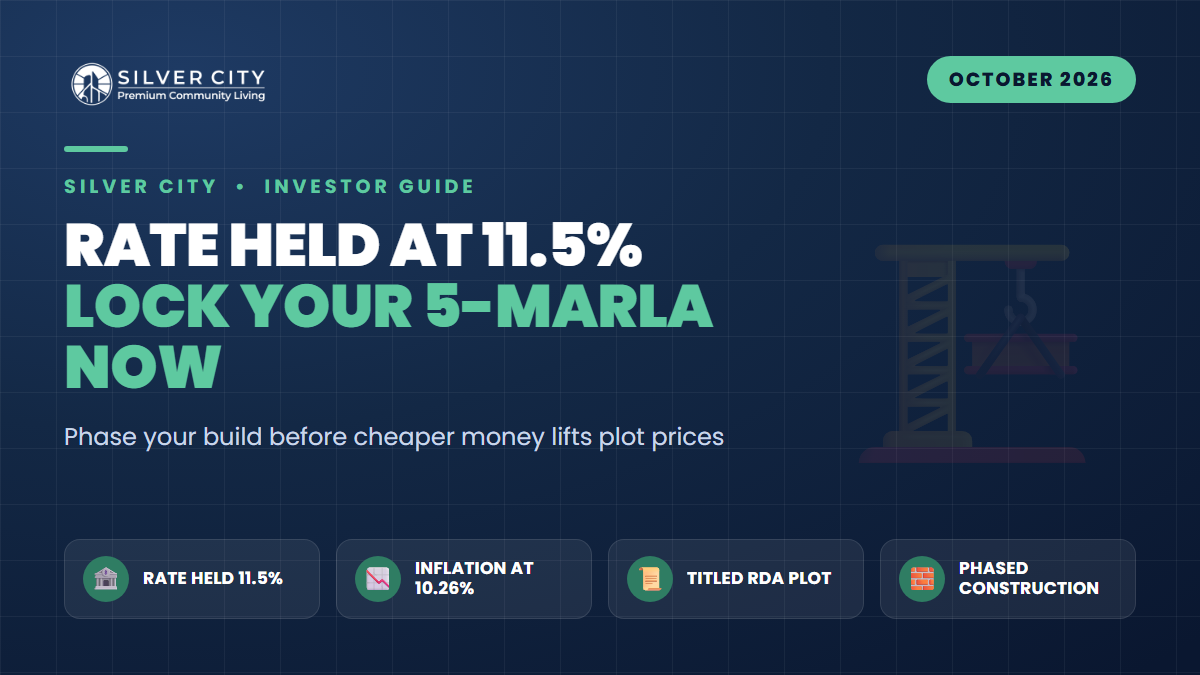
On 26 October 2026, the State Bank of Pakistan’s Monetary Policy Committee (MPC) held the policy rate at 11.5% — the third consecutive hold since the 100 basis-point increase on 27 April. The backdrop is encouraging: headline CPI inflation cooled to 10.26% year-on-year in September 2026, down from 11.15% in August. With the medium-term target still pinned at 5–7%, the direction of travel is clear. The question for property investors is not whether cuts are coming, but how to position before they do.
What the 26 October decision actually signals
A hold is not a pause for its own sake. The MPC has repeatedly said it wants to see inflation settle durably inside the target band before easing. As disinflation holds and real interest rates stay firmly positive, the market consensus is that the SBP is near the top of this cycle and that a rate-cut sequence becomes increasingly likely through FY27 — subject to energy prices, the rupee, and the IMF programme staying on track.
For plot buyers, the mechanism is straightforward. Cheaper money does two things to land: it lowers the opportunity cost of capital parked in an undeveloped plot, and it revives construction demand. When borrowing becomes affordable again, buyers who sat on the sidelines re-enter — and in approved societies with finite inventory, that demand lands on prices. The window to accumulate at today’s levels is the stretch between the last hold and the first cut. That is the window the 26 October decision just opened.
| MPC meeting | Policy rate | Move | Context |
|---|---|---|---|
| 27 Apr 2026 | 11.5% | +100 bps | Pre-emptive tightening |
| 27 Jul 2026 | 11.5% | Hold | First hold |
| 14 Sep 2026 | 11.5% | Hold | Second hold |
| 26 Oct 2026 | 11.5% | Hold | Inflation eased to 10.26% |
Why a titled RDA plot, specifically
In the Twin Cities, “approved” is doing a lot of heavy lifting in sales pitches. The distinction that protects your capital is a titled plot in an RDA-approved scheme with NOC clearance — not an unapproved “file” sold on speculation of future approval. Titled, balloted plots in a regularised society carry a transfer that the Rawalpindi Development Authority recognises, which is what makes them financeable, buildable, and liquid when you exit.
When a rate-cut cycle revives the market, the premium flows disproportionately to inventory that can be built on immediately. Unapproved files can languish or get stuck in regularisation limbo precisely when approved plots are appreciating. Entering before the cycle turns means you buy the de-risked asset at a price that still reflects today’s cautious sentiment.
The phasing logic
The smartest structure for a mid-cycle buyer is to secure the plot now and phase the construction later. Lock the land at current value, pay it off on instalments while rates are still high (so you are not borrowing), and begin building once financing is cheaper and your cash flow allows. You capture the plot’s appreciation through the cut cycle and defer the expensive, interest-sensitive part — construction — to a friendlier rate environment.
Worked numbers: a Silver City 5-marla
As of October 2026, standard 5-marla residential plots in RDA-approved Silver City (Girja Road, near the Thalian interchange off the M-2 Motorway) have been quoted in the region of Rs 2.55–2.75 million, typically on an instalment plan of roughly 15% booking + 15% confirmation + 48 monthly instalments of around Rs 30,000. Confirm exact current pricing and terms directly with the developer, as these change.
| Stage | Indicative outlay | Timing |
|---|---|---|
| Booking (≈15%) | Rs 380,000–415,000 | Month 0 |
| Confirmation (≈15%) | Rs 380,000–415,000 | Month 1–2 |
| 48 monthly instalments | ≈ Rs 30,000/month | Years 1–4 |
| Phase 1 construction (grey structure) | Begin when rates ease | Year 2–3 onward |
The elegance of this plan is that your largest fixed cost — the land — is locked at a pre-cut price, while your monthly commitment during the high-rate period is modest and uses no credit. By the time you pour the foundation, the cost of any construction finance you choose to use should be materially lower than today’s 11.5%-anchored lending rates.
Risks to weigh honestly
- Cuts are expected, not guaranteed. A geopolitical shock, a rupee slide, or an energy-price spike could delay easing. Positive real rates give the SBP room to wait.
- Developer and title risk. Verify the RDA approval and NOC status, the specific block’s balloting, and that your plot number is transferable in your name before paying beyond a token.
- Liquidity. Land is not cash. Budget your instalments from income you can spare for the full plan, not from funds you may need back quickly.
- Over-paying for “upcoming” blocks. Premium pricing on un-balloted phases can erode the value-entry advantage. Prefer titled, developed inventory.
Frequently Asked Questions
Did the SBP cut rates on 26 October 2026?
No. The MPC held the policy rate at 11.5% — its third consecutive hold since April. The significance is in the trend: with inflation easing to 10.26% in September and the target band at 5–7%, the market increasingly expects a rate-cut cycle to follow, which is why many investors see this as the accumulation window.
Why not just wait until rates actually fall to buy?
Because plot prices in approved societies tend to move with the anticipation of cheaper money, not after it. Once cuts begin and construction demand revives, sidelined buyers re-enter and bid up finite approved inventory. Buying before the first cut is how you capture that re-rating rather than pay for it.
What’s the difference between a “titled RDA plot” and a “file”?
A titled plot is balloted, has a specific number, and carries a transfer recognised by the Rawalpindi Development Authority in an NOC-cleared scheme — you can build on it and sell it cleanly. A “file” is often a claim on a plot in an unapproved or not-yet-balloted project, and its value depends on approvals that may never come. For a capital-protection strategy, the titled plot is the point.
Can I really delay construction for years without penalty?
In most approved societies you can hold a titled plot and build when you choose, though some schemes set a construction timeline for certain categories — confirm the specific society’s bylaws. Phasing lets you lock the land at today’s price and defer the rate-sensitive construction spend to a lower-rate period.
The takeaway
The 26 October hold at 11.5%, set against inflation cooling to 10.26%, reads less like a stall and more like the quiet before an easing cycle. For Pakistani investors, the disciplined play is to lock a titled, RDA-approved 5-marla now on instalments and phase the build for when money gets cheaper — capturing the plot’s appreciation while deferring the costly part. An RDA-approved society such as Silver City on Girja Road is one option worth evaluating on these terms; do your own title, NOC and pricing checks directly before you commit.
Sources I verified against: [SBP holds 11.5% (Tribune)](https://tribune.com.pk/story/2613359/sbp-holds-policy-rate-at-115), [SBP next MPC 26 Oct 2026](https://pakera.pk/sbp-monetary-policy-next-meeting-october-2026/), [Pakistan inflation 10.26% Sept 2026 (Business Recorder)](https://www.brecorder.com/news/40442129), [Silver City RDA 5-marla](https://silvercity.pk/rawalpindi-rda-5-marla-value-entry-before-price-surge-2026/).