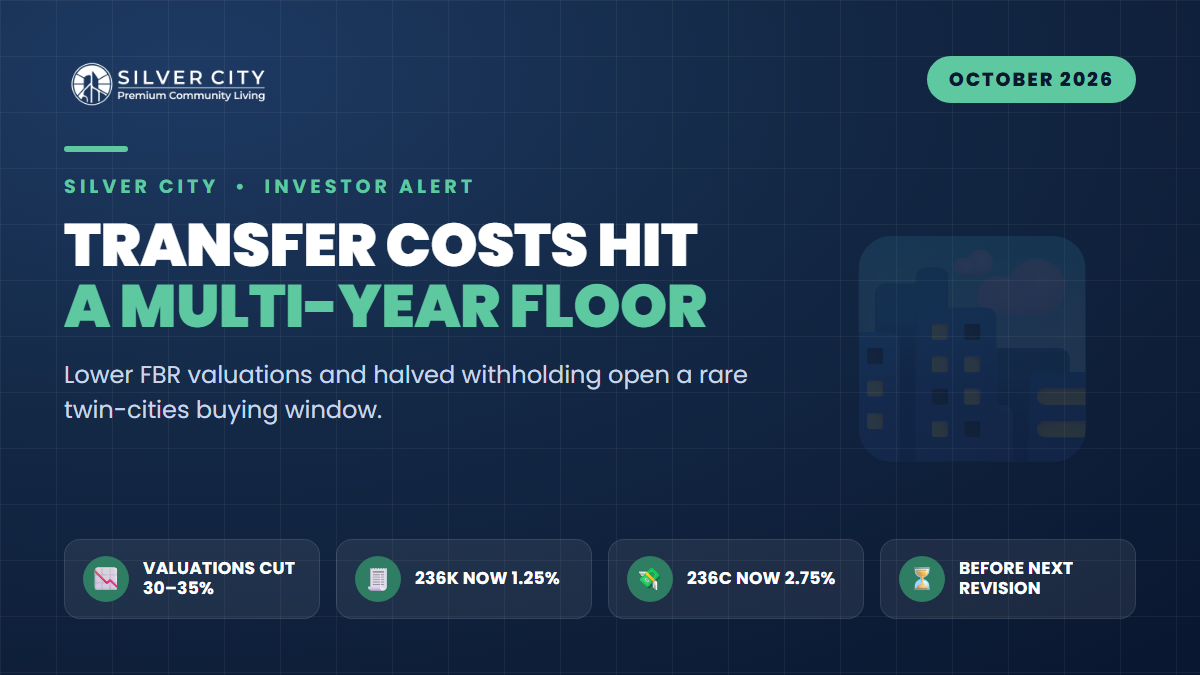
For the first time in several budget cycles, the tax arithmetic has moved firmly in favour of the ordinary, documented property buyer. The Finance Act 2026, effective 1 July 2026, has thrown out the complicated slab tables that used to govern property transfers and replaced them with two clean, low numbers for active filers: a 1.25% advance buyer tax under Section 236K and a 2.75% advance seller tax under Section 236C. At the same time, the long-resented Section 7E deemed-income tax has been abolished outright, taking its transfer-time clearance certificate with it.
Put together, these changes mean a filer buying a modestly priced, titled plot — exactly the profile of a Silver City 5-marla on Girja Road, Rawalpindi — now faces the lowest combined transaction and holding cost seen in years. This guide walks through the numbers, explains the new Rs100 million Eligibility Certificate threshold, and shows why a 5-marla stays comfortably clear of it.
What exactly changed on 1 July 2026
Three reforms matter most to a small-plot investor:
- Section 236K (buyer / purchaser tax): Filers now pay a top rate of 1.25% of the property value, replacing the older tiered structure that pushed an effective ~3–4% burden on many purchases.
- Section 236C (seller / disposal tax): Filers now pay a maximum of 2.75%, down from roughly 4.5% under the previous regime.
- Section 7E (deemed-income tax): Abolished. Following the Federal Constitutional Court ruling that notional or “deemed” income cannot be taxed, the Finance Act 2026 omitted 7E entirely. The annual ~1% charge on high-value holdings is gone — and so is the 7E clearance certificate that sellers previously had to produce before a transfer could be registered.
Critically, both 236K and 236C remain adjustable advance taxes. A filer can set them off against the annual income tax liability, so for a genuine taxpayer the real cost is often lower still.
Filer vs non-filer: the gap is now enormous
The reforms rewarded documentation, not just reduced rates. Non-filers face sharply higher 236K rates on a sliding scale, which makes becoming an active filer the single most profitable move before you buy.
| Transaction | Filer rate | Non-filer rate |
|---|---|---|
| 236K — buyer, value up to Rs50m | 1.25% | 10.5% |
| 236K — buyer, Rs50m–100m | 1.25% | 14.5% |
| 236K — buyer, above Rs100m | 1.25% | 18.5% |
| 236C — seller (any value) | 2.75% | 11.5% |
| 7E deemed-income tax | Abolished | Abolished |
Worked example: a Rs2.75m Silver City 5-marla
A standard 5-marla residential plot in Silver City currently sits in roughly the Rs2.55–2.75 million range, typically on a 3–4 year installment plan. Running the numbers on a Rs2.75m value (advance tax is calculated on the higher of the FBR valuation or the declared consideration, so in practice the base is often lower):
| Cost line | Under old regime (approx.) | Under Finance Act 2026 |
|---|---|---|
| Buyer 236K | ~3% = Rs82,500 | 1.25% = Rs34,375 |
| Annual 7E holding charge | Up to ~1% of value / year | Rs0 (abolished) |
| 7E certificate at resale | Required | Not required |
| Seller 236C (when you exit) | ~4.5% | 2.75% |
On the buyer side alone, the filer saves close to Rs48,000 versus the old rate — and because 7E is gone, there is no recurring annual charge eating into the holding period while you wait for the plot to appreciate. For an investor who plans to buy, hold through the Rawalpindi Ring Road build-out, and sell, every leg of the journey is now cheaper.
The new Rs100 million Eligibility Certificate — and why a 5-marla ignores it
The 2026 reforms also introduced a documentation gate under Section 114C. Any property transaction exceeding Rs100 million now requires an FBR Eligibility Certificate obtained before the deal can be registered. To qualify, the buyer must demonstrate “sufficient resources” — broadly, declared cash or cash-equivalent assets equal to at least 130% of the transaction value — either through the latest wealth statement or a Sources of Investment and Expenditure Statement filed on the FBR portal. Without it, the registering authority is barred from processing the transfer.
This is a meaningful hurdle for buyers of high-value DHA or Bahria files worth tens of crores. It is completely irrelevant to a 5-marla buyer. At roughly Rs2.75 million, a Silver City plot is around 97% below the Rs100 million threshold — you would need to buy more than 35 such plots in a single transaction to trip the rule. In other words, the small-plot investor gets all the upside of the lower rates and the 7E repeal while sitting far outside the one new compliance burden the Act created.
Why the timing favours a titled plot
Low rates reward speed, but only if the asset is clean. The 1.25% / 2.75% advantages apply to properly titled, transferable property in an approved scheme — which is why the quality of the society matters as much as the tax table. A plot in an unapproved or litigation-prone layout can stall at transfer regardless of how good the rates are.
- Become a filer first. The single biggest saving — turning an 18.5% non-filer charge into 1.25% — comes purely from being on the Active Taxpayer List before the transfer date.
- Keep your paperwork ready. CNIC, proof of funds, and a clean source trail make transfer smooth even though no 7E certificate is needed.
- Verify RDA/NOC status. Low tax on a disputed plot is a false economy; confirm the scheme is approved before booking.
Frequently Asked Questions
Do I still need a Section 7E certificate to sell my plot?
No. Section 7E was abolished with effect from 1 July 2026 under the Finance Act 2026, after the Federal Constitutional Court held that deemed income cannot be taxed. Both the annual deemed-income charge and the transfer-time 7E clearance certificate are gone, removing a recurring cost and a paperwork step for sellers.
Will the Eligibility Certificate rule apply to my 5-marla purchase?
Almost certainly not. The Section 114C Eligibility Certificate is triggered only on transactions above Rs100 million. A 5-marla plot priced around Rs2.55–2.75 million is far below that line, so no certificate or 130%-resources proof is required to register it.
Is the 1.25% buyer tax a final tax or can I recover it?
Section 236K is an adjustable advance tax, not a final one. As a filer, you can set it off against your annual income tax liability when you file your return, so the effective cost is often lower than the headline 1.25%.
What happens if I buy as a non-filer?
You pay dramatically more — 10.5% to 18.5% under 236K depending on value, versus 1.25% for a filer. On even a modest plot the difference runs into tens of thousands of rupees, and the gap widens with price. Getting onto the Active Taxpayer List before your transfer is the most cost-effective step you can take.
The bottom line
Finance Act 2026 has quietly delivered what small investors have wanted for years: lower entry cost, no annual holding tax, a cheaper exit, and a new compliance gate that simply doesn’t reach down to plot-sized deals. For a documented buyer, a titled 5-marla in an RDA-approved society is about as tax-efficient as Pakistani real estate gets right now. Silver City, NOC-cleared on Girja Road near the Thalian interchange and the emerging Ring Road corridor, is one such option worth considering while this low-cost window is open — just confirm your filer status and the plot’s approval paperwork before you book.