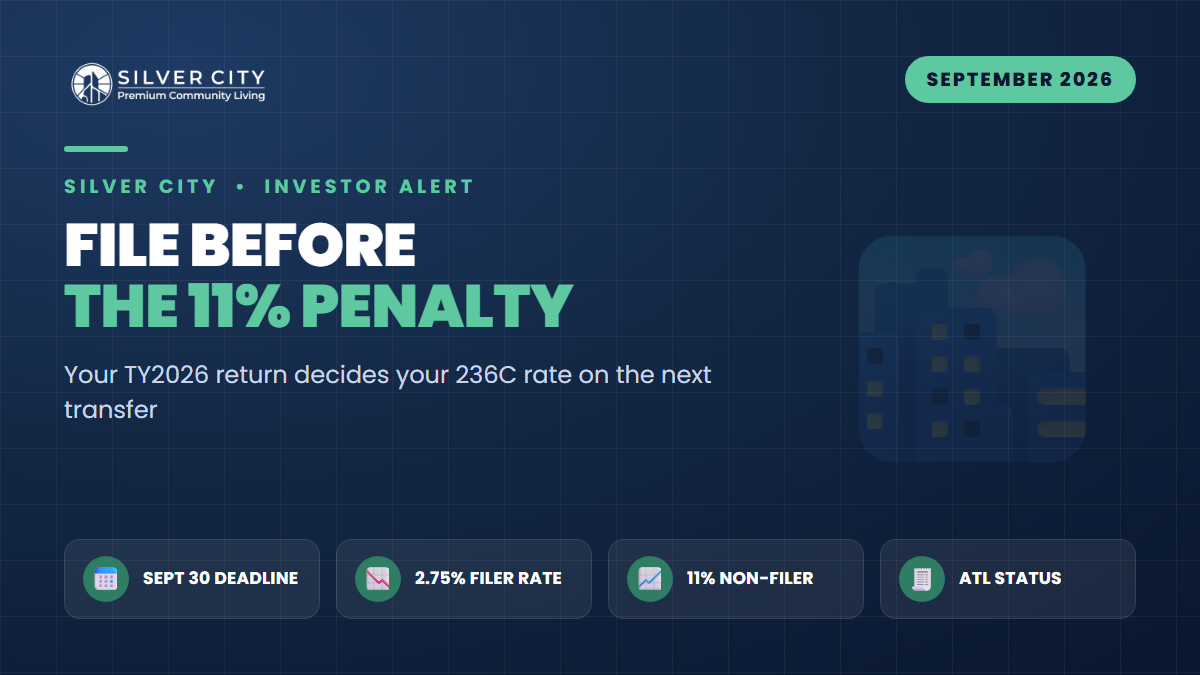
The clock is running. Under Section 118 of the Income Tax Ordinance 2001, the last date to file your Tax Year 2026 income tax return is 30 September 2026 — for individuals, salaried persons and Associations of Persons (AOPs). Tax Year 2026 covers income earned from 1 July 2025 to 30 June 2026, and returns are filed through the FBR IRIS 2.0 portal.
For property investors, this is not just a compliance box to tick. Your filing status is the single biggest lever on what you pay in withholding tax the next time you buy or sell a plot. Miss the deadline, fall off the Active Taxpayer List (ATL), and the advance tax on a routine 5-marla transfer can jump roughly four-fold. Here is exactly what is at stake, in rupee terms, and where the widely-requested FBR extension stands.
Why Your Filing Status Controls Your Property Tax Bill
When you sell immovable property, the seller pays advance tax under Section 236C; when you buy, the purchaser pays under Section 236K. Both rates are tiered by your status on the ATL. Following the simplification of the seller’s schedule, the headline 236C rates now sit as follows:
- Filer (name on the ATL): 2.75% of the consideration value on a typical residential plot.
- Non-filer: roughly 11% (precisely 11.5%) — about four times the filer rate.
Two important points for 2026. First, the separate “late-filer” discount tier that existed for the previous two tax years has effectively been withdrawn, so the practical divide is now filer versus non-filer. Second, 236C is adjustable — you can claim it back as a credit in your annual return under code 236C. If you never file, that money is not just an upfront hit; it is money you can never reclaim.
The Rupee Difference on a 5-Marla Transfer
Take a 5-marla plot changing hands in a Rawalpindi society. The table below shows the seller’s 236C liability at two realistic transaction values, comparing a filer against a non-filer.
| Transfer (consideration) value | Filer @ 2.75% | Non-filer @ 11.5% | Extra you pay as non-filer |
|---|---|---|---|
| Rs 5,000,000 | Rs 137,500 | Rs 575,000 | Rs 437,500 |
| Rs 6,500,000 | Rs 178,750 | Rs 747,500 | Rs 568,750 |
| Rs 8,000,000 | Rs 220,000 | Rs 920,000 | Rs 700,000 |
On an ordinary mid-sized plot, being a non-filer costs you between Rs 4.3 lakh and Rs 7 lakh on a single transaction — far more than the cost and effort of filing a return. And the buyer under 236K faces a parallel penalty structure, so a non-filer status quietly makes you a less attractive counterparty on both sides of a deal.
How the ATL Actually Works (The Part Most People Get Wrong)
The Active Taxpayer List is refreshed once a year and published on 1 March, based on the previous tax year’s returns. The list currently in force runs through February 2027 and is built from Tax Year 2025 returns. When you execute a transfer today, the registrar and FBR check your name against that list.
Here is the timing trap. If you filed TY2025 on time, you are on the active list now — but if you skip TY2026, your name drops off when the new ATL publishes on 1 March 2027. If you file TY2026 late, you can still be restored to the list, but only after paying the ATL surcharge under Section 182A, which the Finance Act 2026 raised sharply from Rs 1,000 to Rs 25,000 for individuals. On top of that sits the late-filing penalty under Section 182.
So filing within the next 48 hours does three things: it keeps your Active status uninterrupted into the March 2027 list, it saves the Rs 25,000 restoration surcharge, and it avoids late-filing penalties — all while locking in the 2.75% rate for transfers in the year ahead.
Filer vs Non-Filer: The Full Cost of Slipping Off the List
| Consequence | Filer (on time) | Non-filer / late |
|---|---|---|
| 236C on plot sale | 2.75% | ~11.5% |
| 236K on plot purchase | Lower filer rate | Substantially higher |
| ATL restoration surcharge (182A) | Nil | Rs 25,000 |
| Late-filing penalty (182) | Nil | Applies |
| 236C refundable in return | Yes, adjustable | Forfeited if never filed |
Is an FBR Extension Coming?
This is the question every investor is asking, and the honest answer is: do not count on it. As of mid-September 2026, no general extension had been notified — the statutory date remains 30 September 2026.
There is, however, real pressure. As reported by Business Recorder and ProPakistani, the Pakistan Tax Bar Association (PTBA) along with the Rawalpindi, Lahore, Gujrat and Multan tax bars and multiple trade bodies have formally asked the FBR Chairman to extend the deadline by one month. Their case rests on genuine grievances: the TY2026 return form was notified only on 2 September 2026 instead of 1 July, IRIS portal glitches, and heavy new disclosure requirements that left filers little runway.
FBR has extended deadlines in past years — Tax Year 2025 was pushed to mid-October — but those notifications typically arrive at the eleventh hour, sometimes on the deadline day itself, and often grant only a short reprieve. An extension is a possibility, never a plan. Filing now removes the guesswork entirely; if an extension does land, you have simply finished early.
What To Do in the Next 48 Hours
- Log in to IRIS 2.0 and confirm your registration and profile are current.
- Gather your income evidence, bank statements, and details of any property bought or sold during the year.
- Declare property holdings in the wealth statement — mismatches here are a common cause of notices.
- File and submit before midnight on 30 September. If you use a consultant, brief them today, not on the 30th.
- After filing, verify your name appears on the ATL before signing any transfer deed.
Frequently Asked Questions
I filed last year — am I still safe if I skip TY2026?
Only until 1 March 2027. Today’s ATL is built on TY2025 returns, so you are active for now, but when the list rolls over you will drop off unless your TY2026 return is filed. For any transfer after that date, you would be treated as a non-filer.
What exactly does a non-filer pay on 236C?
Roughly 11% (11.5%) of the transaction value, versus 2.75% for a filer on a typical residential plot — about four times higher. On a Rs 6.5 million 5-marla transfer, that is Rs 747,500 instead of Rs 178,750.
If I file a few days late, can I still become a filer?
Yes, but you must pay the Section 182A surcharge — now Rs 25,000 for individuals, up from Rs 1,000 — plus any late-filing penalty, and there can be a gap before your name is restored to the ATL. Filing on time avoids all of it.
Should I wait to see if FBR announces an extension?
No. As of the latest reporting no extension has been notified, and any announcement usually comes at the last moment for a short window. File now; if relief is granted, you have lost nothing.
The Bottom Line for Investors
Filing your TY2026 return is the cheapest tax planning you will do all year. It protects your Active status, keeps your next 236C bill at 2.75% instead of ~11%, and saves the Rs 25,000 restoration surcharge — while an extension remains hopeful, not guaranteed. Once your filer status is secure, put it to work in a project with clean documentation and transferable titles. As an RDA-approved housing society on the Rawalpindi–Islamabad corridor, Silver City is worth considering for filers who want their paperwork to be as sound as their tax position — because the value of being a filer is only fully realised when the plot you transfer is properly approved and transparently documented.